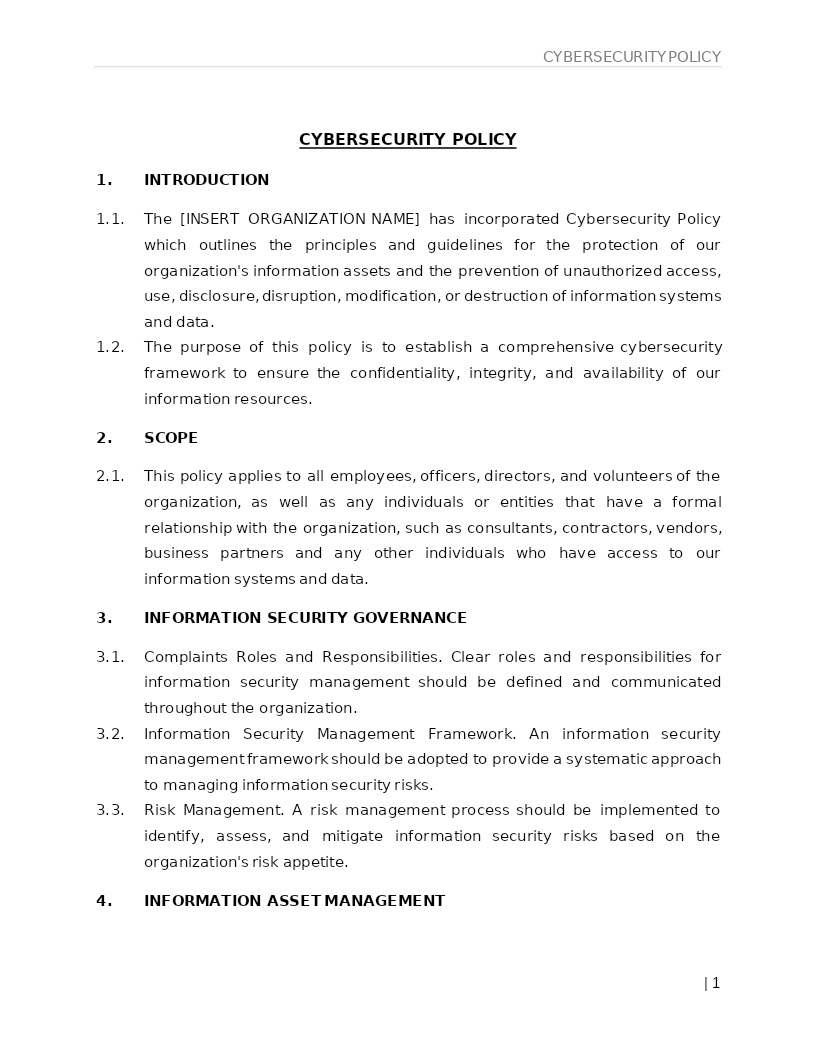
CYBERSECURITY POLICY
How does it work?
1. Choose this template
Start by clicking on "Fill out the template"
2. Complete the document
Answer a few questions and your document is created automatically.
3. Save - Print
Your document is ready! You will receive it in Word and PDF formats. You will be able to modify it.
Understanding Cybersecurity Policy in U.S.
In a digital environment where businesses rely heavily on cloud systems, connected devices, and real-time data exchange, establishing a robust Cybersecurity Policy is essential. A Cybersecurity Policy clearly outlines how an organization safeguards sensitive information, prevents unauthorized access, and ensures the integrity and availability of critical systems. This policy sets the expectations for employees, contractors, and third-party partners regarding safe handling of data and use of technology.
A strong Cybersecurity Policy creates a secure foundation that allows your organization to operate confidently, collaborate externally, and protect itself from malware, data breaches, system failures, and evolving cyber threats.
Where Cybersecurity Policies Are Commonly Used
Cybersecurity Policies are standard across U.S. industries and operational environments, such as:
- Corporate IT environments, cloud-based operations, and remote work ecosystems
- Financial services, healthcare, education, and other regulated sectors
- Vendor access to internal networks, SaaS platforms, or sensitive customer data
- Onboarding of employees, contractors, and service providers
- Businesses using customer-facing platforms, e-commerce, or digital payment systems
- Companies dealing with intellectual property, trade secrets, or proprietary algorithms
Anytime your systems, devices, or information assets may be exposed, a Cybersecurity Policy establishes clear rules and responsibilities to maintain security.
Different Types of Cybersecurity Policies You May Encounter
- Information Security Policy (ISP): Covers overarching security principles, acceptable use, data handling, and system protection guidelines.
- Access Control Policy: Defines who can access systems, at what level, and how authentication is granted or revoked.
- Incident Response Policy: Outlines steps for detecting, reporting, and responding to cyber incidents or data breaches.
- Data Protection & Privacy Policy: Ensures compliance with U.S. laws such as GDPR (if applicable), CCPA, HIPAA, GLBA, and others.
- Network Security Policy: Covers firewalls, encryption standards, intrusion detection, and secure network architecture.
- Vendor & Third-Party Security Policy: Establishes requirements for external partners accessing internal data or systems.
When Legal Guidance Becomes Helpful
While general Cybersecurity Policies can be implemented internally, legal or compliance support becomes valuable when:
- You operate in regulated industries (healthcare, fintech, banking, education)
- Your systems handle sensitive personal data protected under HIPAA, COPPA, FERPA, GLBA, or state privacy laws
- You manage high-value intellectual property, R&D, proprietary technology, or trade secrets
- Your business deals with cross-border data transfers, especially involving GDPR compliance
- Cyber incidents could trigger mandatory breach notifications or regulatory reporting
- Third-party vendors or service providers require multi-layered access controls
- You need enforceable employee responsibilities, disciplinary actions, or legal remedies
Legal review ensures your Cybersecurity Policy aligns with U.S. regulations, is enforceable, and adequately protects your operational environment.
How to Work With This Template
- Identify your system infrastructure, data categories, and access levels
- Define what data is considered sensitive, confidential, or regulated
- Specify employee responsibilities, acceptable use rules, and password protocols
- Outline monitoring practices, reporting processes, and incident response steps
- Choose governing federal and/or state laws (e.g., CCPA for California residents)
- Integrate vendor-management and third-party security requirements
- Review policy internally or with legal counsel (optional but recommended)
- Implement organization-wide compliance through training and acknowledgment
This template aligns with widely recognized U.S. cybersecurity standards and supports electronic distribution and acknowledgment.
Frequently Asked Questions
Q1. Why is a Cybersecurity Policy essential for U.S. businesses?
A Cybersecurity Policy helps organizations comply with U.S. regulations, prevent data breaches, and safeguard digital assets from cyber threats. It outlines clear rules for system access, data handling, and incident response, reducing financial, operational, and legal risks.
Q2. Does this policy help with compliance requirements?
Yes. A structured Cybersecurity Policy supports compliance with federal and state laws like HIPAA, CCPA, GLBA, and industry frameworks such as NIST and ISO 27001. It ensures consistent security practices across your workforce and third-party partners.
Q3. Can this policy be customized for small businesses or startups?
Absolutely. Small businesses often face greater vulnerabilities due to limited resources. Customizing the policy allows them to implement practical, scalable controls without unnecessary complexity, improving resilience against cyber threats.
Q4. Does this policy cover remote work and personal devices?
Yes. It includes rules for secure remote access, VPN usage, password protocols, and BYOD (Bring-Your-Own-Device) requirements to ensure off-site employees maintain the same security standards as in-office staff.
Q5. What should employees do if they suspect a cyber incident?
Employees should immediately report unusual system activity, suspicious emails, or unauthorized access attempts. The policy outlines reporting procedures, contact points, and steps to contain potential threats quickly and effectively.
Q6. Can this Cybersecurity Policy be used with external vendors or contractors?
Yes. Vendors who access your network or data must follow the same security guidelines. The policy helps establish acceptable security practices and ensures external partners comply with your organization’s risk-management standards.
Q7. How often should this policy be updated?
It is recommended to review and update the policy annually or whenever new technologies, threats, regulations, or operational changes occur. Staying updated improves compliance and minimizes exposure to emerging cyber risks.
Q8. Is employee training necessary for policy effectiveness?
Definitely. Even the best Cybersecurity Policy fails without proper training. Regular awareness programs ensure employees understand their responsibilities, recognize threats, and follow secure practices to reduce human-error vulnerabilities.