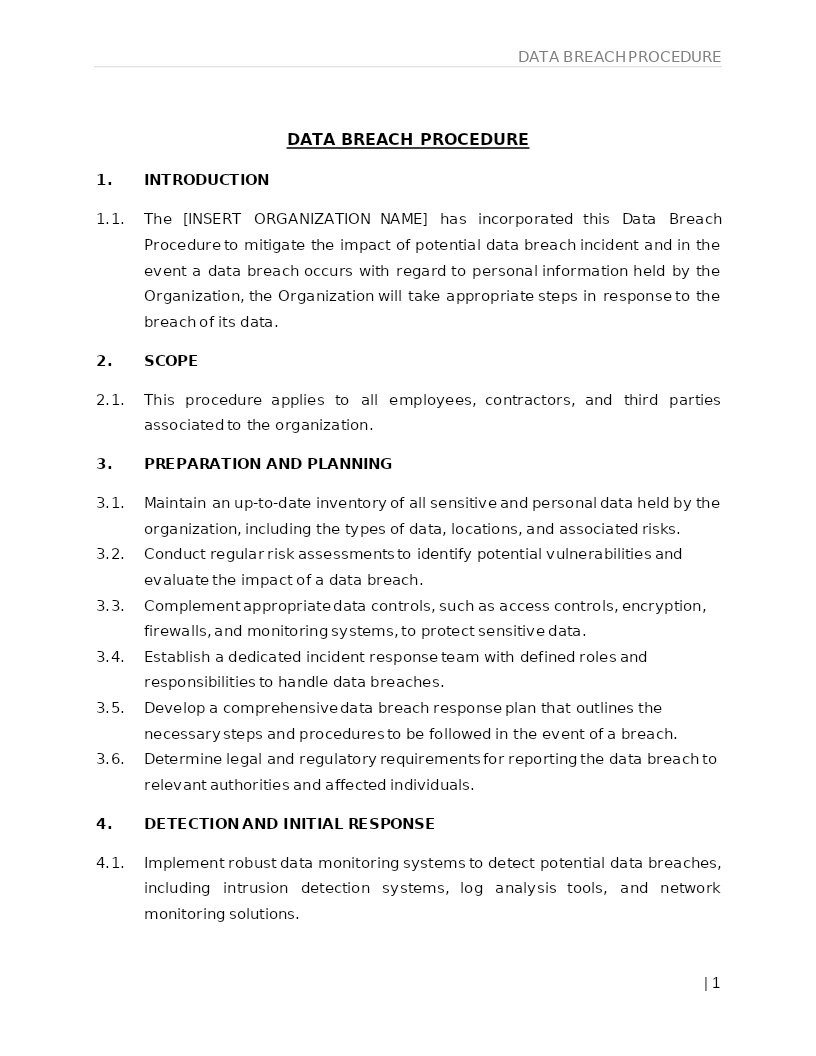
DATA BREACH PROCEDURE
How does it work?
1. Choose this template
Start by clicking on "Fill out the template"
2. Complete the document
Answer a few questions and your document is created automatically.
3. Save - Print
Your document is ready! You will receive it in Word and PDF formats. You will be able to modify it.
Strengthening Incident Response and Regulatory Compliance Through a Data Breach Procedure
A Data Breach Procedure is an organizational governance framework that establishes the mandatory legal, operational, and technological steps required to identify, contain, investigate, remediate, and report data breaches or suspected security incidents involving unauthorized access, disclosure, alteration, loss, or destruction of sensitive information. Developed in accordance with U.S. federal and state data-protection requirements, including the Federal Trade Commission’s (FTC) data-security guidelines, the HIPAA Breach Notification Rule, the Gramm-Leach-Bliley Act (GLBA) for financial institutions, Sarbanes Oxley (SOX) IT-control obligations, and state data-breach notification laws, this procedure ensures that an organization responds to breaches swiftly, lawfully, and effectively. It outlines procedures for detecting cybersecurity anomalies, escalating incidents to designated officials, isolating compromised systems, assessing the scope of exposure, preserving forensic evidence, notifying affected individuals, and filing regulatory disclosures. By implementing this procedure, organizations reduce legal risk, protect consumer trust, preserve critical business operations, and demonstrate compliance with national data-security expectations.
A comprehensive Data Breach Procedure details the categories of incidents that qualify as a breach, including ransomware events, unauthorized system access, compromised credentials, lost or stolen devices, misdirected communications, accidental disclosures, insider threats, and third-party or vendor-related breaches. It outlines the responsibilities of employees to report suspicious activity immediately, the obligations of IT and security teams to investigate through forensic analysis, and the duties of compliance officers to determine whether notification is legally required.
The procedure also establishes containment measures such as disabling compromised accounts, restricting network access, isolating affected servers, and initiating backup-recovery protocols. It incorporates standards for documenting investigation findings, maintaining chain-of-custody evidence, and implementing remedial measures to prevent recurrence. Additionally, the policy includes requirements for timely notification to individuals, regulators, law-enforcement agencies, insurance carriers, and contractual partners when required by law or agreement. By detailing these measures, the organization strengthens operational resilience and ensures that response efforts are coordinated, credible, and legally defensible.
Where Data Breach Procedures Are Commonly Used
Data Breach Procedures are essential in industries that handle regulated or sensitive information, including:
- Healthcare providers and insurers governed by HIPAA
- Financial institutions and lenders subject to GLBA and SOX obligations
- Technology companies, SaaS providers, and cloud-based service platforms
- Government contractors obligated to follow NIST and federal cybersecurity standards
- Retailers and e-commerce businesses processing payment card information
- Educational institutions managing student records under FERPA
- Manufacturing and logistics organizations operating connected systems and IoT devices
- Nonprofits handling donor, beneficiary, and membership data
Any organization storing or transmitting sensitive data benefits from a Data Breach Procedure.
Different Types of Data Breach Procedures
1. Cybersecurity Incident Response Procedures: Focus on digital threats such as hacking, malware, or unauthorized system access.
2. Physical Data Breach Procedures: Address lost devices, stolen files, or physical intrusion.
3. Vendor and Third-Party Breach Procedures: Define obligations when service providers experience breaches affecting the organization.
4. Regulated-Industry Breach Procedures: Implement heightened notification requirements for healthcare, financial, or government entities.
5. Business Continuity and Recovery Procedures: Integrate breach handling with operational restoration and resilience measures.
When Legal Guidance Becomes Helpful
Legal counsel should be consulted when:
- A breach triggers federal or state notification requirements
- Protected health information (PHI), financial data, or biometric data is involved
- The incident may expose the organization to litigation or regulatory penalties
- Contracts require specific breach-reporting terms or indemnification
- Forensic investigations must preserve evidence for law-enforcement coordination
- Notification timelines or legal standards vary across jurisdictions
- Customer, employee, or partner claims may arise following the breach
Legal support ensures accuracy, compliance, and defensible incident resolution.
How to Work with This Template
- Define what constitutes a breach and the events requiring formal escalation
- Establish reporting responsibilities for all employees and contractors
- Implement detection, monitoring, and alerting tools
- Outline immediate containment and isolation procedures
- Describe forensic analysis and evidence-preservation obligations
- Provide instructions for determining breach severity and legal notification thresholds
- Detail notification requirements for individuals, regulators, and contractual partners
- Include guidance for public communication and media response
- Document remediation action plans and long-term corrective measures
- Maintain logs, incident files, and audit documentation for compliance
- Update procedures regularly to reflect evolving threats and legal changes
This template supports regulatory compliance, cyber-resilience, and risk-management best practices.
Frequently Asked Questions
Q1. What is a Data Breach Procedure, and why is it important?
A Data Breach Procedure outlines how an organization responds to cybersecurity or privacy incidents. It is important because it ensures compliance with U.S. laws, protects sensitive data, and reduces legal and financial risk.
Q2. What qualifies as a data breach?
Any unauthorized access, disclosure, loss, or compromise of sensitive information—including online, physical, or third-party incidents.
Q3. Are employees required to report suspected breaches?
Yes. Employees must report any suspicious activity immediately through designated channels.
Q4. Does every breach require consumer notification?
Not always. Notification depends on the sensitivity of the data, the risk of harm, and applicable federal or state laws.
Q5. What types of data are protected under this procedure?
Personal information, financial data, health information, proprietary business data, customer records, and any legally protected information.
Q6. Does this procedure apply to vendors or third-party service providers?
Yes. Organizations must ensure vendors follow breach-notification requirements and contractual security obligations.
Q7. How quickly must notifications be sent?
Notification timelines vary by law—some states require notice “without unreasonable delay,” while HIPAA requires notice within 60 days.
Q8. How does forensic analysis fit into the breach process?
Forensic analysis identifies the cause, scope, and impact of the breach and supports recovery, remediation, and legal documentation.
Q9. Can a breach trigger regulatory penalty?
Yes. Noncompliance with breach laws can lead to fines, audits, litigation, and reputational harm.
Q10. Should legal counsel review the Data Breach Procedure?
Absolutely. Legal review ensures compliance with federal and state laws and supports defensible incident-response practices.