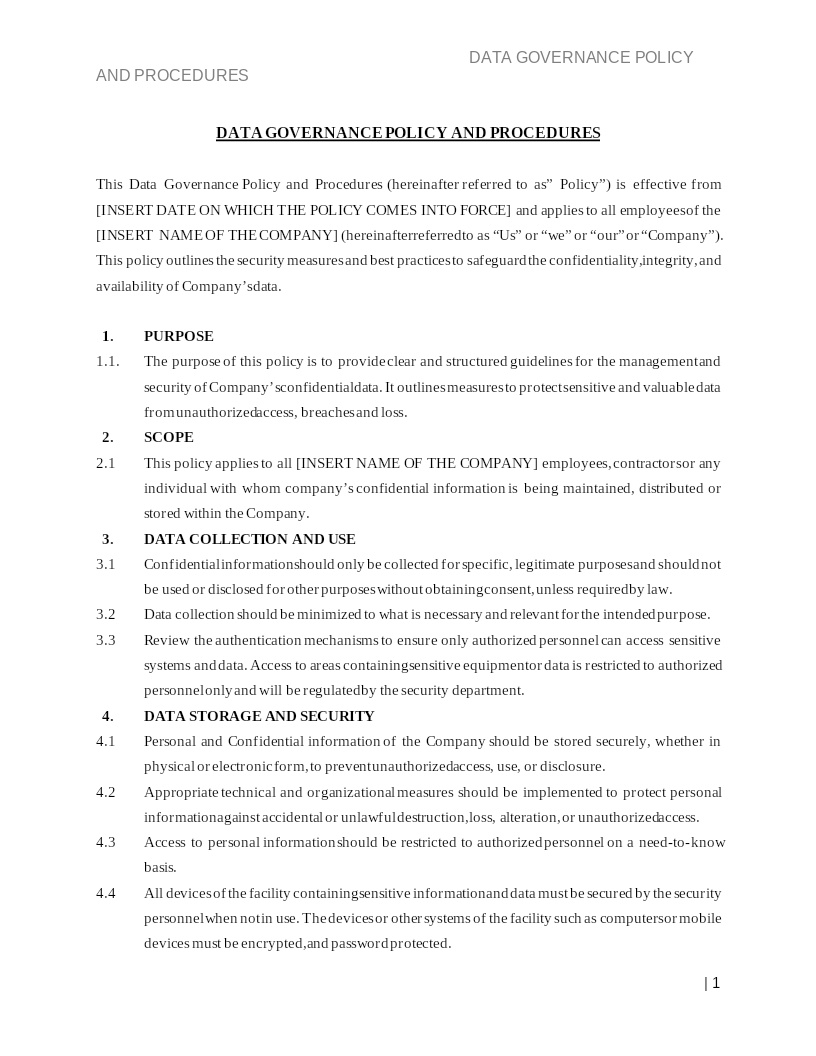
DATA GOVERNANCE POLICY AND PROCEDURE
How does it work?
1. Choose this template
Start by clicking on "Fill out the template"
2. Complete the document
Answer a few questions and your document is created automatically.
3. Save - Print
Your document is ready! You will receive it in Word and PDF formats. You will be able to modify it.
Understanding Data Governance Policy and Procedure in U.S.
A Data Governance Policy and Procedure establishes the framework, standards, and processes for managing, protecting, and utilizing an organization’s data assets. It outlines roles and responsibilities, data quality expectations, access controls, lifecycle management, and compliance requirements. This policy ensures that data is accurate, secure, available, and ethically used across all business functions.
By setting clear governance guidelines aligned with U.S. data protection laws and industry regulations, the policy supports informed decision-making, minimizes risks, strengthens accountability, and enhances organizational efficiency. It helps businesses safeguard sensitive information, maintain regulatory compliance, and build trust among customers, employees, and stakeholders.
Where Data Governance Policies Are Commonly Used
Data Governance Policies are widely implemented in industries that rely heavily on data accuracy, confidentiality, and compliance. They are commonly used in:
• Technology, cloud services, and software companies
• Healthcare organizations requiring HIPAA compliance
• Financial institutions governed by GLBA, SOX, and SEC rules
• Retail, e-commerce, and customer-data-driven businesses
• Government agencies and regulated sectors managing public data
• Large enterprises and multi-department organizations handling complex data systems
Any business that collects, stores, processes, or analyzes data benefits from a structured governance framework.
Different Types of Data Governance Practices You May Encounter
- Data Quality and Integrity Standards: Ensure data is consistent, accurate, complete, and reliable to support operational and strategic decisions.
- Data Security and Access Controls: Protect sensitive information using encryption, authentication, and authorization protocols, all aligned with U.S. cybersecurity and privacy regulations.
- Data Lifecycle and Retention Management: Outline how data is created, stored, archived, and destroyed based on legal, regulatory, and operational requirements.
- Metadata and Documentation Practices: Standardize definitions, classifications, and data dictionaries to improve clarity and cross-department collaboration.
- Regulatory and Compliance Governance: Ensure adherence to laws such as CCPA/CPRA, HIPAA, GLBA, FERPA, and state-specific data-protection rules.
When Legal Guidance Becomes Helpful
Legal consultation is essential when establishing Data Governance Policies because:
• U.S. data privacy laws (CCPA/CPRA, HIPAA, GLBA, state breach-notification laws) impose strict requirements on data collection, storage, and usage.
• Policies must define employee responsibilities without violating privacy or employment rights.
• Lawyers help clarify ownership, access rights, intellectual property, and data-sharing obligations.
• Multi-state organizations must align procedures with varying legal standards and retention requirements.
• Legal experts ensure data governance aligns with cybersecurity frameworks (NIST, ISO 27001) and industry requirements.
• Proper legal review reduces risk of penalties, breaches, misuse, or litigation.
A properly drafted policy protects both the organization and its stakeholders while promoting ethical data management.
How to Work With This Policy Template
• Identify all data types, classifications, and systems used across the organization.
• Assign roles such as Data Owners, Data Stewards, and Governance Committees.
• Establish data quality standards, retention rules, and access protocols.
• Implement cybersecurity controls, audit procedures, and breach-response guidelines.
• Ensure compliance with federal and state data protection laws.
• Create documentation processes to support transparency and consistency.
• Update the policy periodically as technology, laws, or business needs evolve.
Frequently Asked Questions
Q1. Why is a Data Governance Policy and Procedure essential for organizations?
A Data Governance Policy ensures that data is managed responsibly, securely, and efficiently. It provides structure for data quality, access control, and compliance practices. This leads to better decision-making, enhanced security, and improved operational performance across the organization.
Q2. Does this policy help with U.S. legal and regulatory compliance?
Yes. It aligns with U.S. privacy and data-protection laws such as CCPA/CPRA, HIPAA, GLBA, FERPA, and state-specific regulations. A well-designed policy minimizes legal risks, ensures proper handling of sensitive information, and supports audit readiness.
Q3. What responsibilities are typically outlined in a Data Governance Policy?
Common roles include Data Owners, Data Stewards, IT Administrators, and Governance Committees. The policy assigns accountability for data accuracy, security, access, retention, and compliance. Clear responsibilities ensure consistent data practices and reduce organizational risks.
Q4. How does data governance improve organizational efficiency?
By standardizing data processes, eliminating duplication, and defining clear data management procedures, organizations reduce confusion and operational delays. High-quality, well-governed data supports faster decision-making and more efficient workflows.
Q5. Does a Data Governance Policy help protect sensitive information?
Absolutely. It establishes strong security protocols, such as encryption, access controls, and regular audits. These measures defend against unauthorized access, breaches, and cyber threats, helping protect personal, financial, or proprietary data.
Q6. How does this policy support better business decision-making?
Reliable, accurate data enables leaders to make strategic and operational decisions with confidence. By ensuring data quality and consistency, the policy supports analytics, reporting, forecasting, and performance measurement.
Q7. Can the policy prevent data misuse or ethical violations?
Yes. It defines acceptable data usage, access limitations, and confidentiality requirements. This promotes ethical handling of information, reduces misuse, and ensures employees understand the consequences of violating data governance rules.
Q8. Is a Data Governance Policy suitable for small businesses as well?
Definitely. Even small organizations benefit from structured data practices, reduced risks, and improved data accuracy. Scaled-down governance frameworks help small businesses operate more efficiently and protect sensitive data without overwhelming resources.