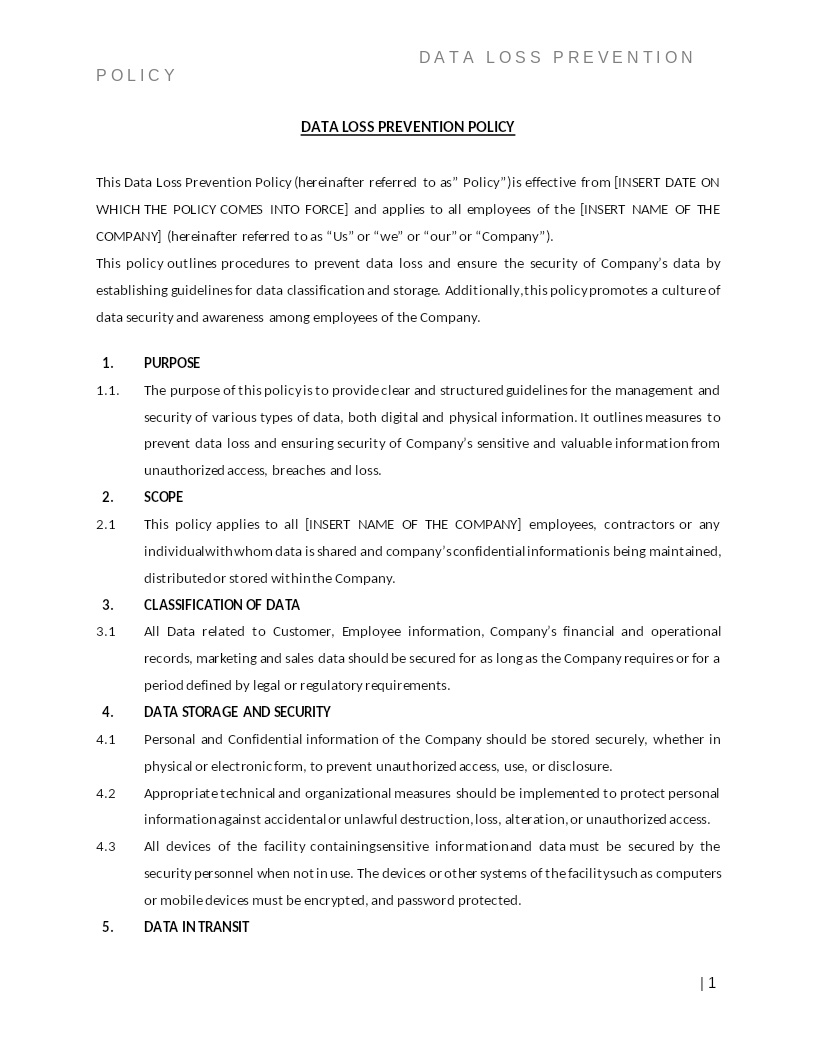
DATA LOSS PREVENTION POLICY
How does it work?
1. Choose this template
Start by clicking on "Fill out the template"
2. Complete the document
Answer a few questions and your document is created automatically.
3. Save - Print
Your document is ready! You will receive it in Word and PDF formats. You will be able to modify it.
Safeguarding Sensitive Information Through a Comprehensive Data Loss Prevention (DLP) Policy
A Data Loss Prevention (DLP) Policy establishes the rules, procedures, and technologies an organization uses to protect sensitive information from unauthorized access, loss, or leakage. It sets the standards for handling business data, defines employee responsibilities, and outlines technical safeguards to prevent accidental or intentional data breaches.
By implementing a structured DLP Policy, organizations can operate with confidence, maintain regulatory compliance, and reduce risks associated with cyber incidents, insider threats, and system vulnerabilities.
Where Data Loss Prevention Policies Are Commonly Used
DLP policies are standard across U.S. industries where data security and regulatory compliance are critical, including:
- Corporate businesses, tech companies, and SaaS providers
- Healthcare institutions handling PHI under HIPAA
- Finance, banking, and insurance organizations
- Educational institutions, government entities, and research bodies
- E-commerce platforms, digital agencies, and cloud-based service providers
Any organization that stores or processes sensitive customer, employee, operational, or proprietary data relies on DLP frameworks to prevent unauthorized exposure.
Different Types of Data Loss Prevention Policies You May Encounter
- Network-Based DLP Policies: Focus on monitoring and controlling data transfers across internal and external networks to prevent unauthorized transmission.
- Endpoint DLP Policies: Address risks on individual devices, such as USB transfers, screenshots, copying, and local storage vulnerabilities.
- Cloud DLP Policies: Protect data stored and shared across cloud environments, SaaS platforms, and remote work infrastructures.
- Email and Communication DLP Policies: Monitor outbound messages to detect sensitive information and prevent accidental or malicious leaks.
- Industry-Specific DLP Policies: Specialized versions tailored to strict regulatory environments such as healthcare, finance, education, or government sectors.
When Legal Guidance Becomes Helpful
While many DLP policies are operational and technology-driven, legal counsel becomes essential when:
- The business handles regulated data such as PHI, PII, financial data, or student records
- Operations span multiple U.S. states with differing privacy and cybersecurity laws
- The organization must comply with GDPR, HIPAA, CCPA, FERPA, or GLBA
- Employees access sensitive information remotely or across jurisdictions
- Vendors and third-party service providers handle internal data
- The company needs clarity on liability, breach notification rules, or enforcement measures
Legal review ensures your DLP Policy aligns with federal and state laws, protects against liability, and includes enforceable standards for data governance.
How to Work with This Template
- Identify the types of sensitive data handled by your organization
- Define the purpose and scope of the DLP Policy
- Outline technical measures, employee duties, and prohibited actions
- Select a governing U.S. state law and regulatory framework
- Establish reporting procedures, response timelines, and escalation steps
- Review internally and, if needed, with real-time counsel
- Share digitally, include in onboarding, and integrate within HR and IT systems
This policy template follows recognized U.S. cybersecurity standards and can be implemented across multiple departments and platforms.
Frequently Asked Questions
Q1. Why is a Data Loss Prevention Policy important for U.S. businesses?
A DLP Policy helps organizations prevent data breaches, unauthorized disclosures, and accidental data loss. It defines strict handling procedures and protects sensitive information across all systems. For U.S. businesses operating under multiple privacy laws, a formal DLP framework ensures compliance and reduces operational and financial risk.
Q2. Does a DLP Policy help with regulatory compliance?
Absolutely. Regulations like HIPAA, GDPR, CCPA, FERPA, and GLBA require businesses to safeguard sensitive data and demonstrate due diligence. A DLP Policy outlines the technical and administrative safeguards needed to meet these obligations. It also helps avoid legal penalties and ensures proper breach-reporting procedures.
Q3. Can this policy reduce cyber risks and insider threats?
Yes. A DLP Policy defines strict rules for data access, movement, and storage, helping detect and prevent suspicious activities. It also outlines monitoring tools and response measures for cyber threats, unauthorized downloads, and employee misuse. This minimizes exposure to attacks and strengthens internal controls.
Q4. Does a DLP Policy apply to remote workers and cloud environments?
Yes. Modern DLP frameworks extend across laptops, mobile devices, cloud apps, and remote networks. The policy can include VPN requirements, secure access tools, and cloud monitoring protections. This ensures sensitive data stays protected regardless of where employees work or which systems they use.
Q5. Does this policy help prevent financial loss and reputation damage?
Definitely. Data breaches can result in fines, lawsuits, customer distrust, and long-term reputation harm. A DLP Policy reduces the likelihood of breaches by defining clear guidelines and deploying preventive technologies. It acts as a safeguard that protects both organizational assets and brand trust.
Q6. Will employees be trained under a DLP Policy?
Yes. Employee awareness is one of the core pillars of an effective DLP program. The policy typically outlines training requirements, acceptable use rules, and consequences for violations. Educating staff ensures they understand how to store, share, and access data responsibly.
Q7. What happens if a data loss incident occurs despite safeguards?
A DLP Policy includes detailed incident-response procedures, such as reporting timelines, investigation steps, containment measures, and recovery actions. It ensures the company can respond quickly, minimize damage, and restore affected systems. Clear processes help maintain business continuity during a crisis.
Q8. Is this policy suitable for small businesses and startups?
Yes. Small and mid-size businesses are often targeted because they lack formal security practices. A DLP Policy gives them structure, risk reduction, and compliance support. It also helps establish trust with customers, investors, and partners by demonstrating a proactive approach to data protection.