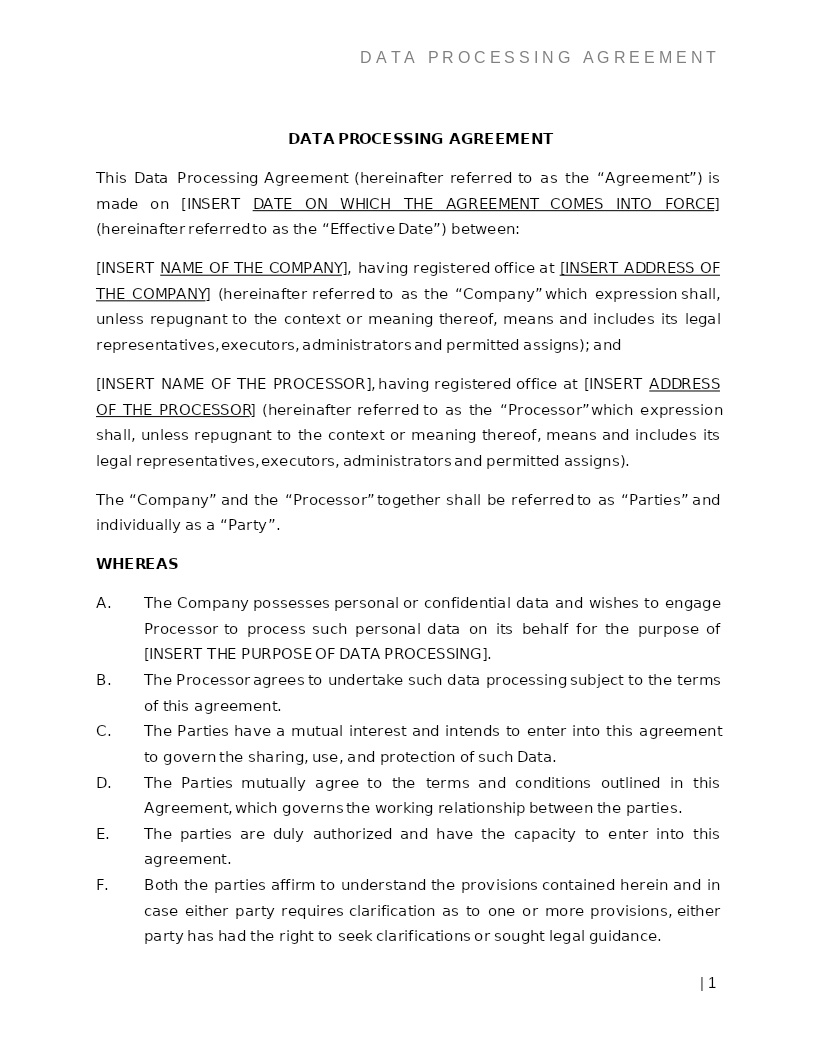
DATA PROCESSING AGREEMENT
How does it work?
1. Choose this template
Start by clicking on "Fill out the template"
2. Complete the document
Answer a few questions and your document is created automatically.
3. Save - Print
Your document is ready! You will receive it in Word and PDF formats. You will be able to modify it.
Understanding Data Processing Agreement in U.S.
A Data Processing Agreement (DPA) is a legally binding contract between a data controller and a data processor that governs how personal data is collected, stored, used, shared, and protected. Under U.S. privacy frameworks such as the California Consumer Privacy Act (CCPA), the California Privacy Rights Act (CPRA), the Virginia Consumer Data Protection Act (VCDPA), and applicable federal sector-specific laws, a DPA ensures that personal information is processed securely, transparently, and solely for authorized purposes. It establishes clear obligations, technical safeguards, and compliance requirements, protecting the interests of businesses and individuals while minimizing data-related risks.
Where a Data Processing Agreement Is Generally Used
A DPA is commonly used in situations where one party handles personal data on behalf of another, such as:
- Cloud storage and data hosting services
- Software-as-a-Service (SaaS) platforms
- IT support and managed services
- Marketing agencies and advertising platforms
- Payroll processors and HR service providers
- Healthcare and financial services vendors
- E-commerce platforms and logistics companies
- Outsourced customer support or call centers
Different Types of Data Processing Agreements
- General Data Processing Agreement: Covers standard processing activities between a controller and processor, applicable across industries.
- Service Provider Data Processing Agreement: Used under CCPA/CPRA to classify a vendor as a “service provider” and restrict data usage to permitted purposes.
- Joint Controller Agreement: Used when two entities jointly determine the purpose and means of processing personal data.
- Sub-Processor Agreement: Ensures third-party contractors handling data on behalf of a processor meet required security and compliance standards.
- Industry-Specific DPA: Tailored for sectors with specialized regulations such as healthcare (HIPAA), education (FERPA), or finance (GLBA).
When Legal Guidance Becomes Helpful
Legal review is strongly recommended when:
- Sensitive personal data is involved (health, biometrics, financial, children’s data)
- The processor uses sub-processors or cloud infrastructure
- Processing activities occur across multiple states or countries
- Large-scale or high-risk data processing is performed
- AI tools or automated decision-making systems are part of the processing
- You need compliance with U.S. privacy laws, GDPR, or international data transfer rules
- The DPA must integrate with a Master Service Agreement (MSA) or commercial contract
Real-time attorneys ensure the agreement meets legal, technical, and regulatory requirements while protecting both parties from liability.
How to Work With This Data Processing Agreement
- Clearly define roles (controller vs. processor)
- Outline the type, purpose, and duration of data processing
- Specify security measures, encryption, and access controls
- Establish breach notification timelines and procedures
- Define rules for sub-processing, cross-border transfers, and data retention
- Maintain written records of processing activities
- Ensure ongoing compliance audits and monitoring
A well-structured DPA enhances trust, reduces risk, and ensures lawful, responsible data management.
Frequently Asked Questions
Q1. What should a Data Processing Agreement include?
A DPA should include the nature and purpose of data processing, types of personal data involved, security obligations, breach notification procedures, audit rights, sub-processor requirements, and data retention rules. These elements ensure compliance with U.S. privacy laws and provide a transparent overview of how data is managed.
Q2. Is a Data Processing Agreement required under U.S. law?
Yes. While federal laws vary by industry, many state privacy laws, including CCPA, CPRA, and VCDPA, require businesses to have contracts with vendors handling personal information. These agreements help classify vendors as service providers or processors and limit their use of consumer data.
Q3. What is the difference between a data controller and a data processor?
A data controller determines the purpose and legal basis for processing personal data, while a data processor handles the data on the controller’s behalf. A DPA clarifies these roles to ensure responsibilities are legally defined and compliant with applicable regulations.
Q4. Does a DPA help prevent data breaches?
A DPA cannot fully prevent breaches, but it significantly reduces risk by requiring strong security practices, encryption, access controls, and breach-response procedures. It ensures both parties follow standardized protocols to protect personal information.
Q5. Can a processor use subcontractors (sub-processors)?
Yes, but only with prior written authorization from the controller. The DPA should ensure sub-processors meet the same security, confidentiality, and compliance obligations, preventing unauthorized data sharing or misuse.
Q6. How does a DPA support compliance with CCPA/CPRA?
A DPA restricts the processor from selling, sharing, or using personal information for unauthorized purposes, helping businesses classify vendors as “service providers” under California law. This protects the business from potential violations and regulatory penalties.
Q7. What happens if there is a data breach under a DPA?
The DPA specifies breach notification deadlines, investigation procedures, responsibilities for mitigation, and liability allocation. Clear instructions allow rapid action, reducing financial, legal, and reputational damage.
Q8. Can DPAs be customized for different industries?
Absolutely. Healthcare, finance, e-commerce, education, and government sectors often require additional clauses addressing industry-specific regulations (like HIPAA or GLBA). Customized DPAs ensure compliance and add stronger protections where necessary.