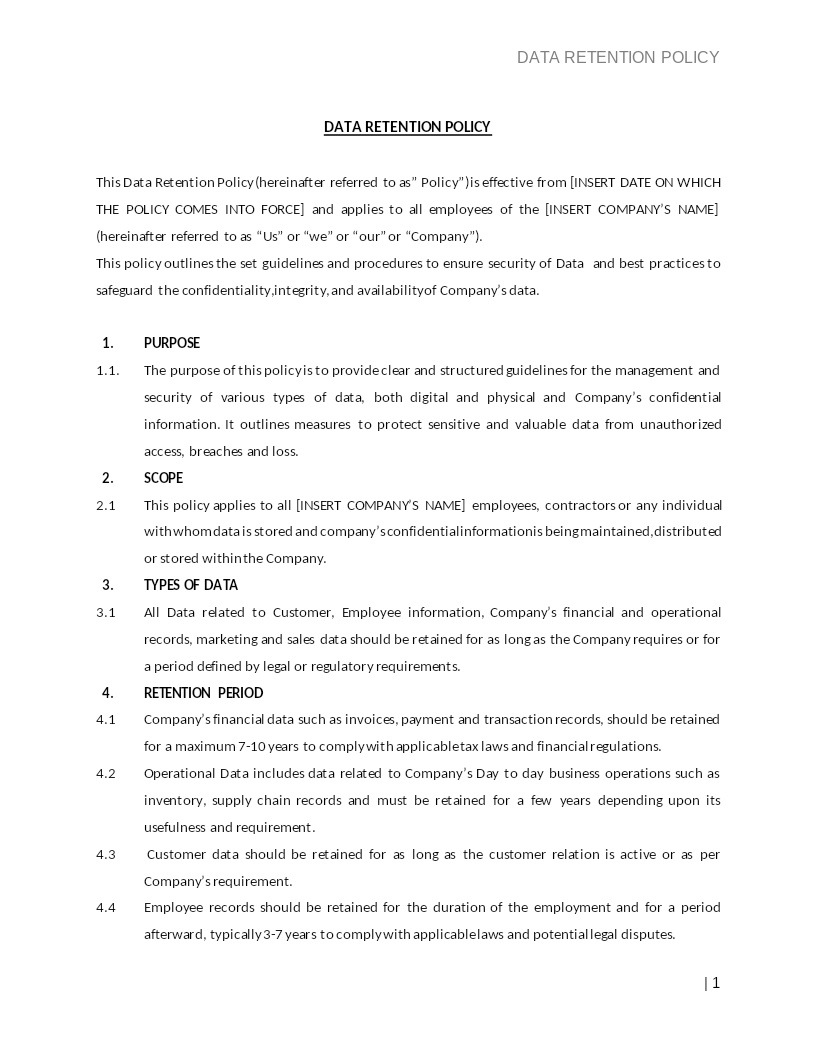
DATA RETENTION POLICY
How does it work?
1. Choose this template
Start by clicking on "Fill out the template"
2. Complete the document
Answer a few questions and your document is created automatically.
3. Save - Print
Your document is ready! You will receive it in Word and PDF formats. You will be able to modify it.
Ensuring Compliance and Information Governance Through a Data Retention Policy
A Data Retention Policy is a formal organizational framework that establishes how data is collected, stored, maintained, archived, and deleted in accordance with U.S. federal and state privacy regulations, including the Federal Trade Commission (FTC) Act, GLBA, HIPAA (where applicable), sector-specific retention laws, and emerging state data-protection statutes such as the California Consumer Privacy Act (CCPA). This policy governs the lifecycle of business records, electronic data, and personal information, providing clear guidance on retention schedules, lawful disposal procedures, and internal accountability mechanisms.
A comprehensive Data Retention Policy ensures that information is preserved for the appropriate duration to satisfy legal, operational, and regulatory obligations while preventing unnecessary storage of outdated or sensitive material. It establishes standards for record classification, backup procedures, data security, access control, and disposal methods. By formalizing these rules, the organization mitigates legal risk, enhances cybersecurity posture, reduces storage costs, and strengthens compliance with government audits, litigation holds, and reporting requirements. The policy also promotes transparency by informing personnel how data must be handled across its lifecycle.
Where Data Retention Policies Are Commonly Used
Data Retention Policies are widely adopted across industries that collect or manage personal, financial, operational, or sensitive information, including:
- Financial institutions subject to federal and state recordkeeping rules
- Healthcare organizations maintaining patient records and medical documentation
- Technology companies managing user accounts, logs, and digital communications
- E-commerce and retail businesses retaining transaction and payment records
- Educational institutions handling student information and accreditation data
- Government contractors and regulated entities needing strict audit compliance
- Professional services firms storing legal, tax, or consulting files
- Corporations maintaining HR files, employee communications, and payroll records
Any organization handling structured or unstructured data benefits from a legally compliant Data Retention Policy.
Different Types of Data Retention Policies
1. General Corporate Data Retention Policies: Cover companywide data categories, business records, and standard retention periods.
2. Industry-Specific Retention Policies: Address regulated industries like healthcare, finance, education, or energy.
3. Electronic Communications Retention Policies: Dictate how emails, chat logs, digital messages, and system logs are stored.
4. Customer and User Data Retention Policies: Apply to businesses storing consumer information, account data, or transactional records.
5. Legal Hold and Litigation Retention Policies: Control retention of records required for lawsuits, investigations, or government requests.
When Legal Guidance Becomes Helpful
Legal assistance is recommended when:
- The organization handles sensitive personal or financial data subject to federal privacy laws
- State regulations require specific deletion rights, disclosure obligations, or retention limits
- The policy must comply with HIPAA, GLBA, FERPA, SOX, FINRA, or industry-specific rules
- Cross-border data storage for international customers trigger foreign compliance requirements
- A litigation hold, subpoena, or government audit affects retention timelines
- Large-scale data migration or cloud-storage transition requires legal oversight
- The organization includes deletion rights under CCPA or similar state laws
- Company operations involve minors’ data, biometric data, or highly sensitive categories
Legal review ensures the policy aligns with data governance, privacy, and regulatory frameworks.
How to Work with This Template
- Identify the types of data collected and categorize them based on regulatory requirements
- Establish retention timelines for each category of records (e.g., 1 year, 7 years, permanent)
- Define storage locations, security measures, backup protocols, and user-access rights
- Explain procedures for document archiving, retrieval, and secure destruction
- Include rules for electronic data, cloud-based storage, and disaster-recovery systems
- Outline responsibilities of employees, managers, IT teams, and compliance officers
- Provide steps for implementing litigation holds and preventing inadvertent deletion
- Specify compliance obligations under federal and state privacy laws
- Require periodic review and updates of retention schedules
- Execute the policy electronically or in writing, ensuring acknowledgment by relevant staff
This template reflects widely recognized U.S. standards for information governance and data-retention compliance.
Frequently Asked Questions
Q1. What is a Data Retention Policy, and why is it important?
A Data Retention Policy is a formal document outlining how long an organization stores data and when it must be deleted. It is important because it ensures compliance with privacy laws, reduces risk, and supports efficient information management.
Q2. Are businesses legally required to maintain a Data Retention Policy?
In many industries such as healthcare, finance, education, and government contracting data retention rules are mandatory under federal and state regulations.
Q3. What types of data require retention schedules?
Common categories include financial records, employee files, customer data, emails, contracts, audit logs, medical records, and transactional data.
Q4. Can customers request deletion of their data?
Yes. Under laws such as the CCPA, consumers may request deletion of certain personal data, subject to legal and operational exceptions.
Q5. How long should data be retained?
Retention periods vary depending on industry laws, business needs, and regulatory requirements. For example, financial records may require seven-year retention, whereas logs or marketing data may be kept for shorter durations.
Q6. Does the policy cover electronic communications?
Yes. Data Retention Policies should address emails, chat logs, cloud documents, system logs, and any electronically stored information (ESI).
Q7. How can businesses securely delete data?
Secure deletion may involve shredding, permanent erasure, de-identification, or destruction of physical and digital files per industry standards.
Q8. Are businesses required to notify customers about data retention practices?
Some laws, such as CCPA, require disclosure of retention practices in privacy policies or user notices.
Q9. What happens if data is deleted prematurely?
Premature deletion may result in regulatory penalties, failed audits, loss of evidence, or breach of contractual obligations.
Q10. Should legal counsel review a Data Retention Policy?
Yes. Given complex federal and state requirements, legal review ensures the policy is compliant, enforceable, and well-aligned with the organization’s operational needs.