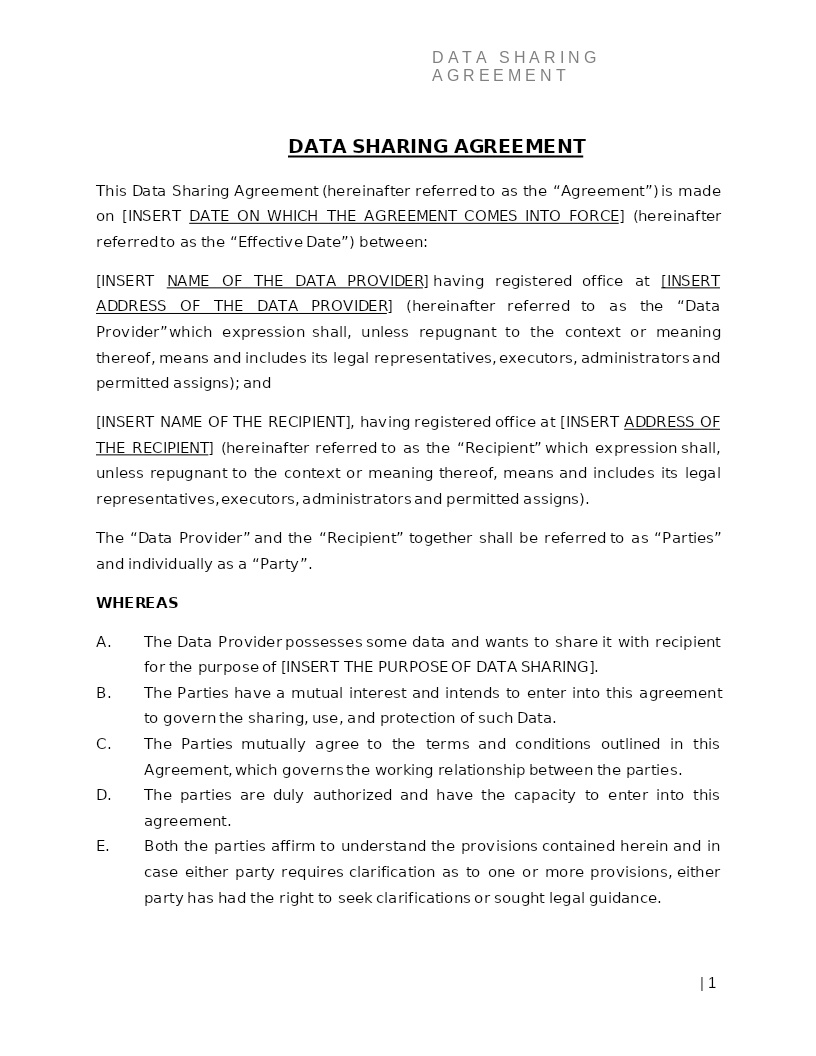
DATA SHARING AGREEMENT
How does it work?
1. Choose this template
Start by clicking on "Fill out the template"
2. Complete the document
Answer a few questions and your document is created automatically.
3. Save - Print
Your document is ready! You will receive it in Word and PDF formats. You will be able to modify it.
Comprehensive Overview of a Data Sharing Agreement
When organizations collaborate, integrate systems, conduct research, or engage in commercial transactions, it becomes essential to establish a clear legal framework governing how data will be exchanged, accessed, processed, and safeguarded. A Data Sharing Agreement (DSA) provides that structure. It defines what constitutes shared data, the purposes for which such data may be used, the rights and restrictions applicable to the receiving party, and the privacy, security, and compliance obligations binding both parties.
Implementing a Data Sharing Agreement creates a foundation of trust that allows parties to share datasets, proprietary information, personal data, analytics outputs, or system-access credentials without fear of unauthorized disclosure, manipulation, or misuse. It ensures transparency by setting out the legal, cybersecurity, and operational standards that govern data flows between the involved entities.
Data Sharing Agreements are used across a broad spectrum of industries, including technology, healthcare, finance, logistics, research institutions, government agencies, and cross-border enterprises where data transfer is integral to operations or partnerships. By clearly defining responsibilities and ensuring compliance with data protection laws, a DSA helps maintain accountability, reduce regulatory exposure, and uphold data integrity throughout the sharing lifecycle.
Where Data Sharing Agreements Are Commonly Used
Data Sharing Agreements are widely implemented in scenarios including:
- Technology integrations, API connections, or cloud-to-cloud migrations
- Vendor onboarding, outsourcing, and third-party service relationships
- Inter-organizational collaboration for research or analytics
- Joint development projects and strategic partnerships
- Access to dashboards, databases, test environments, or proprietary tools
- Sharing of customer data, operational data, or financial datasets
- Government-to-business or business-to-government reporting requirements
- Healthcare entities exchanging patient or compliance data
- Cross-border data transfers subject to privacy regulations
Any time data leaves its originating environment, a Data Sharing Agreement establishes clear boundaries on what the recipient may and may not do.
Types of Data Sharing Agreements
- Unilateral Data Sharing Agreement: Used when only one party discloses data to another, often during onboarding or evaluation.
- Mutual Data Sharing Agreement: Used when both parties expect to exchange data for collaborative or operational purposes.
- Project-Specific DSA: A narrowly tailored agreement limited to a specific initiative, dataset, purpose, or timeframe.
- Research or Academic DSA: Used in universities, research labs, and institutions for controlled sharing of study data, subject data, or experimental datasets.
- Cross-Border Data Transfer Agreements: Used when data is transferred internationally, requiring compliance with foreign privacy laws and transfer mechanisms.
- Information-exchange agreement: it is a document specifying protection requirements and responsibilities for information being exchanged outside authorization boundaries
- Data processing agreements: They capture the relationships between a data controller (the party that decides why and how to process data) and a data processor (the party that processes the data on the controller’s behalf)
- Proprietary information and inventions agreements (PIIAs): It is a contract between the company (typically a startup) and its employees, consultants, or other individuals who have access to the company’s confidential information or create intellectual property while working for the company.
When Legal Guidance Becomes Helpful
While routine operational data exchanges may not always require extensive legal oversight, professional review is recommended when:
- Personal data, sensitive data, or regulated information is involved
- The agreement supports a transaction involving licensing, joint development, or system integrations
- Multiple jurisdictions or international transfers are implicated
- The data includes trade secrets, proprietary algorithms, or confidential datasets
- Cybersecurity, encryption, and breach notification obligations are complex
- The relationship involves obligations under laws such as GDPR, HIPAA, CCPA, or other sector-specific regulations
- You require additional restrictions, such as data minimization or purpose limitation
Legal review is not mandatory, but it reduces risk when handling sensitive or regulated information.
How to Work With This Template
- Identify the parties and specify the nature of the data exchange
- Clearly define the categories of data to be shared
- Establish the authorized purposes for which the data may be used
- Determine security standards, access controls, retention periods, and deletion requirements
- Select the governing law and jurisdiction
- Review the terms together (legal review advised)
- Sign electronically or in hard copy
This template follows contract norms recognized across commercial, governmental, and research-based environments.
Frequently Asked Questions
Q1. Is a Data Sharing Agreement necessary for early-stage collaborations?
Yes. Even preliminary discussions may require limited data exchange. A DSA ensures that all data is used only for authorized purposes.
Q2. Can one DSA be reused for multiple projects?
Yes, but the agreement should be revised to reflect the specific data categories and purposes applicable to each project.
Q3. What if a party refuses to sign a DSA?
You should restrict access, avoid sharing sensitive information, and maintain only high-level discussions until protections are in place.
Q4. Are electronic signatures enforceable?
Yes. Electronic execution of DSAs is legally recognized under federal and state e-signature laws.
Q5. Does a DSA protect personal data?
Yes. A DSA governs the sharing, use, and safeguarding of personal and sensitive information, subject to applicable data protection laws.
Q6. Can a DSA cover temporary system access or API keys?
Yes. Access credentials, dashboards, test environments, and operational interfaces can all be included within the scope of permitted data use.
Q7. How long does a DSA remain in effect?
It remains in effect typically for the duration of the collaboration, plus a retention or destruction period for shared data. Specific timelines must be stated in the agreement.
Q8. Is this suitable for freelancers, contractors, and vendors?
Yes. External providers often require temporary or ongoing access to client data, making DSAs an essential part of third-party risk management.
Q9. What happens if a party breaches the DSA?
The non-breaching party may demand cessation of the misuse, require return or destruction of the data, or pursue financial or injunctive relief.
Q10. Does the DSA cover verbal or informal data disclosures?
Only if the agreement expressly includes them. Written documentation of disclosures is recommended for clarity.
Q11. Is this useful for tech integrations or software pilots?
Yes. Technology demos, prototypes, sandbox access, and dataset testing all require data-use restrictions found in DSAs.
Q12. Do both parties need to approve any revisions?
Yes. No amendment is effective unless mutually agreed and documented in writing.
Q13. Is a DSA suitable for parties in different states or countries?
Yes. A governing law clause ensures consistency even when parties are geographically dispersed.
Q14. What if new data is added later?
You may include the new data categories through written notices, addenda, or updated schedules attached to the agreement.
Q15. Can employees or subcontractors be bound by the DSA?
Yes, this agreement typically requires the receiving party to bind its employees, contractors, and affiliates to obligations at least as strict as those in the DSA.