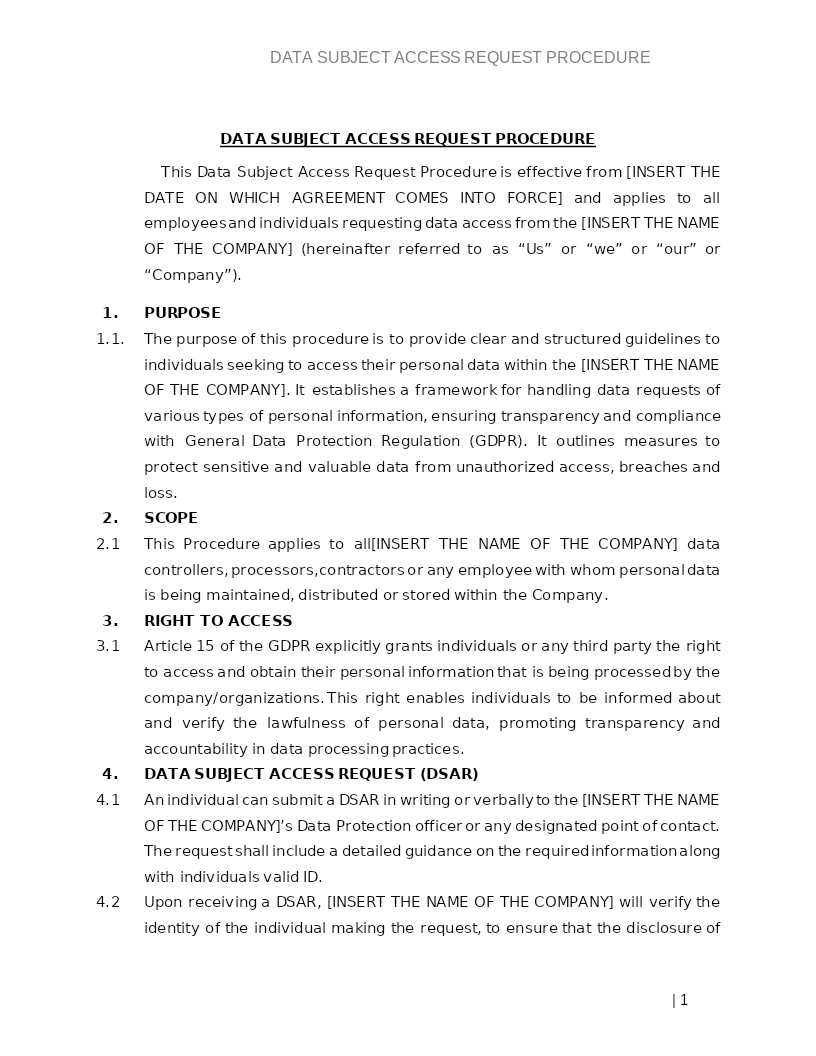
DATA SUBJECT ACCESS REQUEST PROCEDURE
How does it work?
1. Choose this template
Start by clicking on "Fill out the template"
2. Complete the document
Answer a few questions and your document is created automatically.
3. Save - Print
Your document is ready! You will receive it in Word and PDF formats. You will be able to modify it.
Understanding the Data Subject Access Request Procedure
When an organization collects personal information from customers, employees, users, or third parties, individuals have the right to know what data is being gathered and how it is processed. A Data Subject Access Request (DSAR) Procedure provides a clear, consistent framework for responding to such requests. It outlines how individuals can submit a request, what information must be provided, how the organization verifies identity, and the timelines for fulfilling the request.
Implementing a DSAR Procedure builds transparency and trust by showing that your organization respects data privacy and complies with U.S. federal and state privacy regulations. While the U.S. does not have a single comprehensive privacy law, numerous state-level laws including the California Consumer Privacy Act (CCPA), California Privacy Rights Act (CPRA), Virginia Consumer Data Protection Act (VCDPA), and Colorado Privacy Act (CPA) grant individuals the right to access their personal data.
A DSAR Procedure ensures your team knows exactly how to handle incoming requests and how to document compliance.
Where DSAR Procedures Are Commonly Used
Organizations implement DSAR Procedures in nearly every sector where personal data is collected, including:
- E-commerce, subscription services, and online platforms
- Healthcare providers and health-tech companies
- Financial institutions and credit service businesses
- HR departments managing employee data
- SaaS companies handling user accounts and analytics
- Schools, universities, and educational systems
- Marketing agencies and data-driven service providers
- Retailers collecting loyalty program or customer data
Any time your organization stores personally identifiable information (PII), a DSAR Procedure ensures that requests for access are handled lawfully and consistently.
Different Types of DSARs You May Encounter
- Standard Access Requests: An individual asks to view or obtain a copy of their personal data.
- Correction/Rectification Requests: A request to correct inaccurate or incomplete personal information.
- Deletion Requests (Right to Erasure): Certain state laws allow individuals to request deletion of specific categories of data.
- Opt-Out or Restriction Requests: Applicable when individuals want to limit data processing or prevent the sale/sharing of their information.
- Verification-Only Requests: Individuals may request that the organization confirm whether personal data is being processed.
When Legal Guidance Becomes Helpful
Legal support may be necessary when:
- The request involves sensitive categories of personal data, such as health or financial information
- The requester lives in a state with specific privacy rights (California, Virginia, Colorado, etc.)
- Multiple jurisdictions or international data transfers are involved
- The request requires interpreting exemptions or exceptions
- Fulfilling the request may impact third-party rights
- The processing activities fall under regulated industries like healthcare or finance
- You must evaluate whether the request is valid, excessive, or unlawful
While not always required, legal review helps reduce risk in sensitive or complicated DSAR scenarios.
How to Work with This Template
- Identify how data subjects may submit requests (email, portal, form)
- Define verification requirements to confirm identity
- Outline what categories of personal data may be provided
- Specify timelines, typically 30–45 days under state privacy laws
- Note any exemptions or limits to disclosure
- Record all requests for audit and compliance
- Choose the governing U.S. state law that applies
- Sign internally or obtain necessary approvals
This template follows standards recognized across the United States and supports compliance with state privacy regulations.
Frequently Asked Questions
Q1. What is a Data Subject Access Request (DSAR)?
A DSAR is a formal request made by an individual asking an organization to disclose what personal data it holds about them. This helps individuals understand how their information is collected, stored, and used.
Q2. How long does a business have to respond to a DSAR?
Most U.S. state privacy laws require organizations to respond within 30–45 days, with extensions allowed in certain cases. Timely response is important for legal compliance.
Q3. Does a DSAR cover all types of personal information?
Generally, yes, but some information may be exempt—such as proprietary business data, confidential legal materials, or information that impacts another individual’s privacy.
Q4. Can individuals request deletion of their data?
In many states, including California, individuals may request deletion of certain types of data. However, legal or operational requirements may allow the business to retain some information.
Q5. Are electronic submissions of DSARs valid?
Yes. Many organizations offer online forms, portals, or email submission methods. Electronic requests are fully valid and widely accepted.
Q6. Can a DSAR be denied?
Yes. A request may be denied if it is fraudulent, unverified, overly broad, repetitive, or conflicts with legal obligations. The business must provide a clear reason for denial.
Q7. What happens if a business fails to respond to a DSAR?
Failure to comply can result in penalties under state privacy laws, reputational harm, and regulatory complaints. Documenting every request is essential for audit readiness.