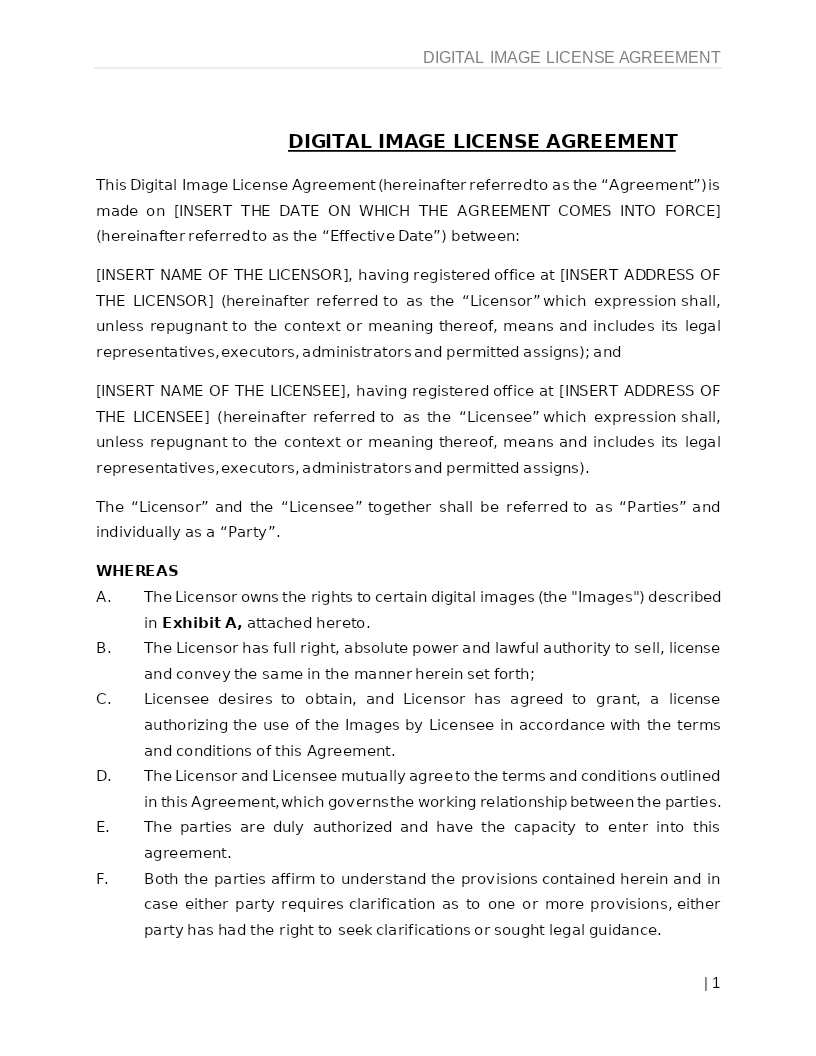
DIGITAL IMAGE LICENSE AGREEMENT
How does it work?
1. Choose this template
Start by clicking on "Fill out the template"
2. Complete the document
Answer a few questions and your document is created automatically.
3. Save - Print
Your document is ready! You will receive it in Word and PDF formats. You will be able to modify it.
Understanding Digital Image Licensing in the United States
A Digital Image License Agreement is a legally binding contract that defines how a digital image may be used by the licensee while preserving the copyright and ownership rights of the creator. In the United States, this agreement specifies whether an image may be used for personal, commercial, editorial, or promotional purposes, and outlines restrictions on modification, distribution, or resale.
Digital Image License Agreements ensure compliance with U.S. copyright laws, prevent unauthorized use, and protect the value of creative work. For photographers, artists, brands, and digital content creators, this agreement provides a structured framework that governs usage rights, licensing fees, attribution requirements, and limitations.
By clearly defining what is permitted and what is prohibited, the agreement helps both parties avoid copyright infringement claims, misuse of images, and disputes over ownership or usage.
Where Digital Image License Agreements Are Commonly Used
Digital Image License Agreements are widely used in:
- Photography and videography services
- Advertising, branding, and marketing campaigns
- Social media content creation
- E-commerce platforms and product listings
- Graphic design and creative agencies
- Publishing, magazines, and online blogs
- Digital art sales and NFT or Web3 licensing
- Stock photo websites and media libraries
- Corporate branding, product packaging, and print materials
- Event photography and wedding shoots
Any time a digital image is transferred for use, a license agreement sets the boundaries and protects the creator’s rights.
Different Types of Digital Image License Agreements You May Encounter
- Royalty-Free License: Allows broad usage of an image without paying each time it is used, subject to specific restrictions.
- Rights-Managed License: Usage is controlled by factors like duration, geographical region, number of impressions, or media type.
- Commercial Use License: Permits use in advertising, promotions, product packaging, or business-related materials.
- Editorial Use License: Allows use in news, education, journalism, and informational content, but not for commercial promotion.
- Exclusive License: Grants sole usage rights to one person or company. The creator agrees not to license the image to others during the license period.
- Non-Exclusive License: Allows the creator to license the same image to multiple users simultaneously.
- Print or Personal Use License: Authorizes personal use such as home décor, private albums, or non-commercial projects.
When Legal Guidance Becomes Helpful
Digital Image License Agreements involve intellectual property rights, which can be complex. Legal consultation is especially useful when:
- The images will be used for high-value commercial campaigns
- Licensing involves multiple regions or countries
- The agreement includes exclusive rights
- The image contains identifiable people requiring model releases
- Images include third-party trademarks, artwork, or property
- The license covers digital products, templates, or NFTs
- A business needs custom usage rights for branding or advertising
- Copyright ownership, attribution, or transfer of rights is involved
Legal guidance ensures that licensing terms comply with U.S. copyright law, avoid infringement, and clearly define rights and limitations for both parties.
How to Work With This Template
- Identify the creator/licensor and the user/licensee
- Describe the digital images being licensed (file names, type, resolution)
- Specify the type of license (commercial, editorial, exclusive, etc.)
- Define permitted and prohibited uses
- Include fees, royalty terms, and payment schedule
- Address attribution requirements
- Specify modification or editing restrictions
- Outline copyright ownership and usage limitations
- Add indemnity, warranties, and liability clauses
- Select governing U.S. state law
- Review terms together (legal consultation recommended)
- Sign electronically or in print
This template aligns with U.S. copyright laws and is compatible with major e-signature and licensing platforms.
Frequently Asked Questions
1. What is a Digital Image License Agreement used for?
It is used to define how a digital image can be legally used by a buyer or client. The agreement clarifies usage rights, protects copyright, prevents unauthorized distribution, and ensures compliance with U.S. intellectual property laws.
2. Does the creator retain ownership of the images?
Yes. Under U.S. copyright law (17 U.S.C.), the creator automatically owns the copyright unless it is formally transferred. The license only grants usage rights—it does not transfer ownership.
3. What is the difference between commercial and editorial use?
Commercial use involves advertising, marketing, or business promotion, while editorial use is for news, commentary, education, or non-commercial informational purposes. Licensing terms should clearly distinguish the two.
4. Can digital images be altered or edited?
Only if the agreement permits editing. Many licenses restrict modifications or require that edits not alter the creator’s original intent or style. Commercial projects may require additional permissions.
5. Are licensing fees mandatory?
Yes, unless the creator chooses to offer free or personal-use licensing. Most commercial and exclusive licenses require payment based on usage type, duration, and distribution.
6. What happens if the image is used without permission?
Unauthorized use may lead to copyright infringement claims, statutory damages, and legal action. A clear license agreement protects both parties by defining permitted use and consequences for misuse.
7. Can a license be exclusive?
Yes. An exclusive license grants sole usage rights to one person or organization. It typically commands a higher fee because it limits the creator’s ability to license the image to others.
8. Does the agreement cover social media use?
Yes, if explicitly included. Social media usage must be clearly stated due to platform-specific rules regarding reposting, attribution, and redistribution.
9. Can the license be used for resale or redistribution?
Only if the agreement allows it. Most standard licenses prohibit resale, redistribution, or creation of derivative stock images without written permission.
10. Can the agreement be amended later?
Absolutely. Licensing terms can be expanded or updated at any time with written consent from both parties. This is common when a client wants expanded rights for additional projects or platforms.