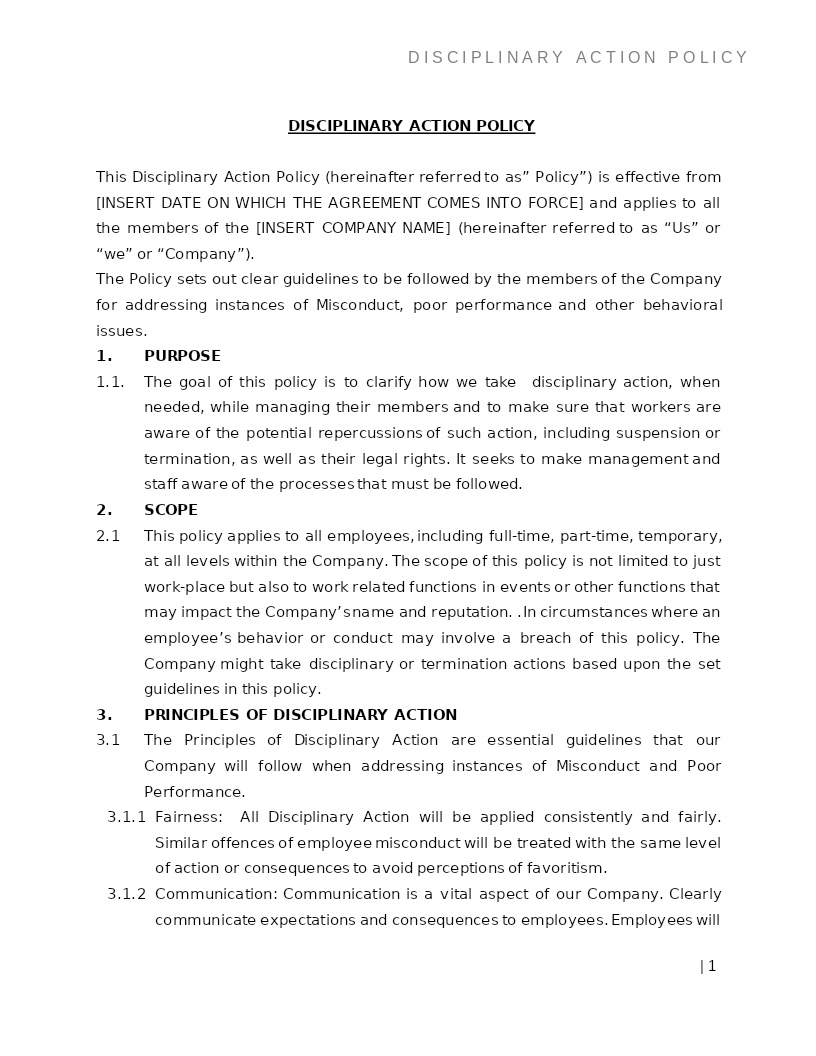
DISCIPLINARY ACTION POLICY
How does it work?
1. Choose this template
Start by clicking on "Fill out the template"
2. Complete the document
Answer a few questions and your document is created automatically.
3. Save - Print
Your document is ready! You will receive it in Word and PDF formats. You will be able to modify it.
Promoting Workplace Accountability and Regulatory Compliance Through a Disciplinary Action Policy
A Disciplinary Action Policy is a formal organizational framework that outlines the standards, procedures, and corrective measures governing employee misconduct, performance deficiencies, or violations of company rules. Developed in alignment with U.S. federal and state employment laws, including anti-discrimination requirements enforced by the Equal Employment Opportunity Commission (EEOC), employee-rights provisions under the National Labor Relations Act (NLRA), wage-and-hour rules under the Fair Labor Standards Act (FLSA), and workplace safety requirements under OSHA, this policy ensures that disciplinary actions are carried out in a consistent, lawful, and non-discriminatory manner. The policy establishes a transparent system of corrective steps designed to maintain productive work environments, uphold professional conduct, and reduce legal exposure resulting from inconsistent treatment or improper disciplinary procedures.
A comprehensive Disciplinary Action Policy sets forth the categories of misconduct, performance concerns, and rule violations that may trigger corrective action, ranging from verbal warnings to written reprimands, suspension, demotion, or termination. It describes investigative processes, documentation standards, and employee-notification requirements, ensuring that corrective steps are applied in an objective and fair manner. The policy also clarifies employee rights to respond to allegations, outlines confidentiality obligations, and explains the company's expectations regarding workplace behavior. By implementing this policy, organizations establish consistent disciplinary practices, protect against claims of unfair treatment or retaliation, support regulatory compliance, and reinforce organizational values by holding employees accountable for their conduct.
Where Disciplinary Action Policies Are Commonly Used
Disciplinary Action Policies support workforce management across a wide range of industries, including:
- Corporate offices managing large teams and diverse employee roles
- Manufacturing and industrial organizations requiring strict safety and conduct compliance
- Healthcare institutions governed by patient-safety and professional-conduct standards
- Retail and hospitality companies with customer-facing employees
- Technology companies navigating performance expectations and cybersecurity protocols
- Educational institutions overseeing faculty, staff, and student-employee conduct
- Nonprofits and public-service organizations seeking legally defensible HR procedures
- Government contractors subject to federal compliance obligations and employee-status rules
Any workplace that requires structured accountability measures benefits from a well-defined Disciplinary Action Policy.
Different Types of Disciplinary Action Policies
1. Progressive Discipline Policies: Include a step-by-step corrective process such as verbal warnings, written warnings, performance improvement plans, and final actions.
2. Zero-Tolerance Policies: Apply to severe forms of misconduct such as violence, harassment, theft, or major safety violations.
3. Performance-Improvement Policies: Focus on addressing inadequate job performance through structured improvement plans.
4. Attendance and Conduct-Specific Policies: Address tardiness, absenteeism, inappropriate behavior, or policy-specific violations.
5. Hybrid Disciplinary Policies: Combine progressive and zero-tolerance elements depending on the nature of the violation.
When Legal Guidance Becomes Helpful
Legal counsel may be needed when:
- Disciplinary actions involve sensitive allegations of harassment, discrimination, retaliation, or protected-class status
- An employee claims wrongful termination, constructive discharge, or unequal treatment
- The policy intersects with union contracts or collective-bargaining agreements
- The organization must handle violations of safety standards under OSHA
- Misconduct involves confidential information or cybersecurity breaches
- The company must comply with state-specific rules governing employee-discipline records
- Disciplinary actions may impact visa-holding employees or federal-contract workforce requirements
Legal review ensures the policy complies with U.S. employment law, minimizing liability and ensuring fair and defensible procedures.
How to Work with This Template
Define the types of misconduct or performance issues that may lead to disciplinary action
- Establish a step-by-step discipline structure, including verbal warnings, written notices, and escalated actions
- Outline investigative procedures, including fact-gathering, witness interviews, and documentation standards
- Require clear communication of expectations and consequences to employees
- Set forth confidentiality standards governing disciplinary matters
- Clarify decision-making authority and supervisory responsibilities
- Include provisions allowing the employer discretion depending on the severity of misconduct
- Ensure compliance with anti-discrimination, retaliation, and employee-rights laws
- Detail employee rights to respond to allegations or appeal disciplinary decisions
- Require consistent recordkeeping and periodic policy reviews
This template reflects best practices for HR governance and workplace compliance in accordance with U.S. employment standards.
Frequently Asked Questions
Q1. What is a Disciplinary Action Policy, and why is it important?
A Disciplinary Action Policy outlines the procedures for addressing employee misconduct or performance issues. It is important because it promotes fairness, reduces legal risks, and ensures consistent and lawful treatment of all employees.
Q2. Does U.S. law require employers to have a disciplinary policy?
While not mandatory, having a written policy is strongly recommended because it helps employers comply with anti-discrimination laws and defend against claims of unfair treatment.
Q3. What behaviors typically result in disciplinary action?
Common violations include attendance issues, breaches of confidentiality, workplace misconduct, insubordination, policy violations, safety breaches, and failure to meet performance expectations.
Q4. What is progressive discipline?
Progressive discipline is a structured approach involving escalating steps verbally warnings, written notices, performance plans, suspension, and termination depending on the nature and severity of the violation.
Q5. Can employers terminate an employee without warning?
Yes. Under at-will employment principles, employers may terminate without prior warnings, except when limited by contracts, union agreements, or discriminatory motives.
Q6. Are employees allowed to respond to disciplinary actions?
Yes. Most policies permit employees to provide written or verbal responses, ensuring transparency and fairness.
Q7. Is documentation required for disciplinary actions?
Documentation is essential. Proper records help defend the employer in disputes and demonstrate compliance with legal requirements.
Q8. How does the policy protect against discrimination claims?
By requiring consistent application, objective standards, and non-discriminatory procedures, the policy helps prevent claims of unfair or unequal treatment.
Q9. Does misconduct outside the workplace count?
In some cases, yes, especially if it impacts workplace safety, reputation, or job performance.
Q10. Should legal counsel review the Disciplinary Action Policy?
Absolutely. Legal review ensures the policy complies with federal and state employment laws, including EEOC regulations, NLRA protections, and wage-and-hour compliance.