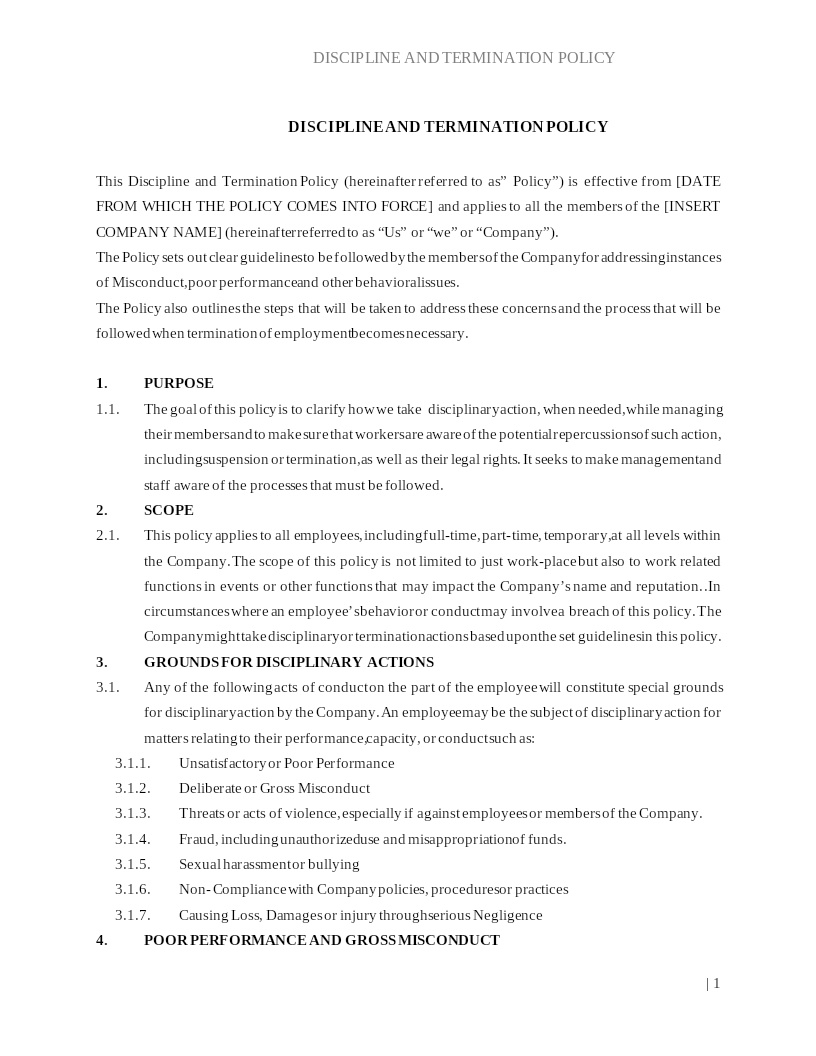
DISCIPLINE AND TERMINATION POLICY
How does it work?
1. Choose this template
Start by clicking on "Fill out the template"
2. Complete the document
Answer a few questions and your document is created automatically.
3. Save - Print
Your document is ready! You will receive it in Word and PDF formats. You will be able to modify it.
Establishing Clear Standards for Employee Conduct and Employment Separation
In any organization, maintaining professional behavior, accountability, and consistent performance is essential for smooth operations. A Discipline and Termination Policy provides the framework for managing employee conduct, addressing performance issues, and enforcing consequences when company standards are violated. It clarifies expectations for both employees and management, enabling fair and transparent handling of workplace issues.
Having this policy in place ensures that disciplinary actions and employment terminations are conducted legally, consistently, and respectfully—protecting the rights of employees and the interests of the organization.
Where Discipline and Termination Policies Are Commonly Used
These policies are standard across workplaces in a wide range of industries, including:
- Corporate offices, professional service firms, and administrative environments
- Healthcare, hospitality, retail, and customer-facing sectors
- Education and training institutions
- Manufacturing plants, logistics operations, and field-based teams
- Hybrid and remote workforces requiring clear behavioral guidelines
- Any workplace where conduct, performance, or compliance must be monitored
Whenever employees interact with internal teams, customers, or company systems, a structured disciplinary framework defines acceptable conduct and consequences.
Different Types of Disciplinary and Termination Structures You May Encounter
- Progressive Discipline Policy: Uses escalating steps such as verbal warnings, written warnings, suspension, and final termination.
- Immediate Termination for Cause: Applies to serious misconduct such as harassment, violence, theft, or severe policy breaches.
- Performance Improvement Process (PIP): Used when employees need corrective action and measurable goals before further steps are taken.
- Redundancy or Layoff Procedures: Follow legal guidelines for ending employment due to business restructuring or role elimination.
- Voluntary Resignation Procedures: Set expectations for notice periods, final duties, and exit processes.
When Legal or HR Guidance Becomes Helpful
While many workplace issues can be resolved internally, professional guidance becomes valuable when:
- Termination involves protected classes or sensitive circumstances
- Employee misconduct may expose the organization to legal liability
- Documentation is unclear and risks a wrongful termination claim
- Multiple jurisdictions or federal regulations apply
- The company must follow union rules or collective bargaining agreements
- Misconduct involves harassment, discrimination, or safety violations
- A Performance Improvement Plan needs legally compliant structure
Consulting HR professionals or legal counsel helps ensure discipline and termination decisions comply with U.S. labor laws and are defensible if challenged.
How to Work with This Policy Template
- Identify the types of conduct or performance issues covered
- Document warnings, corrective actions, and employee responses
- Specify timelines, improvement expectations, and review procedures
- Select governing state employment laws
- Clarify termination categories and exit procedures
- Review the policy with HR or legal guidance (optional)
- Communicate it clearly to employees and obtain acknowledgment
This policy framework mirrors widely accepted U.S. employment practices and compliance standards.
Frequently Asked Questions
Q1. Why is a Discipline and Termination Policy important for workplaces?
A structured policy ensures employees understand expected conduct and the consequences of violating workplace rules. It protects the organization by promoting fair and consistent handling of performance or behavioral issues. A well-defined process reduces the risk of claims related to wrongful termination or bias. It also promotes a positive, accountable work culture. Clear expectations help prevent misunderstandings and conflict.
Q2. Does this policy apply to all types of employees?
Most organizations apply the same disciplinary framework to full-time, part-time, temporary, and remote employees. Applying the policy universally helps maintain fairness and avoids legal inconsistencies. However, managers may adapt steps for probationary employees or specialized roles. Some industries also require additional compliance procedures. Clear communication ensures all employees know the standards expected of them.
Q3. What is progressive discipline and how does it work?
Progressive discipline is a step-based process that typically begins with verbal warnings, progresses to written warnings, suspension, and may end in termination. It gives employees opportunities to correct behavior before facing severe consequences. This method helps demonstrate fairness and due process. It is widely used in U.S. workplaces to maintain accountability. Progressive steps also ensure proper documentation at every stage.
Q4. Can an employer terminate an employee immediately?
Yes, immediate termination is permitted for serious misconduct such as harassment, violence, theft, or major policy violations. These actions compromise safety or organizational integrity and justify removal without prior warnings. The policy outlines the types of conduct that may result in immediate separation. Proper documentation remains essential even in urgent cases. Employers must still follow applicable state and federal laws.
Q5. How does the policy ensure legal compliance during termination?
The policy aligns disciplinary steps with U.S. labor laws, including standards for documentation, due process, and nondiscrimination. It helps employers avoid actions that may be viewed as retaliatory or biased. Following legal guidelines reduces exposure to lawsuits or labor-board claims. It also supports defensible decision-making when disputes arise. Consistent procedures demonstrate fairness to employees and regulators.
Q6. What is the purpose of documentation in disciplinary actions?
Documentation provides a clear record of the employee’s behavior, prior warnings, performance issues, and corrective steps taken. It helps demonstrate that the organization acted fairly and in compliance with the policy. Comprehensive records protect employers in the event of legal challenges. They also help employees understand their performance history. Documentation strengthens transparency throughout the process.
Q7. How are performance issues addressed under this policy?
Performance issues are often handled through structured feedback, coaching, and formal improvement plans. The policy outlines timelines and measurable goals to help employees succeed. If performance does not improve, further disciplinary action may follow. This ensures employees have a fair opportunity to correct deficiencies. Clearly defined improvement steps help both management and staff stay aligned.
Q8. What happens during the termination process?
The policy outlines exit procedures including notice requirements, final paycheck timelines, return of company property, and revocation of access rights. It also defines termination categories such as voluntary, involuntary, or termination for cause. Employees may receive a termination meeting explaining the reasons for separation. Proper process ensures respect, clarity, and legal compliance. It supports a smooth transition for both parties.