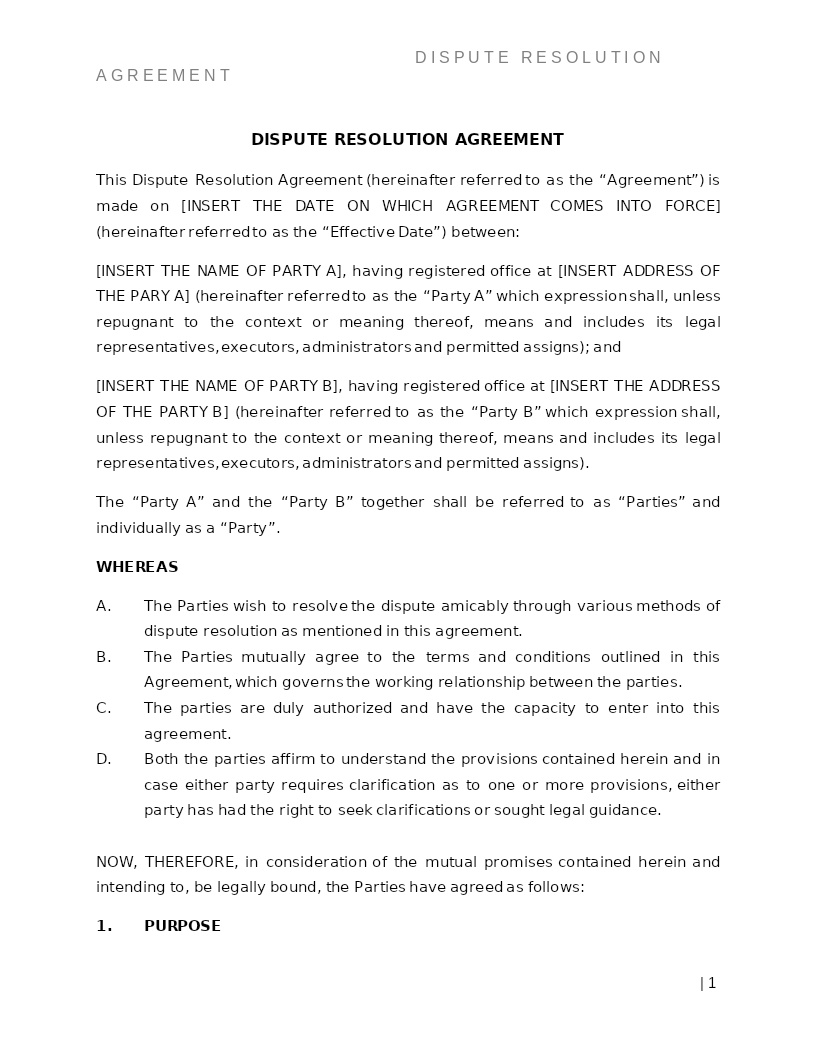
DISPUTES RESOLUTION AGREEMENT
How does it work?
1. Choose this template
Start by clicking on "Fill out the template"
2. Complete the document
Answer a few questions and your document is created automatically.
3. Save - Print
Your document is ready! You will receive it in Word and PDF formats. You will be able to modify it.
Understanding Dispute Resolution Agreement in U.S.
A Dispute Resolution Agreement is a legally binding contract that outlines how parties will resolve conflicts without immediately resorting to court litigation. It establishes preferred methods such as negotiation, mediation, arbitration, or a hybrid approach. The agreement sets clear procedures, responsibilities, and timelines for addressing disputes in a structured, private, and cost-effective manner. This helps minimize uncertainty and provides a predictable framework for managing disagreements in compliance with U.S. dispute-resolution laws.
A well-structured Dispute Resolution Agreement promotes fairness, efficiency, and cooperation while protecting both parties from the financial and reputational burdens of traditional courtroom proceedings.
Where Dispute Resolution Agreements Are Commonly Used
Dispute Resolution Agreements are used in:
- Commercial contracts, partnership agreements, and vendor relationships
- Employment agreements and contractor arrangements
- Real estate, leasing, and property management transactions
- Technology, IP licensing, and SaaS service contracts
- Joint ventures, franchising, and distribution agreements
- Consumer agreements and B2B service arrangements
- Cross-border transactions requiring neutral resolution platforms
Anytime parties want faster, more confidential, and less adversarial dispute processes, a dispute resolution agreement becomes essential.
Different Types of Dispute Resolution Methods You May Encounter
- Negotiation: A voluntary process where parties communicate directly to resolve issues privately and amicably.
- Mediation: A neutral third-party mediator helps the parties reach a mutually acceptable resolution, though the outcome is non-binding unless agreed in writing.
- Arbitration: A private legal process where an arbitrator (or panel) makes a binding decision. Arbitration is widely used in U.S. contracts for its speed, confidentiality, and finality.
- Hybrid Systems (Med-Arb / Arb-Med): Allows parties to use multiple methods sequentially—e.g., mediation first and arbitration if unresolved.
When Legal Guidance Becomes Helpful
Legal guidance is important when:
- Complex or high-value contracts require customized dispute procedures
- Multiple jurisdictions or international parties are involved
- You want to include mandatory arbitration clauses under the Federal Arbitration Act (FAA)
- Enforcement, confidentiality, or emergency relief provisions need tailoring
- Industry-specific rules apply (FINRA, AAA, JAMS, construction arbitration, etc.)
- The dispute process impacts regulatory compliance or intellectual property rights
- You need clear escalation steps, timelines, and decision-maker qualifications
Professional review ensures the agreement remains enforceable, balanced, and legally compliant.
How to Work With This Dispute Resolution Agreement
- Identify all parties and define covered disputes
- Choose appropriate methods such as mediation or arbitration
- Establish timelines, notice requirements, and procedural steps
- Specify governing law, arbitration forums, and confidentiality expectations
- Assign responsibility for fees, mediator or arbitrator selection, and location
- Ensure compatibility with federal and state rules (e.g., FAA, state ADR statutes)
- Review together and sign digitally or in hard copy
Frequently Asked Questions
Q1. Why is a Dispute Resolution Agreement important?
A Dispute Resolution Agreement provides a clear and structured process for resolving disagreements without the delays and expenses of court litigation. It helps preserve professional relationships, ensures confidentiality, and promotes quicker outcomes. This predictability offers security and reduces legal uncertainty.
Q2. Is arbitration legally enforceable in the U.S.?
Yes. Arbitration agreements are enforceable under the Federal Arbitration Act (FAA). Once parties consent to arbitration, courts generally require disputes to be resolved through that process. Arbitration awards are binding and can be enforced just like court judgments, giving parties confidence in finality.
Q3. How is mediation different from arbitration?
Mediation is a collaborative, non-binding process where a neutral mediator guides the parties toward an agreement. Arbitration, in contrast, results in a binding decision made by an arbitrator. Mediation offers flexibility and control, while arbitration provides finality and enforceability.
Q4. Can parties choose their mediator or arbitrator?
Yes. Parties may select professionals with specific expertise, such as industry specialists, retired judges, or accredited neutrals. This allows disputes to be evaluated by experts who understand the technical, commercial, or legal context, resulting in more accurate and efficient outcomes.
Q5. Are dispute resolution proceedings confidential?
Most mediation and arbitration processes are private and confidential. This protects sensitive information such as trade secrets, financial data, and internal business strategies. Confidentiality helps maintain trust and prevents public exposure that court litigation might create.
Q6. Does dispute resolution save time and money?
Absolutely. Alternative dispute resolution (ADR) typically moves much faster than traditional lawsuits and avoids extensive court procedures. Mediation and arbitration often require fewer filings, fewer hearings, and reduced attorney involvement, significantly lowering overall costs and delays.
Q7. Can this agreement be used for cross-border disputes?
Yes. Many businesses use dispute resolution agreements to manage international conflicts through neutral forums and enforceable arbitration clauses. These agreements help address jurisdictional challenges, different legal systems, and cross-border enforcement issues efficiently.
Q8. What happens if the parties cannot resolve the dispute through negotiation or mediation?
If initial steps fail, the agreement may require binding arbitration or an alternative method specified in the contract. This ensures disputes do not stall indefinitely. Escalation clauses provide clarity on next steps, ensuring a definitive resolution path.