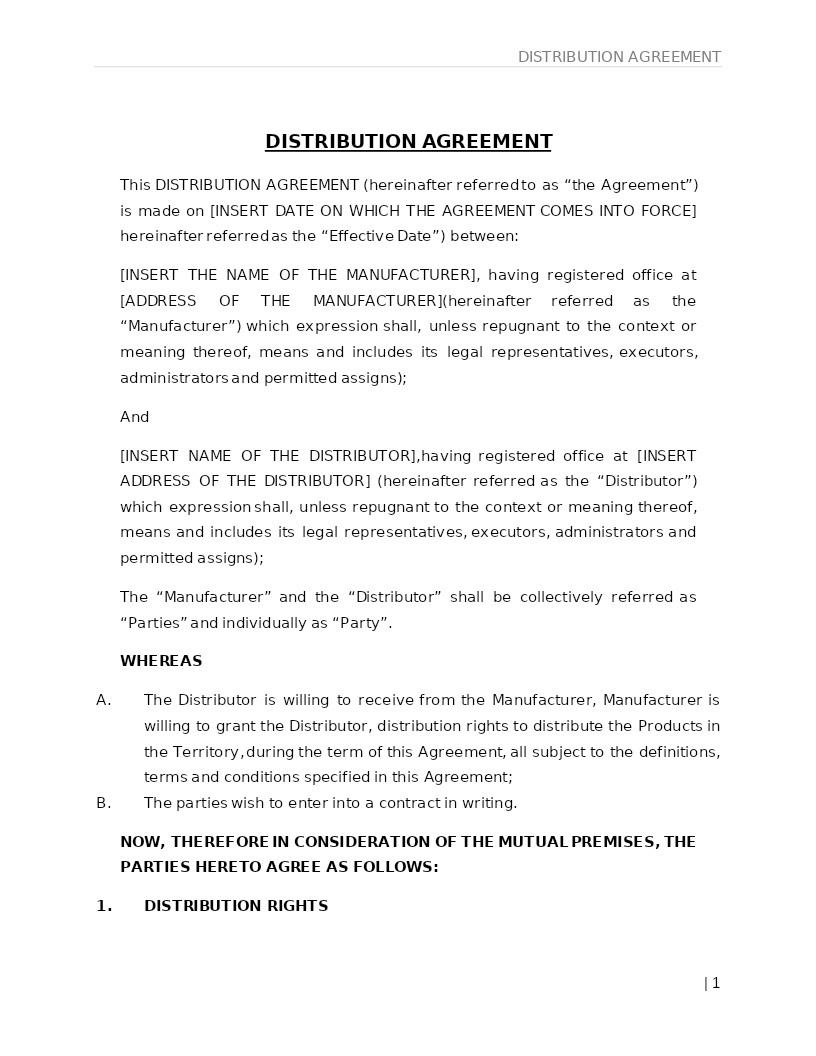
DISTRIBUTION AGREEMENT
How does it work?
1. Choose this template
Start by clicking on "Fill out the template"
2. Complete the document
Answer a few questions and your document is created automatically.
3. Save - Print
Your document is ready! You will receive it in Word and PDF formats. You will be able to modify it.
Understanding Distribution Relationships in U.S. Markets
When a business wants to expand its reach, enter new regions, or streamline product delivery, a Distribution Agreement provides the legal foundation for that relationship.
A Distribution Agreement is a binding contract between a supplier (manufacturer or wholesaler) and a distributor (an independent business) that outlines how products will be marketed, sold, and delivered within a defined territory.
In the United States, these agreements ensure compliance with commercial laws, clarify commercial expectations, and create a structured, transparent business relationship that protects both parties.
A well-drafted Distribution Agreement defines the distributor’s rights, territory, pricing structure, performance targets, and the supplier’s responsibilities related to product quality, marketing support, and inventory supply.
Having a clear framework allows both parties to grow efficiently, minimize conflicts, and ensure that distribution activities comply with U.S. federal and state regulations, including the Uniform Commercial Code (UCC), advertising laws, and consumer protection standards.
Where Distribution Agreements Are Commonly Used
Distribution arrangements are widely used across industries, including:
- Consumer goods and retail
- Electronics, appliances, and technology products
- Pharmaceuticals, medical devices, and healthcare supplies
- Food & beverages
- Automotive parts and machinery
- Industrial equipment and B2B products
- Cosmetics, beauty, and wellness products
- Apparel and specialized fashion items
- SaaS and software licensing distributions
- Import/export and cross-border trade
Any time a supplier needs a trusted partner to deliver products to customers, manage local sales, or expand into a new region, a Distribution Agreement sets out clear rules governing that process.
Different Types of Distribution Agreements in the U.S.
- Exclusive Distribution Agreement: The distributor receives exclusive rights to sell specific products in a defined region. This prevents other distributors from entering the same territory and provides stronger market control.
- Non-Exclusive Distribution Agreement: The supplier may appoint multiple distributors in the same area. This is common in large markets or where broad coverage is required.
- Selective or Restricted Distribution Agreement: Distributors are chosen based on specific criteria such as expertise, infrastructure, market reach, or technical capability.
- Wholesale Distribution Agreement: Used when products are supplied primarily for resale to retail stores, online sellers, or other intermediaries.
- Franchise-Style Distribution Agreement: Allows distributors to sell branded goods under strict quality, marketing, and operational guidelines, common for specialized products.
- Territory-Based Agreement:Defines specific states, counties, or regions where the distributor can operate, ensuring compliance with territorial restrictions.
When Legal Guidance Becomes Helpful
While standard distribution terms may be straightforward, legal guidance is valuable when:
- The parties negotiate exclusive rights or large territories
- Products fall under regulated industries (e.g., healthcare, chemicals, alcohol, firearms)
- Cross-border shipments or import regulations apply
- Intellectual property, branding, or technology licensing is involved
- The agreement covers complex pricing, commissions, or performance obligations
- The distributor is required to meet specific compliance standards
- The contract includes U.S. antitrust considerations under the Federal Trade Commission (FTC) and Clayton Act
- Product warranties or consumer protection obligations are significant
Legal review ensures that the agreement is enforceable, compliant, and tailored to the specific commercial relationship.
How to Work With This Template
- Clearly identify the supplier and the distributor
- Describe the products being distributed
- Define the distribution territory (state, region, or nationwide)
- Specify whether the agreement is exclusive or non-exclusive
- Establish pricing, payment terms, and sales targets
- Outline delivery, warehousing, and inventory responsibilities
- Set out intellectual property, trademarks, and branding permissions
- Specify warranties, product liability, and compliance requirements
- Choose governing U.S. state law and dispute resolution methods
- Review terms jointly (legal consultation is optional but recommended)
- Sign electronically or on paper
This template aligns with standard practices recognized across the United States and is compatible with popular e-signature platforms.
Frequently Asked Questions
1. Is a Distribution Agreement necessary for selling products in the U.S.?
Yes. A Distribution Agreement protects both parties by defining rights, responsibilities, pricing, territory, and performance standards. It also ensures compliance with U.S. laws, including the UCC and consumer protection regulations.
2. Can I use the same Distribution Agreement for different distributors?
It can be reused, but you should adjust the territory, products, and commercial terms for each new distributor. Tailoring the agreement helps avoid disputes and makes the contract easier to enforce in U.S. courts.
3. What if a distributor fails to meet sales targets?
The agreement typically includes remedies such as probation periods, reallocation of territory, or termination rights. Setting clear, measurable performance metrics helps protect the supplier’s market interests.
4. Are exclusive distribution rights enforceable in the U.S.?
Yes. Exclusive rights are enforceable when clearly written. However, they must comply with U.S. antitrust laws to prevent unfair market restrictions.
5. Can electronic signatures be used for Distribution Agreements?
Absolutely. Under the ESIGN Act and UETA, electronic signatures are legally valid and widely accepted across the U.S.
6. Does a Distribution Agreement protect my brand or trademarks?
Yes, if the contract includes intellectual property clauses. You can specify how trademarks, packaging, logos, and branded materials may be used and require the distributor to follow strict brand-use guidelines.
7. What happens if the distributor violates the agreement?
You may seek legal remedies such as termination, compensation for losses, injunctions, or reclaiming inventory. Clear dispute resolution clauses strengthen your protection.
8. Can this agreement be used for cross-border or import distribution?
Yes, but you should include provisions related to customs duties, international shipping, regulatory compliance, product labeling, and applicable foreign laws.
9. Is this suitable for both small businesses and large corporations?
Yes. Distribution Agreements are scalable and can be adapted for startups, wholesalers, retail chains, and global manufacturers.
10. Should distributors carry insurance?
Most U.S. distribution arrangements require insurance (general liability, product liability, or commercial insurance) to reduce risk for both parties.