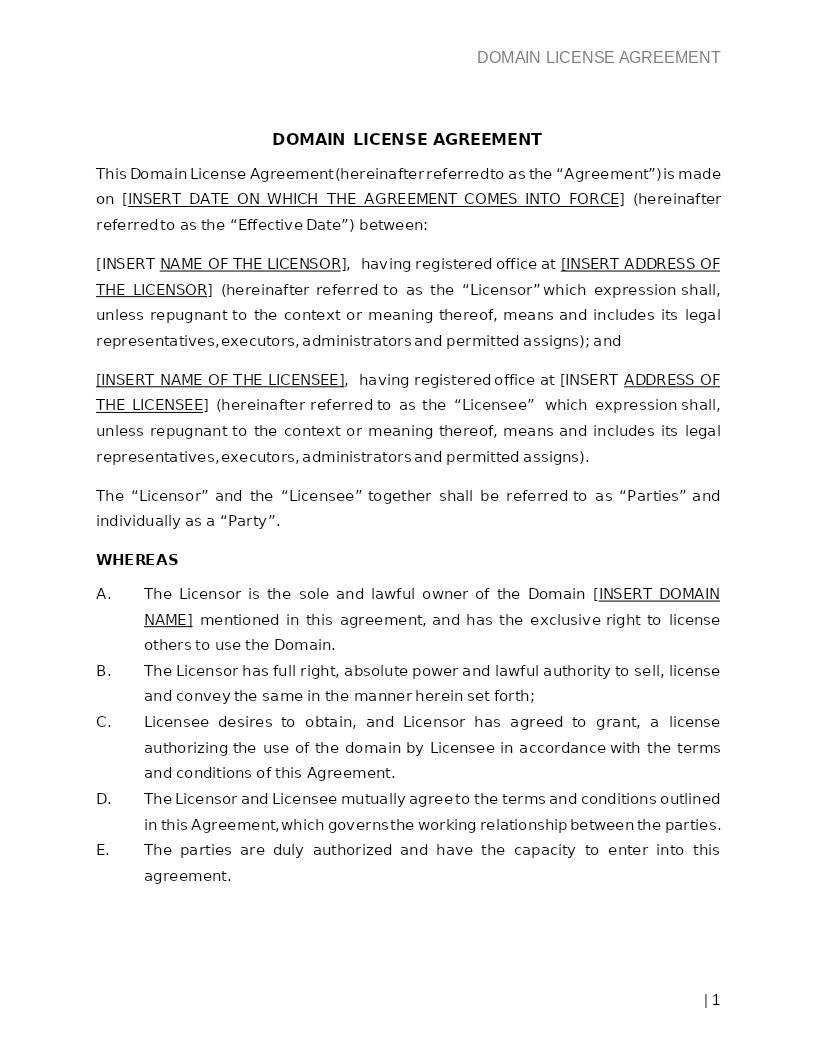
DOMAIN LICENSE AGREEMENT
How does it work?
1. Choose this template
Start by clicking on "Fill out the template"
2. Complete the document
Answer a few questions and your document is created automatically.
3. Save - Print
Your document is ready! You will receive it in Word and PDF formats. You will be able to modify it.
Understanding Domain License Agreements
A Domain License Agreement is a legally binding contract in which the owner of an internet domain name (the “Licensor”) grants another party (the “Licensee”) permission to use the domain for specific purposes without transferring ownership. This agreement outlines usage rights, licensing restrictions, payment terms, intellectual property protections, operational responsibilities, renewal terms, and compliance with U.S. internet and digital commerce laws.
In the United States, Domain License Agreements operate under federal intellectual property law, ICANN domain regulations, state contract law, the Anti-Cybersquatting Consumer Protection Act (ACPA), and applicable trademark and online business regulations. This agreement is essential for businesses, creators, and online brands who want to use a domain without purchasing it outright, while ensuring the owner’s rights remain protected.
Where Domain License Agreements Are Commonly Used
Domain License Agreements are frequently used in digital business settings, including:
- Leasing premium or high-value domain names
- Startups temporarily licensing domains before full purchase
- Companies testing new brand names or campaigns
- Businesses sharing co-branded domains for partnerships
- Influencers licensing domains for marketing or promotional use
- Website operators running niche platforms or web-based services
- Domain investors generating revenue from unused domains
Whenever a domain owner wants to permit controlled use without transferring ownership, a Domain License Agreement provides legal protection and operational clarity.
Different Types of Domain Licensing Arrangements You May Encounter
- Exclusive Domain License: The Licensee receives exclusive rights to use the domain for a set period, preventing others from using it.
- Non-Exclusive Domain License: The Licensor can license the domain to multiple parties for different uses (rare, but possible for redirects or traffic-sharing).
- Short-Term Promotional License: Used for marketing campaigns, seasonal promotions, or temporary business use.
- Long-Term Commercial License: Gives businesses stable access to a domain for branding without requiring a full purchase.
- Lease-to-Own License: Allows the Licensee to lease the domain with an option to purchase it later at a predetermined price.
When Legal Guidance Becomes Helpful
Legal review is beneficial when:
- The domain is tied to existing trademarks, copyrights, or brand assets
- The Licensee needs exclusive, commercial, or international rights
- The domain is valuable or part of a large digital branding strategy
- The agreement includes revenue-sharing or affiliate monetization requirements
- The domain will be used for regulated industries (healthcare, finance, legal services)
- The license includes hosting, website management, or content obligations
- There are concerns about misuse, cybersecurity, or reputation protection
Legal guidance ensures compliance with domain registries, IP laws, and state contract requirements, protecting both owner and user.
How to Work with This Template
- Identify both the Licensor and Licensee
- Describe the domain name and its permitted uses
- Specify whether the license is exclusive, non-exclusive, or promotional
- Outline payment terms, royalty structures, and renewal options
- Include restrictions against misuse, spam, illegal activities, or reputation damage
- Add trademark and intellectual property protections
- Determine hosting responsibilities and content ownership
- Choose the governing U.S. state law
- Include termination rules and transition obligations
- Sign electronically or physically in compliance with U.S. contract laws
This template follows common digital commerce standards and is compatible with major e-signature platforms.
Frequently Asked Questions
Q1. What is a Domain License Agreement and why is it important?
A Domain License Agreement allows a business or individual to use a domain name without owning it. It is important because it protects the owner’s rights while giving the Licensee controlled, authorized access for website use, branding, or marketing.
Q2. Does a Domain License Agreement transfer domain ownership?
No. Licensing only grants permission to use the domain. The Licensor retains full ownership, and the Licensee must follow the rules in the agreement.
Q3. Are Domain License Agreements enforceable in the U.S.?
Yes. These agreements are enforceable under state contract law, ICANN regulations, and federal IP laws. A written agreement ensures clear obligations and legal protection for both parties.
Q4. Can a domain be licensed for commercial purposes?
Absolutely. Many businesses license domain names for e-commerce stores, marketing campaigns, SaaS platforms, or brand testing. The license must clearly define permitted commercial uses.
Q5. What types of restrictions are included in a domain license?
Common restrictions include prohibitions on:
• Illegal or fraudulent activities
• Spam, malware, or harmful content
• Trademark infringement
• Reselling or sub-licensing without permission
• Activities that harm the domain’s reputation
These safeguards protect both the domain owner and the brand.
Q6. Can the Licensee customize or build a website on the licensed domain?
Yes, if allowed by the agreement. Terms typically specify who manages hosting, content ownership, and website maintenance duties.
Q7. Can a domain licensing agreement include an option to purchase the domain?
Yes. Many agreements include lease-to-own provisions, allowing the Licensee to buy the domain at a set price after the lease period.
Q8. What happens when the license expires?
The Licensee must stop using the domain and transfer any website-related materials or access back to the Licensor, unless the agreement is renewed.
Q9. Are electronic signatures valid for Domain License Agreements?
Yes. Under the U.S. ESIGN Act, electronic signatures are legally enforceable. Digital signing is standard for online and technology-related agreements.
Q10. Is a Domain License Agreement useful for small businesses or startups?
Definitely. Startups often license domains before committing to a purchase, allowing them to test branding, traffic, or market response without long-term financial risk.