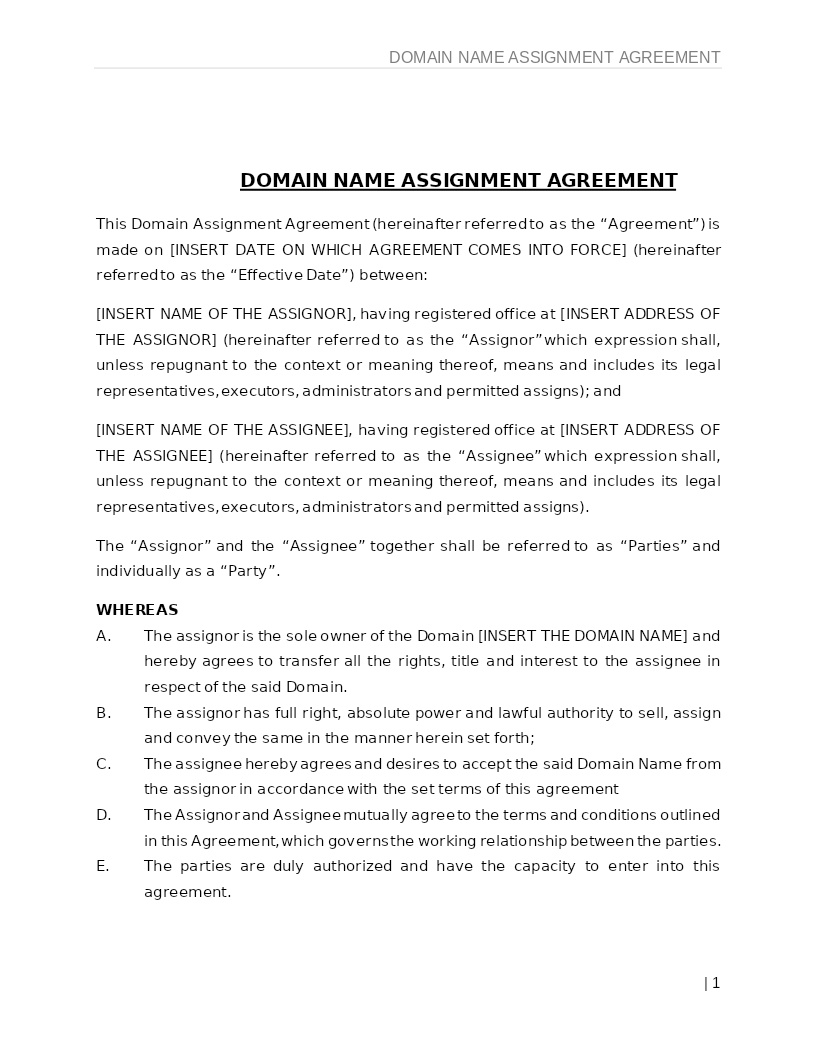
DOMAIN NAME ASSIGNMENT AGREEMENT
How does it work?
1. Choose this template
Start by clicking on "Fill out the template"
2. Complete the document
Answer a few questions and your document is created automatically.
3. Save - Print
Your document is ready! You will receive it in Word and PDF formats. You will be able to modify it.
Ensuring Clear, Secure, and Legally Protected Ownership Transfers Through Domain Name Assignment Agreements
A Domain Name Assignment Agreement is a legally binding contract that transfers full ownership rights of a domain name from the current holder (assignor) to a new owner (assignee). In the United States, this agreement is essential for documenting the transfer, protecting both parties from future disputes, and ensuring that the buyer receives uncontested rights to the domain.
A well-drafted Domain Name Assignment Agreement outlines the purchase price (if applicable), transfer process, warranties, responsibilities, and post-transfer obligations. Businesses rely on this agreement to secure domain names tied to their brand identity, digital presence, and online operations, preventing unauthorized claims or fraudulent transfers. It serves as a legal record that supports registrar updates, DNS changes, and ownership verification.
Where Domain Name Assignment Agreements Are Commonly Used
Domain Name Assignment Agreements are widely used across the U.S. digital and business landscape, including:
- Startups acquiring domain names for new brand launches
- Businesses purchasing premium, aged, or keyword-rich domain names
- Companies undergoing rebranding or expansion
- Mergers and acquisitions involving website assets
- Transfers between partners, agencies, freelancers, or subsidiaries
- Sale of online businesses or e-commerce stores
- Resolution of domain ownership disputes or settlements
Any situation involving the sale, transfer, or reassignment of a domain name benefits from a clear, enforceable Domain Name Assignment Agreement.
Different Types of Domain Name Assignments You May Encounter
- Asset Purchase Domain Assignment: Used when a domain is transferred as part of a larger asset sale, such as an online store, website, or digital business acquisition. The domain is one of several assets being acquired.
- Standalone Domain Name Transfer: A simple, direct transfer of ownership from one party to another, often involving a negotiated purchase price. Common for premium domains or brand-related names.
- Internal or Intra-Company Transfer: Occurs when a domain is moved between related entities, subsidiaries, or organizational divisions for operational or rebranding's purposes.
- Domain Assignment in Settlement or Dispute Resolution: Used when a domain is transferred as part of a legal settlement involving trademark disputes, cybersquatting claims, or business conflicts.
- Registrar-Assisted Transfer: Involves coordination with domain registrars or marketplaces (e.g., GoDaddy, Namecheap, Escrow.com) to complete the ownership verification and secure transfer process.
Each type ensures that the rights are properly assigned, the transfer is documented, and the new owner gains full control.
When Legal Guidance Becomes Helpful
Domain transfers may seem simple, but legal risks can arise when:
- The domain is tied to trademarks, copyrights, or brand identities
- There are competing claims or unclear ownership history
- The domain was previously used for business operations involving liabilities
- A high-value or premium domain is being sold
- The parties require escrow, payment protection, or verification of authenticity
- The domain is related to regulated industries (finance, healthcare, legal)
- Cross-border transfers involve jurisdictional considerations
Legal review ensures compliance with U.S. contract law, protects against fraud, and provides clarity around warranties, indemnities, and long-term rights.
How to Work With This Template
- Identify both parties and confirm ownership of the domain
- Specify the exact domain(s) being transferred
- Outline the purchase price, payment method, and escrow terms
- Include warranties regarding ownership, clear title, and no claims
- Add indemnification clauses protecting the buyer from past disputes
- Detail the transfer process, registrar actions, and DNS changes
- Choose governing U.S. state law and dispute resolution method
- Sign electronically or in physical form, both enforceable under U.S. law
This template aligns with common U.S. digital asset transfer practices and supports secure, verifiable domain transactions.
Frequently Asked Questions
Q1. Why is a Domain Name Assignment Agreement important in the U.S.?
A Domain Name Assignment Agreement ensures the new owner receives full, uncontested rights to the domain. It documents the transfer, protects both parties from ownership disputes, and provides clear proof for registrars, escrow services, and future buyers.
Q2. What key terms should a Domain Name Assignment Agreement include?
Essential terms include the domain name(s), purchase price, warranties of ownership, indemnities, transfer procedures, and responsibilities after the sale. These elements protect against fraud, trademark conflicts, and unclear ownership history.
Q3. Does this agreement prove who legally owns a domain?
Yes. A properly executed agreement acts as a legal record of ownership transfer and can be used to resolve registrar conflicts, respond to legal claims, or verify ownership in future transactions.
Q4. What happens if a domain has legal issues or past disputes?
The agreement typically includes warranties confirming the domain is free from claims, liens, or violations. Indemnification clauses protect the buyer from liabilities tied to past use, reducing risk during and after the transfer.
Q5. Are electronic signatures valid for domain transfer agreements?
Yes. Under the ESIGN Act and UETA, electronic signatures are fully enforceable. Most digital transfers are completed with e-signatures and supported by escrow or registrar verification.
Q6. Can this agreement be used for domains purchased from marketplaces?
Absolutely. Whether the domain is purchased privately or through platforms like GoDaddy Auctions, Sedo, or Escrow.com, a Domain Name Assignment Agreement adds an extra layer of legal protection and clarity.
Q7. Does the agreement include responsibility for DNS updates and hosting changes?
Yes. The agreement outlines who handles technical steps, such as updating DNS records or transferring hosting, to ensure a smooth transition without downtime.