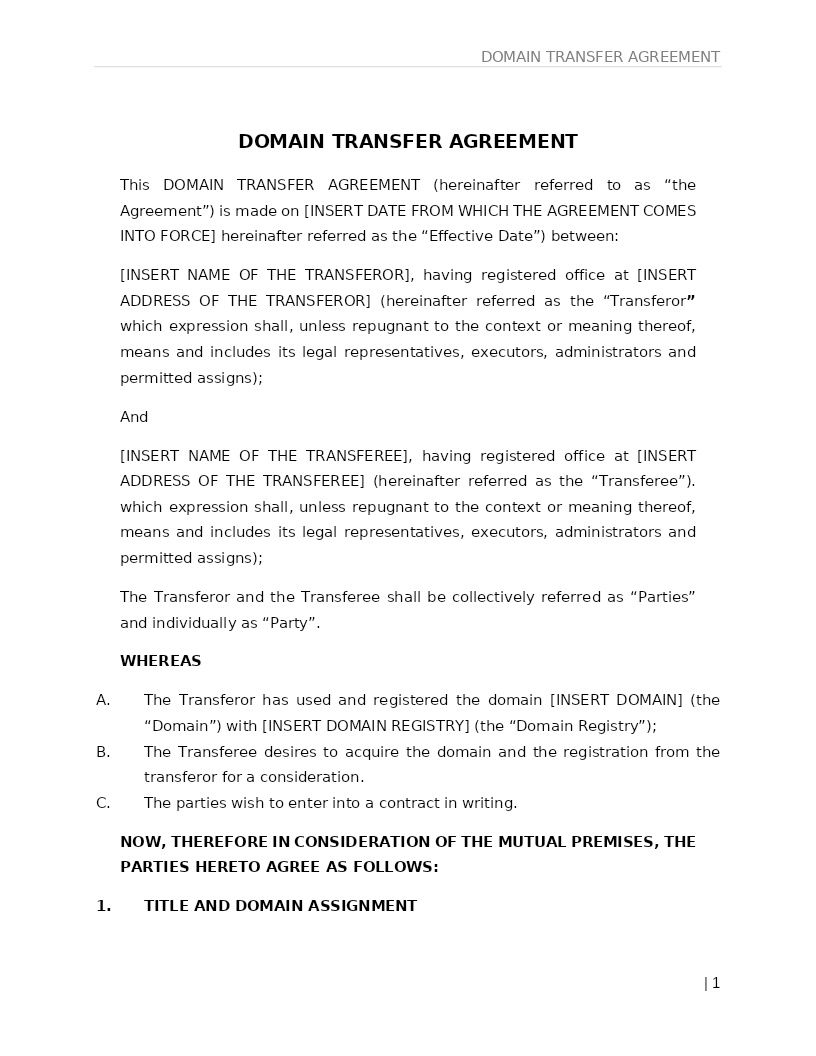
DOMAIN TRANSFER AGREEMENT
How does it work?
1. Choose this template
Start by clicking on "Fill out the template"
2. Complete the document
Answer a few questions and your document is created automatically.
3. Save - Print
Your document is ready! You will receive it in Word and PDF formats. You will be able to modify it.
Understanding Domain Transfer Agreements
A Domain Transfer Agreement is a legally binding contract that outlines the terms under which ownership and control of an internet domain name are transferred from one party (the “Seller” or “Transferor”) to another (the “Buyer” or “Transferee”). This agreement defines the domain being transferred, payment terms, representations and warranties, transfer procedures, rights to associated digital assets, and post-transfer obligations.
In the United States, domain transfers are governed by contract law, ICANN rules, registrar transfer policies, intellectual property laws, and consumer protection regulations. This agreement provides clarity, prevents fraud, and ensures that both parties comply with the technical and legal requirements for a valid domain transfer.
Where Domain Transfer Agreements Are Commonly Used
Domain Transfer Agreements are widely used across digital and commercial environments, especially where domain ownership impacts branding, online presence, or digital business activities. They are commonly used for:
- Purchase and sale of premium or high-value domain names
- Transfers during mergers, acquisitions, or rebranding
- Moving domains between business partners or co-founders
- Startups acquiring domain rights from third parties
- Transferring domains associated with trademarks or digital assets
- Freelancers, designers, and developers handing over domains to clients
- Digital real estate transactions and online business transfers
Any time domain ownership changes hands, a Domain Transfer Agreement ensures a secure and legally protected transfer.
Different Types of Domain Transfers You May Encounter
- Registrar-to-Registrar Transfer: Moving a domain from one accredited registrar to another.
- Owner-to-Owner Transfer: Changing the registered owner while keeping the same registrar.
- Business Asset Transfer: Domain transfer as part of a business purchase, website sale, or IP acquisition.
- Internal Organization Transfer: Assignment of domains between departments, subsidiaries, or related entities.
When Legal Guidance Becomes Helpful
Legal assistance is recommended when:
- The domain is tied to trademarks, copyrighted content, or brand assets
- The transfer involves high-value or premium domain names
- The domain is part of a larger sale of digital assets or an online business
- There are concerns about cybersquatting, IP infringement, or fraud
- The buyer requires warranties ensuring clean title and valid ownership
- The transfer includes associated email accounts, hosting, or content
- The parties need clarity regarding escrow or secure payment processes
Legal review ensures compliance with ICANN rules and protects both parties during a sensitive digital asset transfer.
How to Work with This Template
- Identify the Transferor and Transferee, including contact details
- Clearly state the domain name(s) being transferred
- Specify purchase price, payment method, and escrow requirements
- Describe the technical steps required to complete the transfer
- Include warranties of ownership, non-infringement, and authority to transfer
- Address intellectual property and related digital assets, if applicable
- Choose governing U.S. state law
- Add provisions for disputes, indemnification, and liability limitations
- Sign electronically or physically, in accordance with U.S. contract rules
This template aligns with common domain-transfer industry practices and works with all major e-signature platforms.
Frequently Asked Questions
Q1. What is a Domain Transfer Agreement and why is it important?
A Domain Transfer Agreement outlines the terms for transferring ownership of a domain name. It is important because it protects both parties by confirming payment terms, ownership rights, warranties, and the steps needed for a valid transfer under U.S. and ICANN rules.
Q2. Are Domain Transfer Agreements legally enforceable in the U.S.?
Yes. These agreements are enforceable under state contract law and must comply with ICANN and registrar transfer requirements. A written agreement reduces the risk of disputes or fraudulent transfers.
Q3. What should be included in a Domain Transfer Agreement?
A strong agreement includes the domain name, purchase terms, transfer instructions, warranties of ownership, escrow procedures, liability limitations, and intellectual property rights associated with the domain.
Q4. How long does a domain transfer take?
Most domain transfers take a few hours to several days, depending on the registrar’s verification steps and whether the transfer authorization code (EPP code) is provided promptly.
Q5. Do domain transfers require an escrow service?
For high-value or commercial domains, escrow is recommended for secure payment processing. Escrow services protect both parties by holding funds until the transfer is successfully completed.
Q6. Does a domain transfer include website content or business assets?
Not automatically. The agreement must explicitly state whether the transfer includes website files, branding, email accounts, hosting, trademarks, or other digital assets. Otherwise, only the domain name itself is transferred.
Q7. Can a domain with an active trademark be transferred?
Yes, but care is required. If the domain is linked to a registered trademark, the agreement should clarify the rights being transferred and confirm that the transfer does not infringe on third-party IP rights.
Q8. What happens if the Transferor does not actually own the domain?
The agreement typically requires the Transferor to provide warranties of valid ownership. If they breach this warranty, the Buyer may pursue legal remedies, including refunds, damages, or cancellation.
Q9. Are electronic signatures valid for Domain Transfer Agreements?
Yes. Under the U.S. ESIGN Act, electronic signatures are legally enforceable. Many parties use Docu Sign or similar platforms for fast and secure execution.
Q10. Is a Domain Transfer Agreement necessary for small or inexpensive domains?
Yes. Even low-cost domains can create disputes if ownership, payment terms, or transfer steps are unclear. A written agreement ensures transparency and protects both parties’ rights.