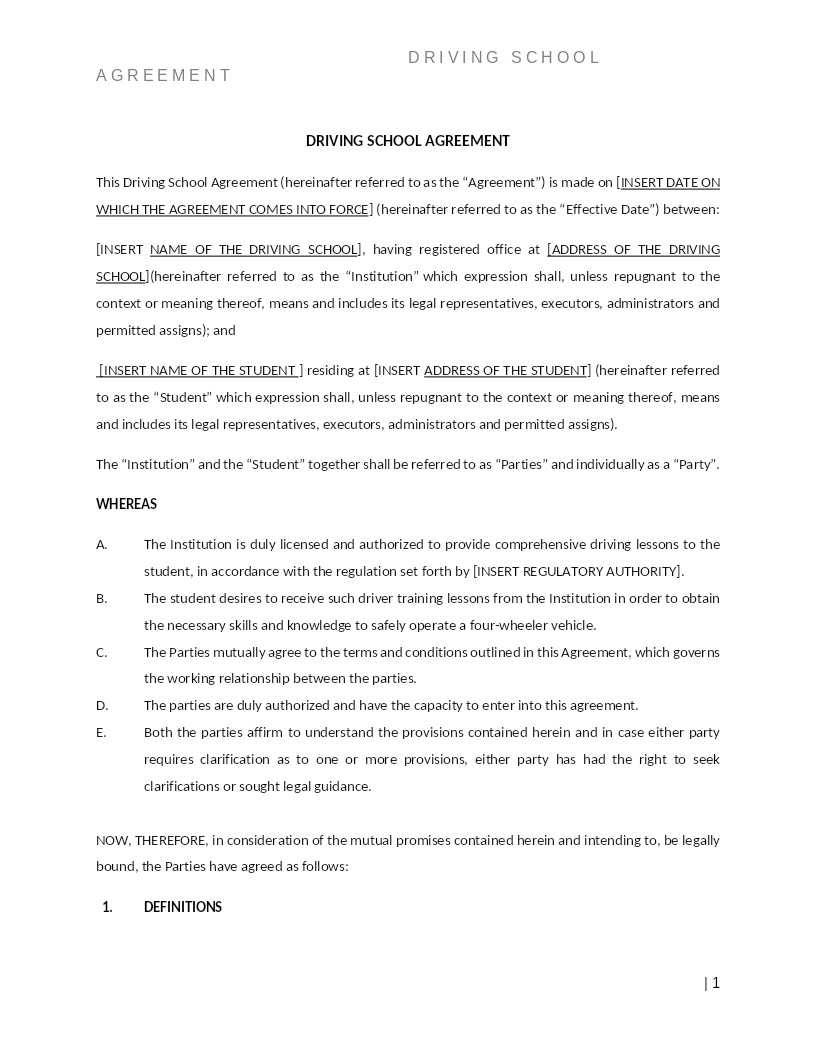
DRIVING SCHOOL AGREEMENT
How does it work?
1. Choose this template
Start by clicking on "Fill out the template"
2. Complete the document
Answer a few questions and your document is created automatically.
3. Save - Print
Your document is ready! You will receive it in Word and PDF formats. You will be able to modify it.
Understanding Driving School Agreements
A Driving School Agreement is a legally binding contract between a driving school (the “Service Provider”) and a student or parent/guardian (the “Client”) that outlines the terms and conditions for providing driving lessons, training sessions, road test preparation, and educational instruction. This agreement establishes service expectations, tuition fees, scheduling rules, cancellation policies, instructor responsibilities, safety requirements, and compliance with U.S. state driving regulations.
In the United States, Driving School Agreements operate under state motor vehicle laws, Department of Motor Vehicles (DMV) regulations, traffic safety standards, consumer protection laws, and liability guidelines. The agreement ensures transparency between the driving school and the student, protecting both parties throughout the training process.
Where Driving School Agreements Are Commonly Used
Driving School Agreements are widely used across the driver training and education industry, including:
- Teen driving programs and high-school driver education
- Adult learner driving courses
- Private driving lessons and behind-the-wheel instruction
- Commercial driver’s license (CDL) training
- Road test preparation and evaluation sessions
- Online or hybrid driver education programs
- Defensive driving and safety certification courses
- Disabled driver accommodation training
Any time a driving school provides structured instruction, this agreement ensures clear communication and legal protection.
Different Types of Driving School Programs You May Encounter
- Beginner Driver Training: For new drivers needing foundational skills and DMV-mandated hours.
- Behind-the-Wheel Training: Hands-on instruction on public roads with certified instructors.
- Online Driver Education: Digital courses approved by state DMVs for licensing requirements.
- Teen Driver Programs: Structured programs designed for minors, requiring parental consent.
- Adult or Refresher Training: Lessons for inexperienced adults or drivers needing skill updates.
- Commercial Driver (CDL) Training: Professional truck, bus, or commercial vehicle training under DOT rules.
When Legal Guidance Becomes Helpful
Legal review is recommended when:
- The school must comply with specific state licensing or DMV requirements
- The student is a minor needing parental consent
- The training involves commercial driver instruction or federal DOT standards
- The agreement includes liability waivers or insurance provisions
- The program includes third-party testing, vehicle usage, or on-road assessments
- Refund, rescheduling, or cancellation policies must meet consumer protection laws
- The school uses telematics, dash-cams, or GPS monitoring in training vehicles
Legal oversight ensures the agreement remains compliant with U.S. laws and reduces risk for both the school and the student.
How to Work with This Template
- Identify the driving school and the student (or parent/guardian)
- Outline training hours, lesson structure, and curriculum expectations
- Specify tuition, fees, refunds, and payment schedules
- Define vehicle requirements, instructor qualifications, and safety procedures
- Include attendance rules, cancellation policies, and rescheduling terms
- Add liability limitations, insurance disclosures, and DMV compliance obligations
- Choose the governing state law
- Sign electronically or in hard copy according to state contract requirements
This template follows standard U.S. driving school policies and is compatible with major e-signature platforms.
Frequently Asked Questions
Q1. What is a Driving School Agreement and why is it important?
A Driving School Agreement outlines the terms for receiving driving lessons or road training. It is important because it ensures both the student and the school understand expectations regarding scheduling, fees, safety requirements, and compliance with state driving laws.
Q2. Is a Driving School Agreement legally enforceable in the U.S.?
Yes. These agreements are enforceable under state contract law and must comply with DMV rules, safety regulations, and consumer protection standards. A written agreement protects both the student and the school.
Q3. What should be included in a Driving School Agreement?
A comprehensive agreement includes training hours, curriculum details, instructor qualifications, payment terms, cancellation policies, vehicle use rules, liability limitations, and compliance requirements.
Q4. Do driving schools need to follow state laws?
Absolutely. Each state regulates driver education programs, instructor certifications, training hours, and road test preparation requirements. The agreement helps ensure compliance with these rules.
Q5. Are parents involved in teen driving programs?
Yes. Most states require parental consent for minors. The agreement outlines parental responsibilities, supervision expectations, and communication procedures.
Q6. What happens if a student cancels or misses a lesson?
Policies vary by school. Many agreements include cancellation fees, rescheduling rules, or requirements for advance notice. Clear terms help avoid misunderstandings.
Q7. Are students covered by insurance during training?
Driving schools generally carry insurance for instructional vehicles and liability coverage. The agreement describes insurance obligations and limitations to ensure safety and transparency.
Q8. Can the driving school guarantee a passing score on the road test?
No. No school can legally guarantee a pass. However, the agreement may include test preparation, mock tests, or skill assessments to improve student readiness.
Q9. Are electronic signatures valid for Driving School Agreements?
Yes. Under the U.S. ESIGN Act, electronic signatures are legally valid and widely used for student enrollment and onboarding.
Q10. Is a Driving School Agreement useful for short-term or one-time lessons?
Yes. Even single lessons benefit from a written agreement to clarify expectations, fees, safety responsibilities, and state-mandated training standards.