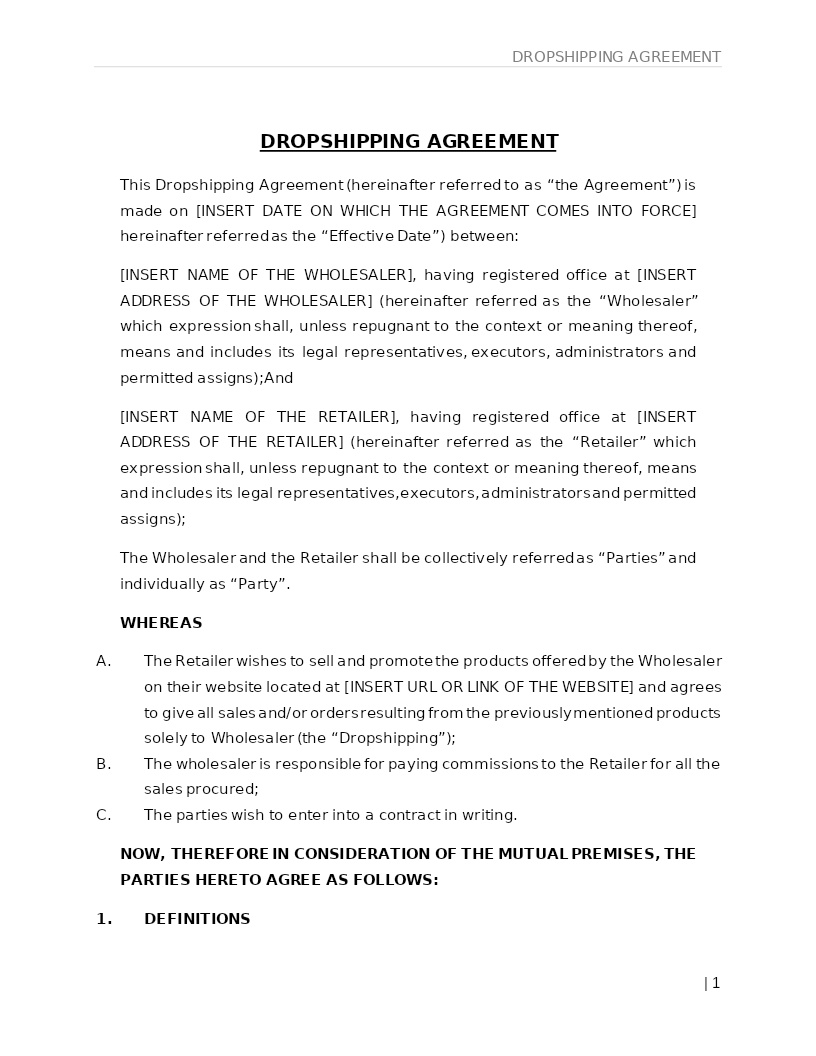
DROPSHIPPING AGREEMENT
How does it work?
1. Choose this template
Start by clicking on "Fill out the template"
2. Complete the document
Answer a few questions and your document is created automatically.
3. Save - Print
Your document is ready! You will receive it in Word and PDF formats. You will be able to modify it.
Ensures a clear and secure business relationship by protecting parties and customer expectations
In the e-commerce industry, businesses often rely on third-party suppliers, manufacturers, or wholesalers to store, package, and ship products directly to the end consumer. A Dropshipping agreement provides the legal framework governing this relationship. It sets out the rights, obligations, service expectations, and operational standards that apply when a retailer markets products but the supplier fulfills and dispatches orders on the retailer’s behalf.
This Agreement establishes clear rules regarding order processing, inventory management, product quality, shipping timelines, customer service obligations, payment terms, returns and refunds, intellectual property rights, and data protection. It protects the retailer by ensuring that the dropshipping supplier handles inventory, packaging, and delivery in accordance with agreed standards, and it protects the supplier by defining limitations on liability, reseller conduct, and the authorized use of product information and marketing content.
Dropshipping agreements are widely used in online retail, platform-based commerce, direct-to-consumer businesses, white-label product sales, and marketplace environments where delivery is outsourced to a third party. Whenever a retailer depends on a supplier to perform core fulfilment functions, a written Dropshipping Agreement ensures legal compliance, operational consistency, and commercial stability.
Where Dropshipping Agreements Are Commonly Used
A Dropshipping Agreement is typically implemented in situations such as:
- E-commerce retailers partnering with wholesalers or distributors
- Online stores selling products managed and stored by third-party suppliers
- Marketplace sellers using fulfilment partners for shipping
- Brands engaging manufacturers to deliver white-label or private-label goods
- Influencers or content creators selling merchandise without holding inventory
- Subscription box or curated-product businesses relying on supply partners
- International sellers shipping directly from overseas warehouses
In all such cases, a Dropshipping Agreement ensures that each party understands its role in product fulfillment and customer satisfaction.
Types of Dropshipping Agreements
1. Standard Dropshipping Agreement: Covers general supply, order handling, and shipping expectations.
2. Private-Label Dropshipping Agreement: Used when the supplier provides products under the retailer’s branding.
3. Print-on-Demand Dropshipping Agreement: Covers personalized or made-to-order products.
4. Marketplace-Compliant Dropshipping Agreement: Designed for sellers operating on Amazon, Shopify, eBay, etc., with platform-specific rules.
5. International Dropshipping Agreement: Addresses customs, duties, cross-border regulations, and global shipping.
When Legal Guidance Becomes Helpful
Legal assistance is particularly useful when:
- Products are shipped internationally
- Goods involve regulatory compliance (cosmetics, supplements, electronics, toys)
- The retailer relies heavily on the supplier’s accuracy and timelines. Payment terms, margins, or refund policies are complex
- Customer data is shared with the supplier
- Intellectual property rights (branding, designs, packaging) are involved
- Liability for defective, delayed, or damaged goods is unclear
A well-drafted Dropshipping Agreement minimizes financial risk, reputational harm, and customer disputes.
How to Work With This Template
- Identify the retailer and the dropshipping supplier
- Define product categories, quality standards, and order fulfillment procedures
- Establish pricing, payment schedules, and inventory responsibilities
- Specify shipping timelines, carriers, and tracking requirements
- Outline return, refund, and warranty processes
- Include data privacy, intellectual property, and confidentiality clauses
- Set governing law and dispute resolution procedures
- Sign electronically or in hard copy
Frequently asked questions (FAQs)
Q1. What is the primary purpose of a Dropshipping Agreement?
The purpose of this agreement is to establish a legally enforceable understanding between the retailer and the supplier regarding:
- handles inventory,
- who fulfils customer orders,
- who bears the risk of product defects or shipment delays,
- what service levels must be met, and
- how payments, refunds, and returns will work.
Without this Agreement, retailers risk customer complaints, chargebacks, platform penalties, and legal exposure due to supplier errors, while suppliers risk unauthorized resale or misuse of product information.
Q2. Does the Agreement create an exclusive relationship?
Not automatically. Unless expressly stated, the supplier may work with multiple retailers, and the retailer may source products from different suppliers. It must be clearly stated whether it is intended to be territorial, product-based, or platform-based.
Q3. Who is responsible for fulfillment errors or delayed shipments?
This depends on the agreement. Typically the supplier is responsible for packing errors, wrong product shipped, poor packaging, late dispatch, and stock shortages, among other things. The responsibility of retailer includes looking for for incorrect customer information, inaccurate orders submitted and misrepresenting products to customers
Clear responsibility allocation avoids disputes and protects the retailer’s reputation.
Q4. Do dropshipping suppliers have confidentiality obligations?
Yes. Suppliers often access sensitive data, including customer shipping information, sales volumes, pricing strategies, marketing assets, and proprietary product designs (for private-label goods). A confidentiality clause similar to that in an NDA prevents unauthorized use or disclosure of this information.
Q5. How are returns and refunds handled?
There are three common models:
1. The supplier accepts returns directly and refunds the retailer.
2. The retailer accepts returns and sends items back to the supplier.
3. The supplier issues refunds without requiring returns for low-value or non-resalable items.
The Agreement must specify who pays return shipping, how quickly refunds must be issued, which products qualify for returns, warranty terms, and defect procedures.
Q6. Can the retailer set its own pricing?
Usually yes. Retailers typically control retail prices, but some suppliers impose MAP (Minimum Advertised Price Policies), restrictions against extreme price inflation, and platform-specific pricing requirements. Failure to comply may lead to termination of supply rights.
Q7. Who owns the intellectual property (IP) associated with the products?
Suppliers typically own product trademarks, product images, and manufacturing designs. Retailers own their store branding, marketing content they create, and private-label marks, if applicable. The Agreement must prohibit unauthorized use of IP by either party and define licensing rights.
Q8. What happens if the supplier runs out of inventory?
The Agreement may require the supplier to:
- Provide real-time stock updates,
- Notify the retailer immediately of shortages.
- offer substitute products,
- Prioritize restocking based on demand.
If the supplier frequently runs out of stock, the retailer may face penalties on marketplaces, making clear inventory obligations essential.
Q9. Is the supplier responsible for product defects or legal compliance?
Yes. Suppliers are usually responsible for ensuring that products comply with applicable regulations (safety, labeling, certifications), meet quality standards, and are free from defects. Retailers may still share legal liability under consumer protection laws, so the agreement should include warranties and indemnification clauses.
Q10. Who bears liability for lost or damaged shipments?
Typically the supplier bears liability until the package is handed to the carrier. The carrier bears liability during transit. The retailer must resolve customer complaints, but the supplier may reimburse costs. The Agreement should align liability rules with shipping carriers’ policies.
Q11. Can the supplier contact the retailer’s customers?
Usually no. Dropshipping suppliers must not market products to the retailer’s customers, include promotional material in packages, disclose their identity to the customer, or solicit reviews or direct orders. Violation is considered a breach of confidentiality and relationship boundaries.
Q12. How is customer data protected?
A compliant Dropshipping Agreement must include data processing restrictions, confidentiality obligations, permitted-use limitations, data disposal requirements.
compliance with privacy laws (GDPR, CCPA, etc.). Customer data may only be used for fulfilling the order.
Q13. Can either party terminate the agreement at any time?
Most agreements allow termination for convenience (with notice), for breach, for regulatory or platform compliance violations, or if the supplier fails to meet service standards. Upon termination, outstanding orders must still be fulfilled unless otherwise stated.
Q14. How are disputes between the retailer and supplier resolved?
Dispute resolution typically includes negotiation, mediation, arbitration, jurisdiction, and governing law provisions. Retailers selling internationally often prefer arbitration to avoid cross-border litigation.
Q15. What should be done if the supplier changes product specifications or pricing?
The Agreement should require advance written notice, a defined notice period (15–45 days), retailer approval for material changes, and return/refund rights for outdated products. Sudden changes can harm customer trust and platform rating