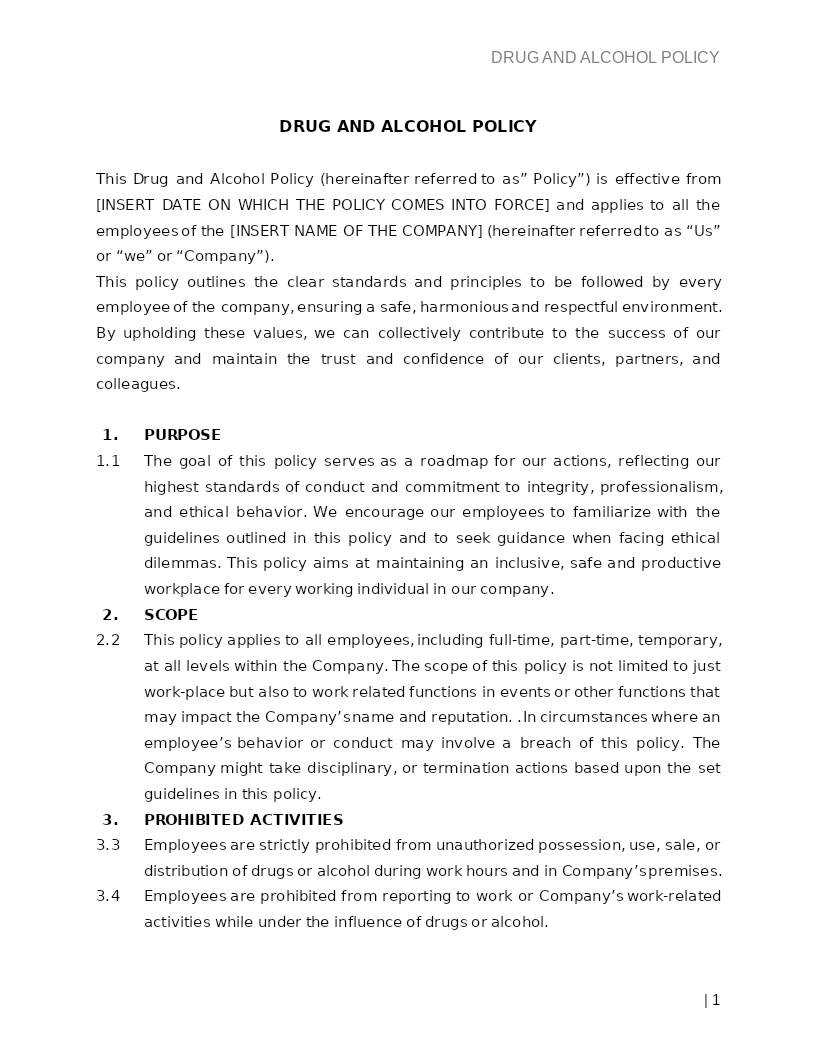
DRUG AND ALCOHOL POLICY
How does it work?
1. Choose this template
Start by clicking on "Fill out the template"
2. Complete the document
Answer a few questions and your document is created automatically.
3. Save - Print
Your document is ready! You will receive it in Word and PDF formats. You will be able to modify it.
Promoting Workplace Safety and Legal Compliance Through a Drug and Alcohol Policy
A Drug and Alcohol Policy is a formal organizational directive that establishes rules, procedures, and expectations governing the possession, use, testing, and prohibition of drugs and alcohol in the workplace. Developed in accordance with U.S. federal and state laws, including the Drug-Free Workplace Act, Department of Transportation (DOT) drug and alcohol testing regulations, Occupational Safety and Health Administration (OSHA) safety standards, the Controlled Substances Act, and relevant state cannabis laws, this policy ensures that employees understand their obligations to maintain sobriety and safe conduct while performing job duties. The policy outlines the company’s commitment to providing a safe, healthy, and productive work environment and defines prohibited substances, testing protocols, disciplinary consequences, employee-assistance options, and confidentiality protections.
A comprehensive Drug and Alcohol Policy identifies the types of prohibited conduct, including the use, possession, sale, manufacture, or distribution of illegal drugs, controlled substances, or unauthorized alcohol on company premises or during work hours. It further identifies circumstances requiring drug or alcohol testing—such as pre-employment screenings, reasonable-suspicion testing, post-accident testing, random selection in safety-sensitive positions, and return-to-duty verification. The policy outlines the legal process for handling positive results, employee rights, medical explanations, and the use of certified laboratories consistent with federal testing standards. Additionally, the policy describes procedures for accommodating employees lawfully using prescribed medications, balancing workplace safety with anti-discrimination obligations under the ADA. By implementing this policy, organizations minimize risk, prevent workplace accidents, reduce liability exposure, and maintain a compliant, safety-focused workplace culture.
Where Drug and Alcohol Policies Are Commonly Used
Drug and Alcohol Policies are implemented across a wide range of industries, including:
- Transportation, trucking, aviation, and maritime sectors regulated by DOT
- Construction, manufacturing, and industrial workplaces with high safety risks
- Healthcare organizations responsible for patient safety and regulatory compliance
- Retail, hospitality, and service industries where employees interact with customers
- Corporate offices with workforce productivity and professional conduct concerns
- Government contractors required to maintain drug-free workplaces
- Educational institutions managing student, staff, and facility safety
- Nonprofits and community-service organizations providing vulnerable-population care
Any organization committed to maintaining a safe workplace environment benefits from a clearly drafted Drug and Alcohol Policy.
Different Types of Drug and Alcohol Policies You May Encounter
1. Drug-Free Workplace Policies: Prohibit all unlawful drug and alcohol use and may be required for federal contractors.
2. DOT-Regulated Drug and Alcohol Testing Policies: Apply to safety-sensitive transportation employees and have strict federal testing rules.
3. Reasonable Suspicion and Post-Accident Testing Policies: Authorize testing when impairment is suspected or after work-related incidents.
4. Random Drug Testing Policies: Used in safety-sensitive environments to ensure compliance and deter substance use.
5. Medical and Prescription Drug Policies: Address lawful medication use, disclosure requirements, and safety protocols.
When Legal Guidance Becomes Helpful
Legal review is strongly recommended when:
Drug testing is conducted, as state laws vary widely on permissible testing practices
- Employees work in DOT-regulated positions requiring federally mandated testing
- Cannabis is legalized at the state level, creating conflict with federal laws
- Terminations involve alleged substance use and could trigger wrongful-dismissal claims
- Policies intersect with ADA accommodations for prescribed medications
- The company intends to conduct searches or investigations involving employee property
- Confidential medical information must be handled under HIPAA or privacy laws
Legal counsel ensures compliance with U.S. employment, privacy, and safety laws, reducing liability and ensuring enforceability.
How to Work with This Template
- Define prohibited substances, including illegal drugs, unauthorized alcohol, and controlled substances
- Outline testing procedures, including pre-employment, post-accident, random, and reasonable-suspicion testing
- Specify employee rights, confidentiality protections, and laboratory testing standards
- Establish expectations for lawful use of prescription medications
- Identify safety-sensitive roles requiring strict impairment rules
- Detail consequences for violations, including discipline or termination
- Describe reporting and documentation procedures for supervisors
- Provide guidelines for employee assistance programs (EAPs) and rehabilitation
- Address compliance with federal and state cannabis and drug-testing laws
- Require acknowledgment by employees confirming their understanding of the policy
- Update the policy regularly to reflect evolving legal standards and workplace needs
This template reflects best practices for drug and alcohol management within U.S. workplaces.
Frequently Asked Questions
Q1. What is a Drug and Alcohol Policy, and why is it important?
A Drug and Alcohol Policy establishes rules about substance use in the workplace. It is important because it protects employee safety, reduces accidents, ensures regulatory compliance, and strengthens organizational accountability.
Q2. Does this policy prohibit cannabis use?
Cannabis remains illegal under federal law, but some states protect off-duty use. The policy must be tailored to state-specific cannabis rules while still prohibiting impairment during work.
Q3. Are employers allowed to conduct drug testing?
Yes. Employers may conduct drug testing consistent with state laws, federal regulations, and DOT requirements for safety-sensitive positions.
Q4. What happens if an employee fails a drug or alcohol test?
Consequences may include disciplinary action, mandatory rehabilitation, removal from duty, or termination, depending on applicable laws and company policy.
Q5. Are prescription medications allowed?
Yes, when taken lawfully and safely. Employees may need to inform the employer if a medication affects their ability to perform essential job functions.
Q6. Are drug and alcohol test results confidential?
Absolutely. Results must be handled in accordance with privacy laws and stored separately from general personnel files.
Q7. Can employees be terminated for off-duty substance use?
It depends on state law and job function. Safety-sensitive and federally regulated positions often have stricter rules.
Q8. Does the policy apply to remote workers?
Yes. Employees working from home must remain fit for duty and free from impairment during work hours.
Q9. Can an employee refuse a drug test?
Refusal may result in disciplinary action and, in DOT environments, is treated as a test failure.
Q10. Should legal counsel review this policy?
Yes. Due to varying state laws and complex federal mandates, legal review is strongly recommended to ensure compliance.