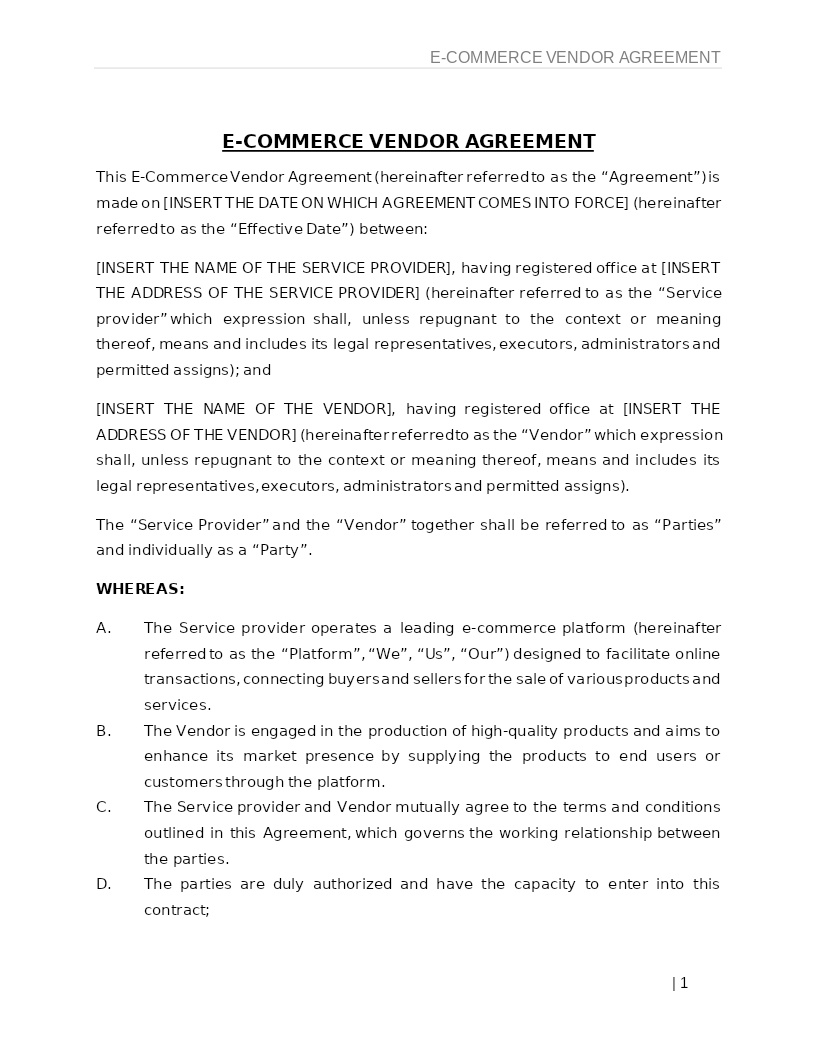
E-COMMERCE VENDOR AGREEMENT
How does it work?
1. Choose this template
Start by clicking on "Fill out the template"
2. Complete the document
Answer a few questions and your document is created automatically.
3. Save - Print
Your document is ready! You will receive it in Word and PDF formats. You will be able to modify it.
Ensures operational clarity, legal compliance, and accountability on a digital platform
In today’s digital marketplace, businesses frequently collaborate with third-party sellers, service providers, and brands to list products, manage catalogs, and fulfill orders on online platforms. Such engagements require a clearly defined legal framework to regulate how goods will be listed, how transactions will be processed, and how obligations will be allocated. An E-Commerce Vendor Agreement provides that structure and framework for the parties. It clearly defines the terms under which a vendor may sell products or services through an online marketplace, the standards they must comply with, the rights and controls on the platform, and the restrictions placed on the vendor’s conduct.
Putting an e-commerce vendor agreement in place creates a trusted environment that allows platforms and vendors to operate seamlessly. It outlines the rules for product listings, pricing, inventory accuracy, payment settlement, customer service responsibilities, intellectual property protections, and compliance with consumer protection laws. By specifying what a vendor may and may not do on the platform, the agreement helps prevent unauthorized listings, counterfeit products, unfair practices, or misuse of platform systems.
These agreements are widely used by online marketplaces, retail platforms, aggregator businesses, multi-seller websites, and app-based e-commerce environments. Whenever products or services are offered for sale through a digital platform owned by another entity, an E-Commerce Vendor Agreement ensures operational clarity, legal compliance, and accountability.
Where E-Commerce Vendor Agreements Are Commonly Used
Vendor agreements are standard across a broad range of commercial situations, including:
- Marketplace onboarding for sellers on large e-commerce platforms
- Drop-shipping, reseller, or affiliate product arrangements
- Brand-authorized listings and supply partnerships
- Aggregator platforms hosting multiple independent Vendors
- Marketplace-based distribution of digital products or services
- Subscription-based or storefront-based online selling models
- Fulfilment-by-platform or hybrid shipping arrangements
- White-label or private-label online product sales
Any time a vendor lists goods or services on a platform they do not own, the vendor agreement sets boundaries around what they must and must not do.
Different Types of E-Commerce Vendor Agreements You May Encounter
- Standard Vendor Agreement: Used for onboarding general sellers on a marketplace or retail platform
- Exclusive Vendor or Brand Partnership Agreement: Provides one vendor with exclusive rights to supply, distribute, or list certain products on the platform.
- Drop-Ship Vendor Agreement: Used when the vendor ships directly to the customer while the platform handles order intake.
- Marketplace Service Agreement: Governance for vendors using platform services such as fulfillment, storage, advertisement, or logistics.
- Digital Products Vendor Agreement: Tailored for vendors offering software, courses, subscriptions, or virtual items.
When Legal Guidance Becomes Helpful
Most routine vendor onboarding may not require extensive legal involvement, but professional review becomes crucial when:
- The Vendor deals with regulated goods (health, cosmetics, food, pharmaceuticals)
- The Vendor uses trademarks, copyrighted materials, or proprietary branding
- Cross-border logistics, customs, or taxation apply
- Complex payment, refund, or commission structures exist
- The agreement includes penalties, performance benchmarks, or exclusivity
- The platform requires strong indemnities or liability caps
- Customer data is shared or accessed by the vendor
- Local consumer protection or e-commerce laws impose strict compliance obligations
Professional legal guidance reduces risk when transactions involve significant volume, global shipping, or reputational exposure.
How to Work With This Template
- Identify the parties (platform and vendor).
- Clearly state the scope of permitted listings and product categories
- Define quality standards, compliance obligations, and product authenticity requirements
- Specify pricing, commission structures, payout cycles, and settlement rules
- Set forth customer service expectations, return/refund policies, and dispute processes
- Detail intellectual property protections and restrictions against counterfeit goods
- Select the governing law and jurisdiction
- Review terms jointly (legal review strongly recommended)
- Execute electronically or in physical form
This template aligns with widely recognized e-commerce and commercial contracting standards.
Frequently Asked Questions
1. Is a vendor agreement necessary for selling on an online marketplace?
Yes. It defines the rights and responsibilities of both the vendor and the platform and protects each party from unauthorized conduct.
2. Can the same vendor agreement be reused for multiple sellers?
Yes, platforms commonly use a standard agreement, but it must be updated to reflect the vendor’s identity and category of products.
3. What if a vendor refuses to accept the terms?
The platform should restrict listing access until the vendor agrees to comply with essential rules and safeguards.
4. Are electronic signatures enforceable?
Yes. E-signatures are legally binding under federal and state laws.
5. Does the Vendor Agreement protect the platform from counterfeit products?
Yes. It typically includes strong authenticity requirements, indemnity clauses, and rights to remove or penalize violating vendors.
6. Can vendors sell regulated products under this agreement?
Only if explicitly permitted and compliant with applicable laws and certifications.
7. How long does a vendor agreement remain effective?
For the duration of the vendor’s active presence on the platform, subject to termination clauses.
8. Is this agreement suitable for both physical and digital products?
Yes. It may be customized to govern physical goods, services, digital content, and subscription-based offerings.
9. What happens if a vendor breaches the agreement?
The platform may suspend, delist, or terminate the vendor’s account and may pursue damages or other remedies.
10. Are verbal assurances between the vendor and the platform enforceable?
Only if incorporated into the written agreement. Written terms always prevail.
11. Does the agreement control pricing and discounting?
Yes, the platform may impose rules on pricing accuracy, MRP, discount policies, and promotional participation.
12. Can the vendor appoint sub-vendors or agents?
Only if explicitly permitted in the agreement; otherwise, listings must be directly controlled by the vendor.
13. Is this valid for vendors in different states or countries?
Yes. A governing law clause and cross-border compliance terms address jurisdictional differences.
14. What if new products or categories are added later?
These may be included through written notices, updated schedules, or revised vendor listings.
15. Must the vendor bind its employees or packers to the agreement?
Yes. Vendors must ensure that their employees, shippers, and subcontractors comply with obligations equivalent to those in the Vendor Agreement.