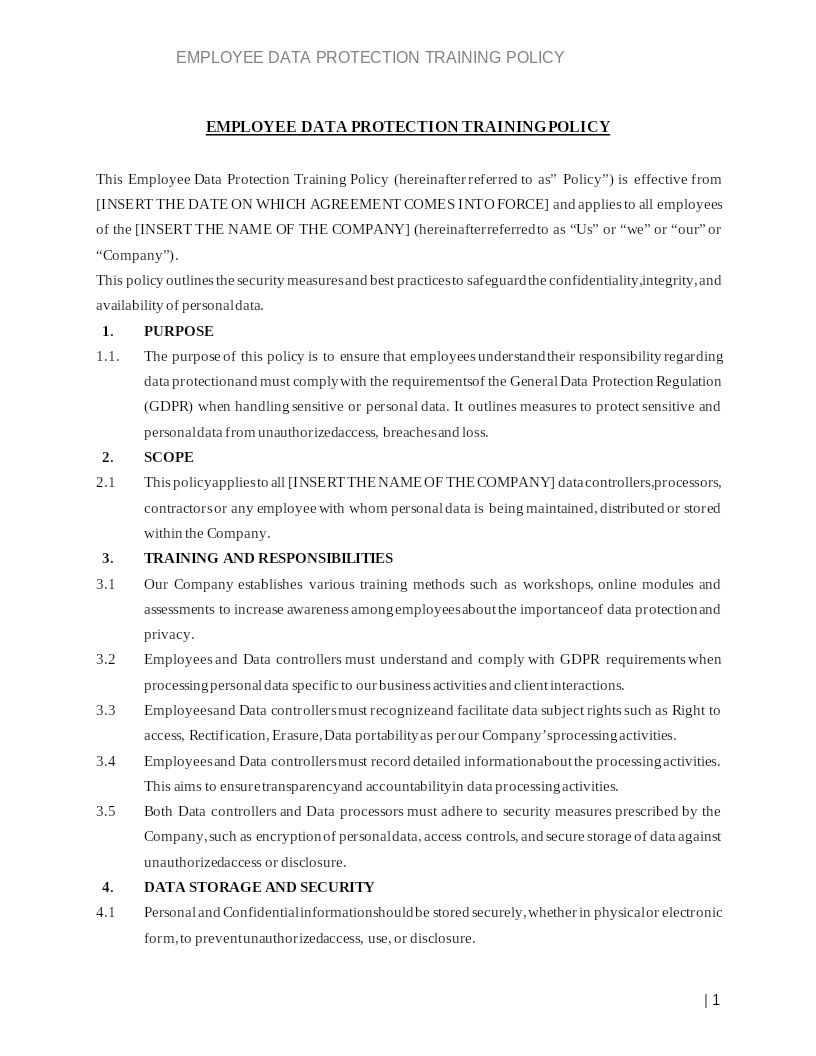
EMPLOYEE DATA PROTECTION POLICY
How does it work?
1. Choose this template
Start by clicking on "Fill out the template"
2. Complete the document
Answer a few questions and your document is created automatically.
3. Save - Print
Your document is ready! You will receive it in Word and PDF formats. You will be able to modify it.
Why an Employee Data Protection Training Policy Matters
When employees handle personal data whether customer information, internal HR files, financial documents, or confidential business records it becomes essential to have clear standards for protecting that data. An Employee Data Protection Training Policy establishes the expectations, training requirements, and behavioral guidelines that ensure employees understand how to handle sensitive information securely and lawfully.
This policy creates a framework that helps companies comply with U.S. privacy laws, such as applicable state data protection acts, federal regulations, and industry-specific standards. It supports stronger data governance, reduces the risk of unauthorized disclosure, and strengthens trust with clients, partners, and internal teams.
Where Employee Data Protection Training Policies Are Commonly Used
Organizations across nearly all industries rely on these policies, including:
- Businesses handling customer data, billing information, or marketing lists
- Technology companies managing user accounts and digital platforms
- Healthcare organizations handling regulated patient information
- Financial institutions, lenders, and insurance companies
- HR departments responsible for sensitive employee data
- E-commerce platforms and online service providers
- Any company subject to compliance audits or privacy regulatory requirements
Anytime employees access or store sensitive or personal information, a structured training policy helps ensure they are handling it responsibly and in compliance with applicable laws.
Different Types of Data Protection Training You May Encounter
- General Data Privacy Training: Covers basic responsibilities, handling of personal data, and organizational policies.
- Role-Based Data Training: Tailored for employees in finance, HR, IT, sales, or operations handling specialized data.
- Cybersecurity Awareness Training: Focuses on phishing, secure passwords, device protection, and incident reporting.
- Compliance-Specific Training: Links company practices to U.S. laws and standards such as HIPAA, GLBA, FERPA, state privacy laws, or industry frameworks.
- Advanced Technical Training: Used for IT staff managing systems, encryption, access controls, and secure storage.
When Legal Guidance Becomes Helpful
Professional advice is valuable when:
- Employees handle regulated or highly sensitive information
- The organization must align with federal or state privacy regulations
- The policy supports compliance for audits, certifications, or government requirements
- Employees access international data subject to cross-border restrictions
- The company faces cybersecurity risks or prior data incidents
- The policy includes disciplinary actions for misuse or negligence
Legal review ensures the training program reflects industry standards and current privacy requirements.
How to Work with This Template
- Identify which employees require mandatory training
- Outline the key training topics and frequency
- Specify responsibilities for HR, IT, and department heads
- Choose the governing U.S. state law
- Include reporting, documentation, and compliance procedures
- Provide guidance for incident reporting and escalation
- Sign electronically or in hard copy when acknowledgment is required
This template follows widely recognized U.S. privacy standards and is compatible with major e-signature platforms.
Frequently Asked Questions
Q1. Why is employee data protection training necessary?
Training ensures employees understand how to handle personal and sensitive data properly. It reduces risks of data breaches, maintains compliance with privacy laws, and promotes responsible workplace behavior.
Q2. How often should employees receive data protection training?
Many companies conduct training annually, with additional sessions for new employees or when policies or laws change. Frequent refreshers help reinforce good practices.
Q3. Does this policy apply only to employees?
No. Contractors, temporary workers, interns, and anyone with access to company data should be included to maintain consistent data protection standards.
Q4. What topics are usually included?
Typical topics include secure data handling, access controls, password security, phishing awareness, confidentiality rules, device protection, and incident reporting procedures.
Q5. Are electronic signatures valid for training acknowledgments?
Yes. Under U.S. e-signature laws, electronic acknowledgments are enforceable and commonly used during onboarding or annual compliance training.
Q6. Does this policy help with legal compliance?
Yes. It supports compliance with U.S. privacy regulations and industry standards by documenting that employees have been trained in proper data-handling practices.
Q7. What happens if an employee violates data protection rules?
The policy typically outlines consequences such as retraining, disciplinary action, or access restrictions. Serious violations may require further action depending on company procedures and legal requirements.
Q8. Is remote employee training covered?
Yes. Remote and hybrid employees should receive the same training, often through virtual modules or e-learning platforms.
Q9. Can this policy be customized for different departments?
Absolutely. Many organizations create role-specific modules to address unique risks in HR, IT, finance, or customer service.
Q10. Does training include incident reporting procedures?
Yes. Employees must know how to quickly report suspected data breaches or security concerns so the organization can respond promptly.