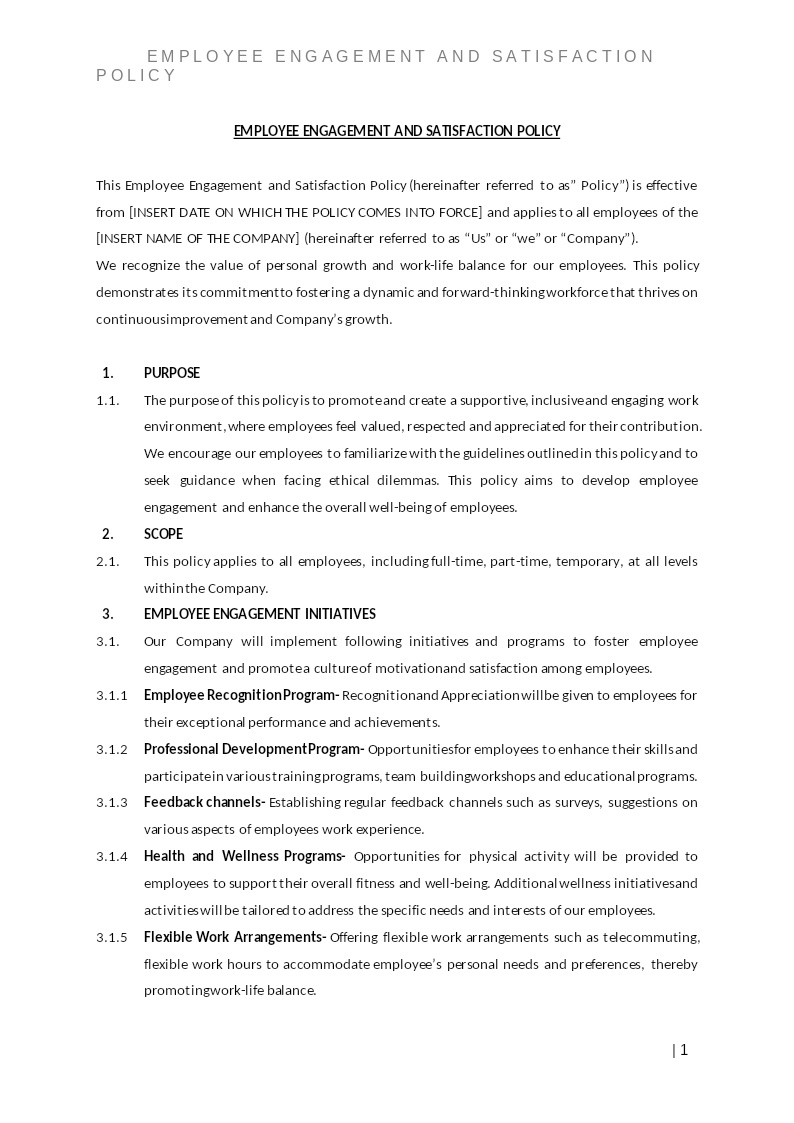
EMPLOYEE ENGAGEMENT AND SATISFACTION POLICY
How does it work?
1. Choose this template
Start by clicking on "Fill out the template"
2. Complete the document
Answer a few questions and your document is created automatically.
3. Save - Print
Your document is ready! You will receive it in Word and PDF formats. You will be able to modify it.
Promoting Employee Engagement and Workplace Satisfaction in U.S. Organizations
An Employee Engagement and Satisfaction Policy establish a structured approach for how an organization motivates its workforce, supports employee well-being, and cultivates a positive and productive work culture. It outlines the standards, initiatives, rights, and expectations that guide the relationship between employees and the employer throughout their tenure.
Having a defined policy allows companies to build trust, promote transparent communication, and create an environment where employees feel valued, heard, and empowered to contribute meaningfully to organizational goals.
Where Employee Engagement & Satisfaction Policies Are Commonly Implemented
Structured engagement policies are widely used across U.S. organizations, including:
- Corporate workplaces, law firms, consulting companies, and financial institutions
- Hospitals, educational institutions, and non-profit organizations
- Manufacturing units, logistics companies, and industrial facilities
- Tech companies, startups, and digital service providers
- Government bodies, public agencies, and large-scale administrative offices
Any time an organization relies on people as its primary operational engine, a clear engagement and satisfaction framework establishes consistency, fairness, and a high-performance culture.
Different Types of Employee Engagement & Satisfaction Initiatives You May Encounter
- Well-Being and Work-Life Balance Programs: Initiatives that promote mental health, flexible schedules, wellness benefits, and stress-management practices.
- Performance and Recognition Programs: Systems for celebrating achievements, rewarding excellence, and encouraging consistent performance.
- Training and Professional Development Programs: Opportunities that provide upskilling, mentorship, cross-functional exposure, and career advancement pathways.
- Feedback and Communication Mechanisms: Structured systems like surveys, suggestion channels, town halls, and review cycles that help employees voice concerns and share input.
- Culture-Building and Inclusion Programs: Programs that encourage diversity, team building, open communication, and a respectful workplace environment.
When Legal Guidance Becomes Helpful
Although most engagement policies are operational tools rather than legal instruments, real-time lawyer or in-house counsel support becomes valuable when organizations:
- Implement company-wide standards that intersect with state or federal employment laws
- Manage multi-state workforces with varying labor regulations
- Wish to align engagement policies with wage laws, employee rights, or union considerations
- Handle sensitive issues such as employee grievances, harassment reporting, disciplinary processes, and protected leaves
- Develop benefits programs that must comply with ERISA, FMLA, ADA, OSHA, or state-level workplace mandates
- Operate in highly regulated sectors such as healthcare, education, government, or finance
Legal review ensures that engagement initiatives are fair, enforceable, and compliant with applicable U.S. regulations.
How to Work with This Template
- Identify the departments and employee groups covered under the policy
- Define the purpose, vision, and cultural goals of engagement initiatives
- Outline employee rights, available programs, support systems, and communication channels
- Specify responsibilities of managers, HR teams, and leadership
- Align the policy with U.S. labor laws and internal HR governance
- Review the terms collaboratively with HR and legal teams
- Implement digitally, share with staff, and integrate into onboarding systems
This policy template follows widely accepted HR standards across the United States and is compatible with digital workflow and document-management systems.
Frequently Asked Questions
Q1. Why is an Employee Engagement and Satisfaction Policy important for U.S. companies?
A structured engagement policy helps U.S. employers maintain a motivated, productive workforce while reducing turnover and workplace disputes. It ensures fairness, clarifies expectations, and supports consistent employee experience across departments. When the policy is well-designed, it improves morale, reduces burnout, and strengthens long-term retention strategies.
Q2. Does this policy help improve workplace productivity and performance?
Yes. Engaged employees are more proactive, committed, and aligned with the organization's mission. A formal policy outlines recognition programs, performance feedback systems, and motivation-driven initiatives that directly enhance daily output. By improving communication and support systems, companies see measurable improvements in efficiency and work quality.
Q3. Can this policy address remote or hybrid work environments?
Absolutely. U.S. companies increasingly rely on remote and hybrid models, and engagement policies help define expectations, communication protocols, and performance standards for distributed teams. The policy can include virtual wellness programs, flexible scheduling, and tools for maintaining connection across locations. This ensures a consistent employee experience regardless of physical workspace.
Q4. Does an Employee Engagement & Satisfaction Policy support legal compliance?
Yes. While engagement frameworks are primarily cultural tools, they often intersect with employment regulations such as FMLA, ADA, anti-discrimination laws, and health and safety rules. When the policy is reviewed by legal counsel, it helps reduce compliance risks and ensures that employee practices align with federal and state mandates. This enhances organizational protection and operational integrity.
Q5. How does this policy improve employee retention?
A well-designed engagement policy improves career satisfaction through recognition programs, mentorship opportunities, growth pathways, and transparent communication. When employees feel valued and supported, they are more likely to remain loyal to the organization. Reducing turnover also saves U.S. employers significant recruitment and training costs over the long term.
Q6. Can the policy be tailored for different departments or job roles?
Yes. Organizations often customize engagement initiatives based on departmental needs, risk exposure, and the intensity of workload. For example, frontline teams may require wellness and fatigue-management programs, while corporate roles may benefit from leadership development or flexible scheduling. Customization ensures that all employees receive relevant, meaningful support.
Q7. What happens if employees do not follow engagement or conduct expectations?
The policy can include a clear, legally compliant escalation process for addressing misconduct, lack of participation, or disruption of workplace culture. This may involve counseling, performance reviews, corrective action, or HR intervention. Having a consistent and transparent structure ensures that all employees are treated fairly and expectations remain uniform across the organization.
Q8. Is this policy suitable for small businesses and startups?
Yes. Employee engagement frameworks are highly beneficial for smaller U.S. companies that want to build strong culture early. A clear policy helps streamline communication, define expectations, and maintain motivation within small teams. It also positions the business as a competitive employer, helping attract talent in a crowded market.