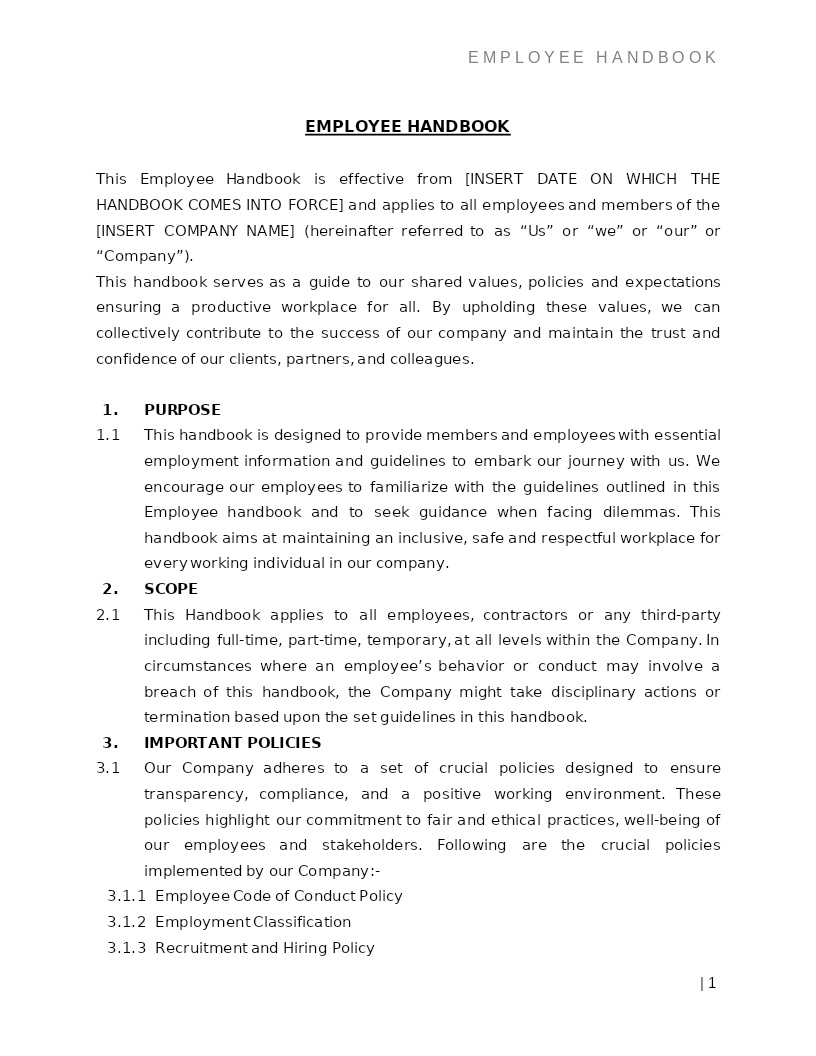
EMPLOYEE HANDBOOK
How does it work?
1. Choose this template
Start by clicking on "Fill out the template"
2. Complete the document
Answer a few questions and your document is created automatically.
3. Save - Print
Your document is ready! You will receive it in Word and PDF formats. You will be able to modify it.
Understanding the Purpose of an Employee Handbook
When employees join an organization, they need a clear, dependable framework that outlines workplace expectations, cultural values, and operational procedures. An Employee Handbook provides that structure. It defines the company's policies, conduct standards, benefits information, performance expectations, and the rights and responsibilities of both the employer and the employee.
Having a handbook in place ensures consistency, promotes transparency, and helps employees understand how the organization functions. It serves as a trusted reference point for resolving questions, navigating workplace concerns, and supporting compliance with company rules and legal obligations.
Where Employee Handbooks Are Commonly Used
Employee handbooks are standard across a wide range of industries and employment settings, including:
- Corporate offices, startups, and professional service firms
- Retail, hospitality, manufacturing, and warehouse environments
- Healthcare organizations, educational institutions, and nonprofits
- Hybrid, remote, or multi-state workforce environments
- Growing companies formalizing their HR processes and compliance frameworks
- Organizations with diverse teams that require uniform policies
Any time a business manages employees under one set of rules, an employee handbook becomes the cornerstone of workplace communication.
Different Types of Employee Handbooks You May Encounter
- General Employee Handbook: Covers broad company-wide policies such as attendance, conduct, benefits, and workplace expectations.
- Industry-Specific Handbook: Tailored for sectors like healthcare, technology, retail, or construction where specialized rules apply.
- Compliance-Focused Handbook: Centers around legal standards, workplace safety, discrimination prevention, and regulatory obligations.
- Remote or Hybrid Workforce Handbook: Designed for companies with flexible work arrangements, covering virtual conduct, remote security, and communication rules.
- New Hire Orientation Handbook: A simplified version given to new employees to help them quickly adapt to workplace culture and operational norms.
When Legal Guidance Becomes Helpful
Although many organizations can draft basic handbooks internally, legal input becomes important when:
- Policies involve federal or state labor laws, including FLSA, OSHA, ADA, or anti-discrimination rules
- The company operates across multiple states with differing legal requirements
- Workplace privacy, data protection, or digital-monitoring practices are included
- Employees work with sensitive information or intellectual property
- The handbook governs disciplinary actions, performance reviews, or termination procedures
- Unionized or heavily regulated industries require specialized language
- The organization seeks protection against wrongful termination or harassment claims
Legal review ensures the handbook is enforceable, compliant, and tailored to the organization's operational and regulatory environment.
How to Work with This Template
- Identify the policies, behaviors, and procedures employees must follow
- Customize sections regarding conduct, communication, benefits, and discipline
- Integrate federal and state legal requirements that apply to your workforce
- Align handbook language with internal HR practices and company culture
- Review final content with HR and legal teams to ensure compliance and clarity
- Distribute the handbook, train employees on its use, and obtain written acknowledgment
This template follows widely recognized U.S. workplace standards and is suitable for organizations of all sizes and industries.
Frequently Asked Questions
Q1. What is an Employee Handbook and why is it important?
An Employee Handbook is a written guide that outlines workplace rules, company values, procedures, and employee expectations. It helps employees understand their rights, responsibilities, and available benefits. A clear handbook improves communication and reduces confusion. It also reinforces a consistent and professional workplace culture.
Q2. Does an Employee Handbook protect the company legally?
Yes. A handbook documents policies related to conduct, discrimination prevention, leave rights, and workplace safety. This offers protection by proving that employees were informed of company standards. While it is not a contract, it can help prevent disputes and reduce liability. Properly drafted handbooks support compliance with U.S. employment laws.
Q3. What topics should be included in an Employee Handbook?
Common sections include attendance rules, code of conduct, nondiscrimination policies, anti-harassment standards, safety procedures, benefits, leave policies, and performance expectations. Depending on the industry, additional sections may cover confidentiality, remote-work rules, or equipment use. A comprehensive handbook helps employees navigate workplace processes with ease.
Q4. Can an Employee Handbook improve workplace culture?
Absolutely. A handbook communicates company values, teamwork standards, and behavioral expectations, which directly shape workplace culture. It helps employees understand how to interact professionally and respectfully. This clarity fosters collaboration and reduces conflicts. A strong handbook strengthens the environment for long-term retention.
Q5. Is legal review necessary before distributing an Employee Handbook?
Although not required, legal review is highly recommended. Employment laws vary by state, and companies must ensure their policies comply with federal regulations. Lawyers can verify that the handbook does not contain unlawful or unenforceable terms. This reduces risk and ensures the handbook accurately reflects the company’s obligations.
Q6. How often should an Employee Handbook be updated?
Handbooks should be reviewed annually or whenever legal, operational, or cultural changes occur. Updates may be needed due to new labor laws, evolving workplace technology, or changing company policies. Regular reviews keep the handbook current and effective. Employees should always receive updated versions promptly.
Q7. Is the Employee Handbook useful for remote or hybrid teams?
Yes. Modern handbooks include guidelines for remote communication, flexible scheduling, cybersecurity, and virtual meeting etiquette. Clear remote-work policies ensure fairness and productivity across different work arrangements. They also help maintain accountability and alignment with company goals.
Q8. Do employees need to sign acknowledgment of the handbook?
Yes. A signed acknowledgment confirms that employees received, read, and understood the handbook. This protects the employer by demonstrating informed consent to workplace policies. It also encourages employees to take the handbook seriously. Most companies keep acknowledgment forms in personnel files for compliance purposes.