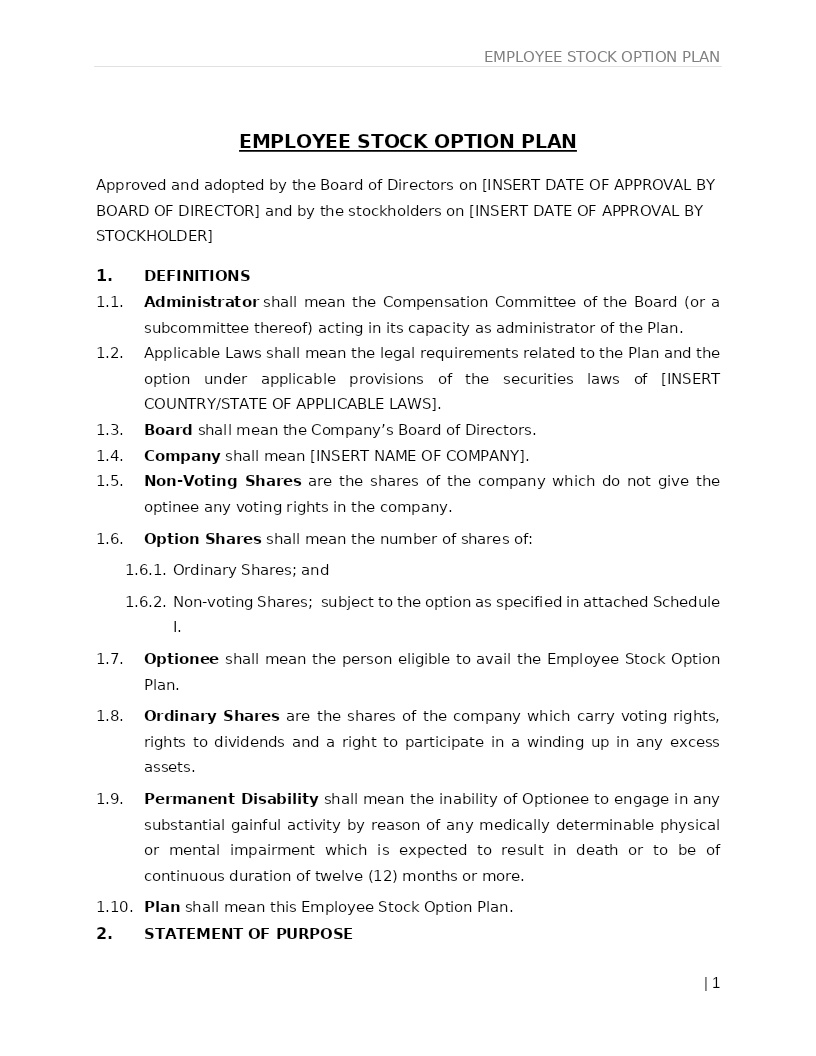
EMPLOYEE STOCK OPTION PLAN
How does it work?
1. Choose this template
Start by clicking on "Fill out the template"
2. Complete the document
Answer a few questions and your document is created automatically.
3. Save - Print
Your document is ready! You will receive it in Word and PDF formats. You will be able to modify it.
Providing for Employee Equity Participation under U.S. Corporate and Tax Laws
Employee ownership has become a critical tool for U.S. companies aiming to enhance employee engagement, retain top talent, improve productivity, and create long-term wealth-building opportunities. Employee Stock Ownership, often administered through an Employee Stock Ownership Plan (ESOP) or equity grant program, offers employees an ownership interest in the company through shares of stock, stock options, or equity-based incentives.
Under U.S. law, ESOPs are governed primarily by the Employee Retirement Income Security Act of 1974 (ERISA) and the Internal Revenue Code (IRC), which establish strict fiduciary rules, tax advantages, reporting obligations, and protections for participating employees. Employee ownership arrangements may also be implemented through stock option agreements, restricted stock units (RSUs), profit-sharing plans, or direct share purchase programs not classified as ERISA plans.
An Employee Stock Ownership structure ensures that employees have a financial stake in the company’s success, while employers benefit from improved retention, stronger workplace morale, tax incentives, and a succession planning mechanism. For companies exploring a sale or transition, ESOPs may also function as a long-term ownership strategy that rewards employees while preserving the legacy of the business.
Where Employee Stock Ownership Arrangements Are Commonly Used
Employee stock ownership is widely utilized in various organizational settings in the United States, including:
- Privately held companies adopting ESOPs for succession planning
- Startups offering stock options or RSUs to attract and retain talent
- Public companies granting equity as part of compensation packages
- Family-owned businesses transitioning ownership to employees
- Corporations using equity incentives to align employee and shareholder interests
- Professional services firms (tech, consulting, engineering) with equity-based compensation
- Growth-stage companies compensating employees when cash flow is limited
Any U.S. business seeking long-term retention, ownership transition, and employee investment in organizational performance may adopt an employee ownership structure.
Different Types of Employee Stock Ownership You May Encounter
- Employee Stock Ownership Plan (ESOP): A retirement plan under ERISA that invests primarily in employer stock.
- Stock Option Agreements (ISOs or NSOs): Allow employees to purchase company stock at a predetermined price.
- Restricted Stock Units (RSUs): Equity awarded subject to vesting conditions, common in public companies and tech startups.
- Employee Stock Purchase Plans (ESPPs): Enable employees to buy stock through payroll deductions, often at a discount.
- Phantom Stock or Stock Appreciation Rights (SARs): Provide cash or share-based payments tied to the increase in stock value.
- Direct Share Grants: Outright issuance of equity, typically in early-stage companies.
When Legal Guidance Becomes Helpful
Legal counsel is especially important when:
- Establishing an ESOP in compliance with ERISA, DOL rules, and IRS regulations
- Structuring equity plans that meet U.S. tax rules for qualified and non-qualified options
- Creating vesting schedules, exercise terms, and repurchase rights
- Transitioning ownership during succession planning or corporate restructuring
- Ensuring fair valuation of company stock (required annually for ESOPs)
- Drafting equity award agreements and employee communications
- Addressing securities law compliance under the Securities Act of 1933 and Rule 701
- Managing dilution, capitalization tables, and voting rights
Legal support ensures compliance, protects the business from regulatory risk, and offers employees clear and enforceable rights.
How to Work With This Template
- Identify the type of stock ownership program (ESOP, options, RSUs, ESPP, etc.)
- Specify eligibility, vesting schedules, and conditions for participation
- Clarify employee rights, limitations, and forfeiture rules
- Outline tax implications under U.S. federal and state law
- Address valuation procedures, repurchase rights, and distribution rules
- Provide termination, retirement, or separation provisions
- Include confidentiality, non-solicitation, and intellectual property protections if relevant
- Ensure compliance with ERISA, IRS requirements, and securities regulations
- Execute electronically or in writing
This structure aligns with U.S. employment, tax, and securities law standards.
Frequently Asked Questions
Q1. What is Employee Stock Ownership in the United States?
Employee Stock Ownership refers to programs that allow U.S. employees to acquire an ownership interest in their employer through stock, stock options, RSUs, or an ESOP. These programs give employees financial participation in company growth, profit-sharing, and long-term wealth accumulation. ESOPs are subject to ERISA and offer significant tax advantages for both employers and employees.
Q2. What is an ESOP and how does it work?
An Employee Stock Ownership Plan (ESOP) is a qualified retirement plan under ERISA that holds employer stock in a trust for employees.
Key features include:
• Employer contributions (not employee-funded)
• Annual stock valuation by an independent appraiser
• Vesting schedules for employee ownership
• Special tax benefits for owners selling to an ESOP
• Tax-deductible employer contributions
ESOPs are commonly used as a succession planning tool for U.S. privately held companies.
Q3. How do stock options differ from restricted stock units (RSUs)?
Stock Options allow employees to buy company stock at a fixed price (the strike price). Options may increase in value if the company grows.
RSUs are promises to deliver shares once vesting is satisfied—no purchase required.
Options can expire worthless if the stock price falls; RSUs retain value unless forfeited.
Q4. What are the tax implications for employee stock ownership?
U.S. tax treatment varies by equity type:
• ISOs (Incentive Stock Options) – potential long-term capital gains if holding requirements are met.
• NSOs (Non-Qualified Stock Options) – ordinary income tax at exercise.
• RSUs – taxed as ordinary income upon vesting.
• ESOP distributions – tax-deferred until withdrawal; potential rollover options.
• ESPPs – may receive favorable tax treatment depending on the plan design.
Employees should consult tax advisors for individualized advice.
Q5. Can employees sell their shares anytime?
It depends on the program:
• ESOPs generally offer a repurchase mechanism governed by ERISA rules.
• Private-company stock options or RSUs may be subject to restrictions until a liquidity event.
• Public-company grants may include blackout periods or trading windows.
The Agreement should specify transfer restrictions, resale rights, and holding requirements.
Q6. Are employees guaranteed voting rights with stock ownership?
Not always. ESOP participants have limited voting rights (unless holding allocated shares in a C corporation with major corporate actions). Stock option and RSU holders typically gain voting rights only after shares are issued, and phantom stock does not confer voting rights. The ownership plan must clearly outline employee voting and governance rights.
Q7. Is employee stock ownership suitable for small businesses?
Yes. Employee stock programs, especially ESOPs and option grants, are widely used by small and mid-sized U.S. companies to support growth, retention, and succession planning. ESOPs offer tax advantages and can help business owners exit while rewarding employees.
Q8. What happens to employee stock if the employee resigns or is terminated?
The outcome depends on plan terms. Unvested equity is typically forfeited, while vested options may be exercisable for a limited post-termination period (commonly 30–90 days). ESOP participants retain vested balances, subject to distribution schedules, and RSUs may accelerate or lapse depending on employment agreements. Clear forfeiture rules help avoid disputes.
Q9. Does offering equity dilute ownership of existing shareholders?
Yes, issuing new shares generally dilutes ownership percentages.
Companies manage dilution by creating equity pools, using buyback rights, adjusting capitalization tables, and applying controlled issuance schedules. Legal and financial planning ensures fairness for all stakeholders.
Q10. Are equity awards enforceable if granted electronically?
Yes. Under the ESIGN Act and UETA, equity grant agreements and ESOP documents executed electronically are legally enforceable throughout the United States, provided the system reliably captures consent and records.