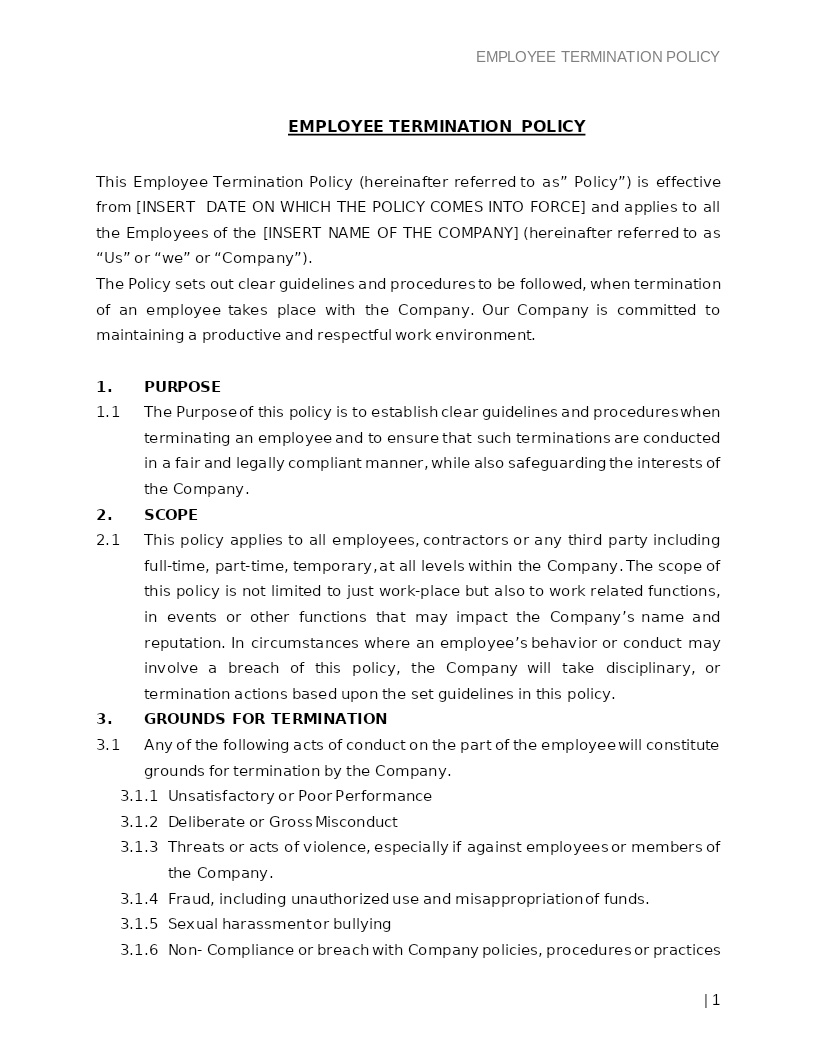
EMPLOYEE TERMINATION POLICY
How does it work?
1. Choose this template
Start by clicking on "Fill out the template"
2. Complete the document
Answer a few questions and your document is created automatically.
3. Save - Print
Your document is ready! You will receive it in Word and PDF formats. You will be able to modify it.
Ensuring Fairness and Legal Compliance Through an Employee Termination Policy
An Employee Termination Policy is a comprehensive organizational directive that outlines the standards, procedures, and legal requirements governing the separation of an employee from employment. Developed in accordance with U.S. employment laws and relevant state regulations, this policy establishes a transparent, consistent, and legally compliant framework for ending employment relationships whether voluntary or involuntary. The policy defines the various forms of termination, including resignation, layoff, reduction in force, termination for cause, and termination without cause, and it clarifies employer obligations regarding notice requirements, final wage payments, benefits continuation, return of company property, and documentation. It also reinforces the organization’s commitment to fairness, nondiscrimination, and due process in accordance with EEOC-enforced laws, ensuring that all termination decisions are based on legitimate business reasons and applied uniformly across the workforce.
A detailed Employee Termination Policy describes the procedural steps that supervisors and managers must follow before initiating a termination, including performance evaluations, disciplinary documentation, corrective-action opportunities, and consultation with Human Resources or legal counsel when appropriate. It outlines how investigations should be conducted in cases involving misconduct, harassment, insubordination, policy violations, or workplace safety issues, ensuring that decisions are made based on factual evidence and legally defensible processes. The policy further establishes guidelines for conducting termination meetings, notifying employees of separation decisions, administering final paychecks in compliance with state-specific deadlines, and providing separation documents such as COBRA notices, unemployment information, and severance agreements where applicable. By implementing this policy, organizations protect themselves from wrongful termination claims, preserve workplace integrity, and maintain compliance with federal and state employment laws.
Where Employee Termination Policies Are Commonly Used
Employee Termination Policies are essential across all sectors, including:
- Corporate offices and large enterprises with hierarchical supervision structures
- Retail, hospitality, and service industries with high employee turnover
- Healthcare and clinical environments with strict compliance requirements
- Manufacturing, logistics, and industrial operations involving safety-sensitive roles
- Government contractors and regulated entities subject to federal oversight
- Technology companies managing proprietary information and intellectual property
- Educational institutions employing academic and administrative personnel
- Nonprofits with grant-funded positions and reporting obligations
Any organization employing workers benefits from a clearly drafted Employee Termination Policy.
Different Types of Employee Termination Policies
1. At-Will Termination Policies: Reflect most U.S. states’ presumption of at-will employment, allowing termination without cause.
2. Progressive Discipline Termination Policies: Require a structured process of warnings and corrective actions before termination.
3. Immediate Termination Policies: Apply to severe misconduct such as violence, theft, harassment, or safety violations.
4. Layoff and Reduction-in-Force Policies: Define procedures for business-driven separations based on operational needs.
5. Contractual Termination Policies: Apply where written employment agreements specify grounds and notice requirements.
When Legal Guidance Becomes Helpful
Legal counsel should be consulted when:
- Termination circumstances involve discrimination, retaliation, or harassment claims
- Employees request accommodations under the ADA or leave under the FMLA
- Reductions in force may trigger WARN Act notice obligations
- Employees work under union contracts or collective bargaining agreements
- Sensitive investigations involve misconduct, confidentiality breaches, or criminal acts
- Departing employees handle regulated information such as HIPAA or financial data
- The organization offers severance agreements requiring legal enforceability
- State laws affect final wage deadlines or accrued paid-time-off payout rules
Legal review ensures compliance with federal and state laws and reduces liability.
How to Work with This Template
- Define the types of termination and provide clear criteria for each
- Outline pre-termination steps such as documentation, performance reviews, and investigations
- Establish procedures for conducting termination meetings
- Detail final-paycheck rules consistent with state law
- Require return of company property, including IDs, equipment, records, and confidential information
- Specify benefits continuation, COBRA notices, and unemployment eligibility disclosures
- Clarify internal communication procedures for notifying relevant departments
- Describe severance-pay rules and conditions, if applicable
- Emphasize the importance of nondiscrimination and compliance with employment laws
- Provide recordkeeping and documentation requirements
- Require periodic review and updates to ensure compliance with evolving laws
This template reflects best practices for managing terminations in a lawful, fair, and consistent manner.
Frequently Asked Questions
Q1. What is an Employee Termination Policy, and why is it important?
It is a policy that outlines the procedures, expectations, and legal requirements associated with ending employment. It is important because it protects both the employer and employee, reduces legal risk, and ensures fair treatment.
Q2. Does this policy apply to at-will employment?
Yes. Most U.S. workers are employed at will, meaning either party can terminate the relationship; however, the policy ensures that decisions are lawful and nondiscriminatory.
Q3. What documentation is required before terminating an employee?
Performance evaluations, disciplinary records, misconduct investigations, and any notices of corrective action should be documented to support a termination decision.
Q4. Are employees entitled to a final paycheck immediately?
State laws vary. Some states require payment on the last day of work, while others allow payment on the next scheduled pay date.
Q5. Does the policy address layoffs and reductions in force?
Yes. It outlines procedures for business-driven separations and ensures compliance with the federal WARN Act where applicable.
Q6. Are terminated employees eligible for unemployment benefits?
Possibly. Eligibility depends on state law and the reason for termination.
Q7. What happens to employee benefits after termination?
The policy explains benefit continuation rights, COBRA requirements, and final compensation rules.
Q8. Can employees be terminated immediately for misconduct?
Yes. Severe policy violations may warrant immediate separation, consistent with documentation and legal review.
Q9. Does this policy apply to remote workers?
Absolutely. Remote employees must also follow organizational rules, and termination procedures apply regardless of location.
Q10. Should legal counsel review an Employee Termination Policy?
Yes. Legal review ensures the policy complies with U.S. employment laws, reduces liability, and enhances defensibility in disputes.