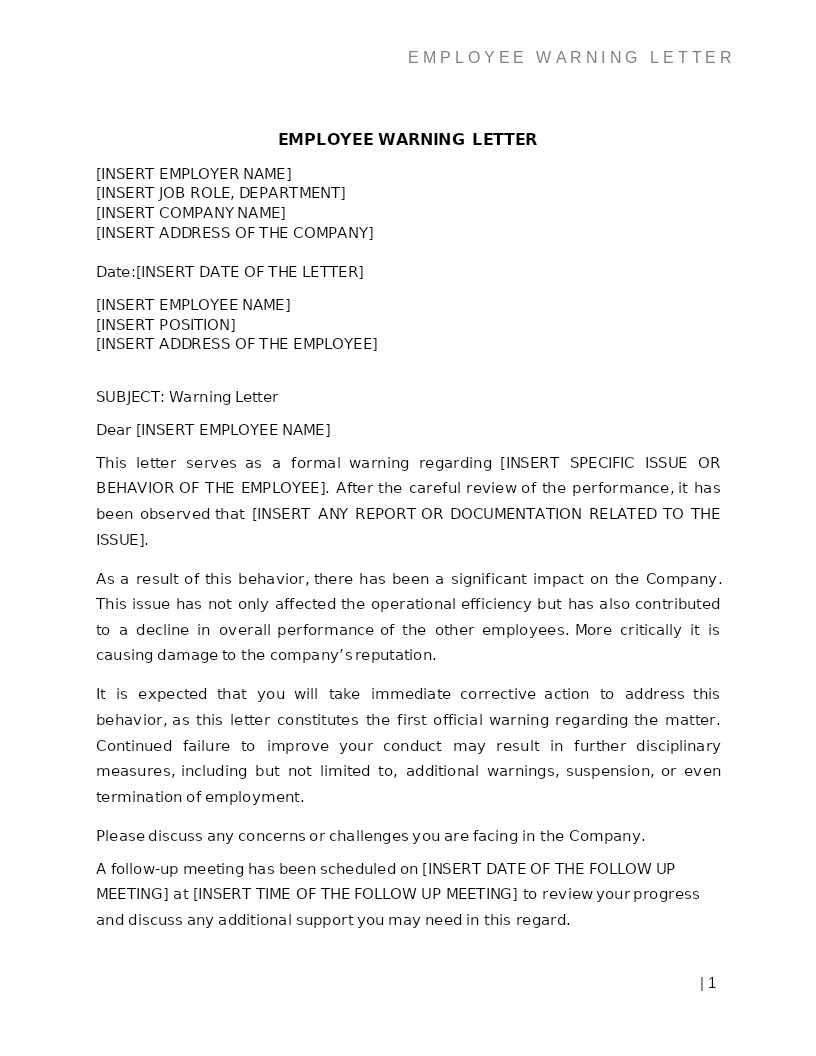
EMPLOYEE WARNING LETTER
How does it work?
1. Choose this template
Start by clicking on "Fill out the template"
2. Complete the document
Answer a few questions and your document is created automatically.
3. Save - Print
Your document is ready! You will receive it in Word and PDF formats. You will be able to modify it.
Understanding Employee Warning Letters
An Employee Warning Letter is a formal written document used by employers to address performance issues, policy violations, or workplace misconduct. It clearly outlines the behavior or incidents of concern, the corrective action required, and any consequences for failing to improve. A warning letter helps maintain professional standards, ensures fair treatment, and provides documentation that supports consistent and legally compliant employee management.
Putting a written warning in place creates structure and clarity. It allows both the employer and employee to acknowledge the issue, understand expectations, and work toward improvement while protecting the organization from potential legal disputes.
Where Employee Warning Letters Are Commonly Used
Employee Warning Letters are standard across U.S. workplaces, including:
- Corporate offices and administrative roles
- Retail, hospitality, and service industries
- Remote and hybrid work environments
- Healthcare, education, and regulated industries
- Warehousing, construction, and trade-based professions
- Startups and small businesses
- Any organization enforcing employee performance or conduct policies
Whenever an employee’s actions affect productivity, safety, compliance, or workplace culture, a warning letter provides clarity and documentation.
Different Types of Employee Warning Letters You May Encounter
- Performance Warning: Used when an employee fails to meet job expectations or deadlines.
- Conduct Warning: Addresses unprofessional behavior, conflict, or inappropriate communication.
- Attendance Warning: Issued for absenteeism, tardiness, or violating timekeeping policies.
- Policy Violation Warning: For breaches of company rules, safety procedures, or code of conduct.
- Final Warning: A serious notice given after repeated issues or severe misconduct, often preceding termination.
When Legal Guidance Becomes Helpful
Legal review can be valuable when:
- The issue involves harassment, discrimination, or protected characteristics
- Multiple employees are involved and consistency matters
- The warning is part of a larger disciplinary process
- Termination may follow if improvement does not occur
- The company needs to ensure compliance with federal and state labor laws
- Documentation is required for unemployment or legal claims
- The conduct involves workplace safety or regulatory violations
Legal guidance ensures the warning letter is fair, compliant, and protective of employer rights.
How to Work with This Template
- Identify the employee, position, and date of the incident
- Clearly describe the issue or policy violation
- Reference the applicable company policy, handbook, or code of conduct
- Specify required improvements and deadlines
- Document prior discussions or warnings if applicable
- Select the governing U.S. state law if referenced
- Review the letter with HR or management
- Have the employee acknowledge receipt (signature optional)
- Store the letter in the employee’s personnel file
Frequently Asked Questions
Q1. Is an Employee Warning Letter legally required?
While not mandated by law, a warning letter provides essential documentation showing that the employee was informed of issues and given a fair opportunity to improve. This documentation is often critical if future disciplinary action is taken.
Q2. Can a verbal warning replace a written warning?
Verbal warnings are common for minor issues, but written warnings provide clearer records. Many HR departments use verbal warnings first and written warnings when problems continue or are more serious.
Q3. Does the employee have to sign the warning letter?
A signature simply acknowledges receipt, not agreement. If an employee refuses to sign, the employer can document the refusal and still issue the warning.
Q4. Can an employee respond to a warning letter?
Yes. Employees may submit a written response explaining their perspective. Employers typically store this response with the warning.
Q5. How many warnings are needed before termination?
There is no legal standard. Some companies use a progressive discipline system (e.g., verbal → written → final), while others issue a final warning immediately for serious misconduct.
Q6. Can a warning letter be issued for remote employees?
Absolutely. In remote and hybrid settings, written warnings help maintain accountability, clarify policies, and reinforce expectations.
Q7. How long does a warning letter stay in the employee file?
Most organizations keep warnings on file for 6–12 months, though severe misconduct may be documented permanently according to company policy.
Q8. What if the employee improves after receiving the warning?
Improvement should be acknowledged, and employers may document that the issue has been resolved. This promotes fairness and helps rebuild trust.
Q9. Can a warning letter be challenged by the employee?
Employees can raise concerns with HR or provide written objections. Employers should evaluate claims fairly but are not required to remove a valid warning.
Q10. Are electronic warning letters enforceable?
Yes. Under the U.S. ESIGN Act, electronic communications and signatures are fully enforceable, making digital HR documentation legally valid.