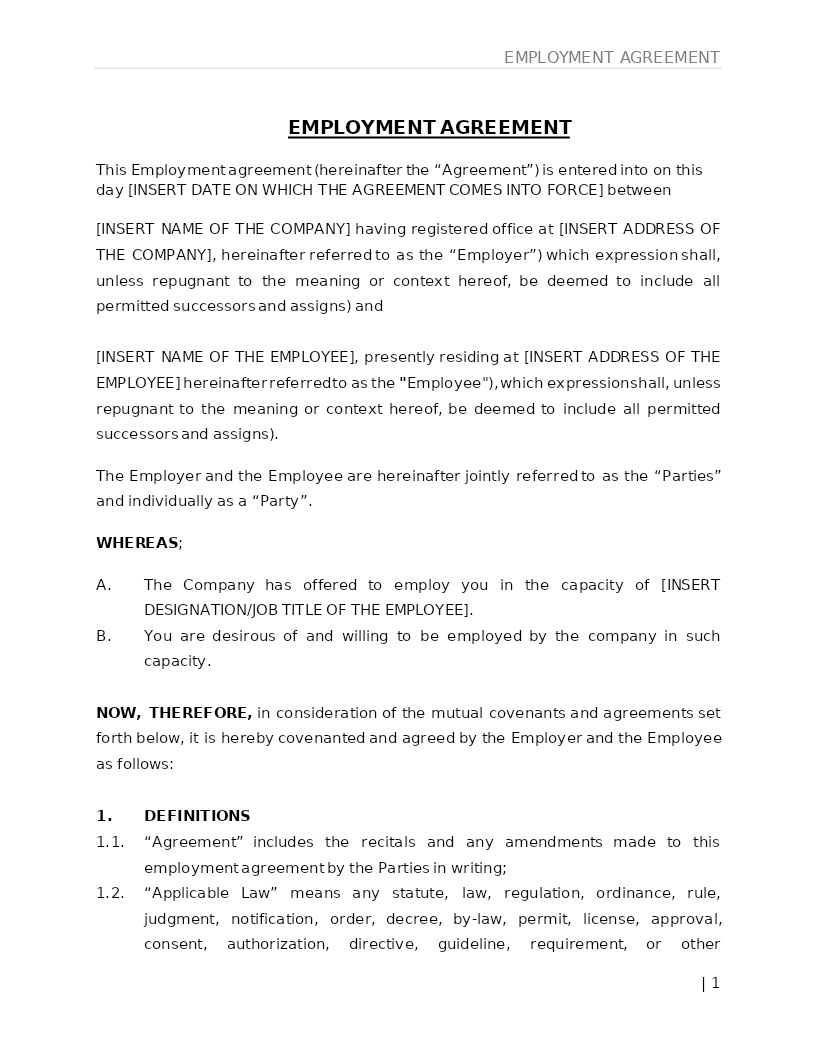
EMPLOYMENT AGREEMENT
How does it work?
1. Choose this template
Start by clicking on "Fill out the template"
2. Complete the document
Answer a few questions and your document is created automatically.
3. Save - Print
Your document is ready! You will receive it in Word and PDF formats. You will be able to modify it.
Establishing Clarity and Stability in Employer–Employee Relationships
When an individual joins an organization, both parties benefit from having a clear understanding of the employment terms, job responsibilities, compensation, and workplace expectations. A well-structured Employment Agreement provides that foundation. It outlines the employee’s role, reporting structure, salary, benefits, work hours, confidentiality obligations, and the conditions under which employment may be continued or terminated.
Putting an Employment Agreement in place ensures that the employer and employee begin the relationship with transparency, mutual understanding, and legal protection. It minimizes misunderstandings, promotes fair treatment, and aligns both parties with the standards and policies of the workplace.
Where Employment Agreements Are Commonly Used
Employment Agreements are standard across most industries in the United States including corporate offices, startups, healthcare, finance, technology, education, hospitality, and service sectors. They are frequently used for full-time employees, senior executives, specialized roles, remote workers, and positions involving access to sensitive or proprietary information. Whenever an employer wants to formalize job terms and reduce long-term risks, an Employment Agreement becomes essential.
Different Types of Employment Agreements You May Encounter
- At-Will Employment Agreement: The most common U.S. format, allowing either party to end the employment at any time for lawful reasons.
- Fixed-Term Employment Agreement: Used for defined-duration roles or project-based positions.
- Executive Employment Agreement: Covers leadership roles with additional clauses on bonuses, stock options, severance, and confidentiality.
- Remote or Hybrid Work Agreement: Outlines expectations and obligations for employees working partially or fully offsite.
- Part-Time or Hourly Employment Agreement: Used for non-exempt workers with defined work hours and wage rules under FLSA.
When Legal Guidance Becomes Helpful
Legal review becomes important when employment involves restrictive covenants, access to confidential information, complex compensation structures, equity grants, multi-state tax issues, or high-level executive terms. Lawyers help ensure compliance with federal laws such as FLSA, FMLA, ADA, and state-specific employment regulations. They also help draft enforceable non-compete, confidentiality, and IP-ownership clauses tailored to the employer’s operations.
How to Work with This Template
- Identify the employer and employee
- Define job role, duties, and reporting structure
- Specify compensation, benefits, and work schedule
- Add confidentiality, IP, and compliance obligations
- Select governing state law
- Review the terms together
- Sign electronically or in hard copy
This template follows widely accepted U.S. employment-contract standards and is compatible with all major e-signature platforms.
Frequently Asked Questions
Q1. Is an Employment Agreement legally binding in the United States?
Yes. Once signed by both parties, an Employment Agreement becomes a legally enforceable contract that outlines the rights and obligations of the employer and employee. It provides clarity on compensation, job duties, and workplace standards. Because U.S. employment laws vary by state, having a written agreement helps ensure compliance with applicable regulations. It also gives both parties a clear reference point if disputes arise during the employment relationship.
Q2. Does an Employment Agreement override at-will employment?
Not necessarily. Most U.S. states follow the at-will employment doctrine, meaning either party may end the relationship at any time for lawful reasons. Employment Agreements often state this explicitly to avoid misunderstandings. While the agreement may impose notice requirements or define termination procedures, it usually does not change the at-will status unless it is a fixed-term contract. Clear wording helps prevent confusion about job security and employer rights.
Q3. What compensation and benefits are covered in an Employment Agreement?
Employment Agreements typically detail salary or hourly wages, bonus structures, overtime eligibility, health benefits, retirement plans, paid time off, and other incentives. They may also include provisions for expense reimbursements, allowances, or stock options in executive roles. By documenting these terms, both parties understand exactly what the employee is entitled to receive. This reduces disputes and supports transparent payroll and HR management practices.
Q4. How does an Employment Agreement address confidentiality and intellectual property?
Most U.S. Employment Agreements include strong confidentiality clauses requiring employees to protect company data, trade secrets, and proprietary information. They often specify that any intellectual property created during employment belongs to the employer, not the employee. These provisions help safeguard business assets, prevent data misuse, and clarify ownership of work products. Employers rely on these clauses to maintain competitive advantage and comply with privacy or data protection laws.
Q5. Are non-compete or non-solicitation clauses allowed in Employment Agreements?
Yes, but enforceability varies by state. Some states, like California, prohibit most non-compete agreements, while others allow them with reasonable limits on duration, geography, and industry scope. Non-solicitation clauses preventing employees from poaching clients or staff are more widely enforceable. An Employment Agreement helps ensure these restrictions are properly drafted so they protect the employer without violating state labor laws.
Q6. How does an Employment Agreement handle termination or resignation?
The agreement usually outlines the procedures for ending the employment relationship, including notice periods, grounds for termination, severance (if applicable), and obligations after leaving the company. This may include returning company assets, maintaining confidentiality, or completing transition tasks. Setting clear termination terms helps prevent last-minute disputes and ensures both parties follow a fair, structured process when the employment ends.
Q7. Can a U.S. Employment Agreement be signed electronically?
Yes. Under the federal E-SIGN Act and UETA, electronic signatures are legally valid and enforceable in all U.S. states. This makes it easy for employers and employees whether in-office, remote, or in different states, to execute agreements online. Electronic signing also creates secure digital records and speeds up the onboarding process. As remote hiring becomes more common, e-signatures are increasingly the preferred method for employment contracts.
Q8. What happens if an employee breaches the Employment Agreement?
If an employee violates terms such as confidentiality, performance obligations, or attendance requirements, the employer may take disciplinary action as described in the agreement. This may include warnings, suspension, termination, or legal remedies for breaches involving intellectual property or confidential information. Written agreements help employers enforce their expectations consistently while giving employees clear notice of consequences.
Q9. Are job duties and performance expectations included in the agreement?
Yes. Employment Agreements usually outline job responsibilities, reporting lines, performance standards, and any required KPIs. Some employers also attach job descriptions or performance expectations as annexures for clarity. These details help set measurable standards for evaluating the employee’s work. They also support accountability and reduce confusion regarding assigned tasks.
Q10. Does a governing law clause matter in an Employment Agreement?
Absolutely. The governing law clause determines which state’s employment laws apply to the agreement. This is important because rules on wages, overtime, non-competes, benefits, and termination differ widely across states. Choosing a clear governing law helps ensure the agreement remains enforceable and provides predictability if any dispute arises. For multi-state teams or remote employees, this clause is particularly important.