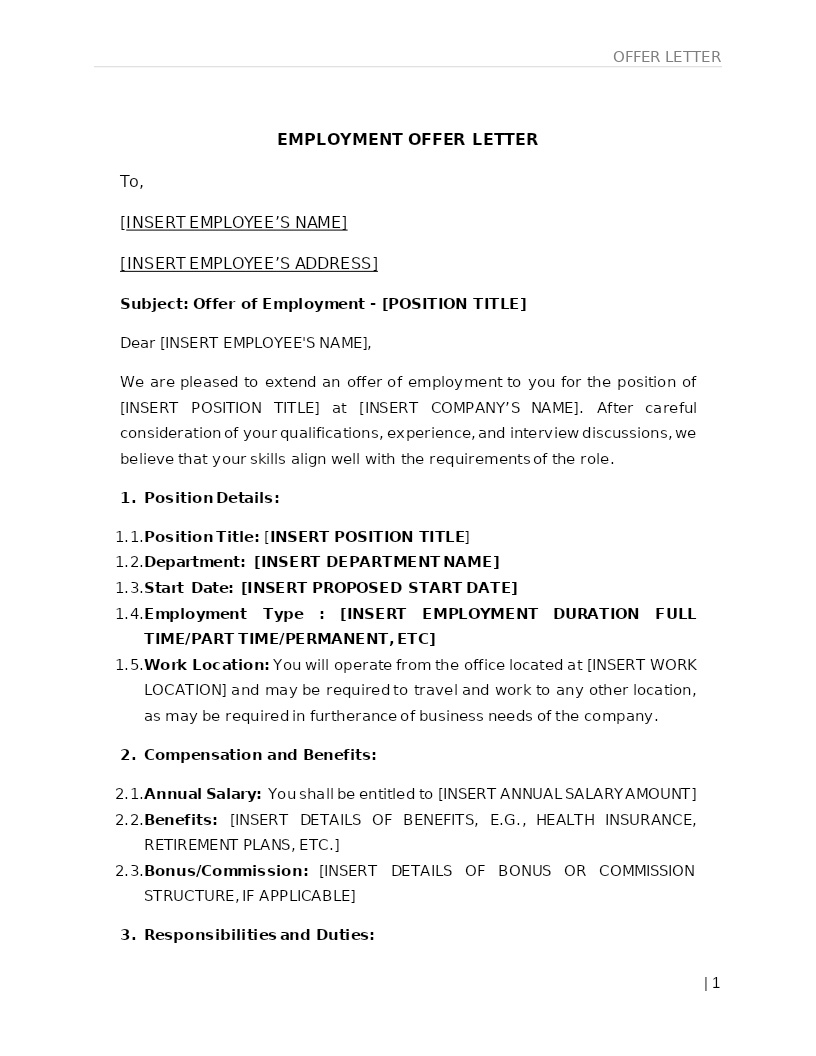
EMPLOYMENT OFFER LETTER
How does it work?
1. Choose this template
Start by clicking on "Fill out the template"
2. Complete the document
Answer a few questions and your document is created automatically.
3. Save - Print
Your document is ready! You will receive it in Word and PDF formats. You will be able to modify it.
Understanding Employment Offer Letters
An Employment Offer Letter is a formal document provided by an employer to a selected candidate outlining the essential terms of employment before a full employment agreement is signed. It sets the foundation for the working relationship by clearly communicating the position offered, compensation, start date, work schedule, reporting structure, benefits, and initial employment conditions.
In the United States, offer letters serve as an important step in the hiring process. While they are typically non-binding, they help ensure clarity and avoid misunderstandings during onboarding. A well-structured Employment Offer Letter supports compliance with state and federal employment regulations, including wage laws, equal opportunity requirements, and classification guidelines.
Putting an offer letter in place establishes transparency from day one and allows both parties to confirm expectations before employment officially begins.
Where Employment Offer Letters Are Commonly Used
Offer letters are standard across nearly all industries and business types, including:
• Corporate and office-based positions
• Startups, small businesses, and growing ventures
• Remote, hybrid, and flexible work arrangements
• Retail, hospitality, and service-based roles
• Healthcare, education, and non-profit environments
• Contract-to-hire or probationary roles
• Skilled trades, manufacturing, and field roles
Different Types of Employment Offer Letters You May Encounter
- Standard Offer Letter: Used for full-time or part-time employees with basic terms and conditions.
- At-Will Employment Offer Letter: Common in the U.S., clarifying that either party may end employment at any time, consistent with state law.
- Conditional Offer Letter: Employment is offered but subject to background checks, licensing verification, or other requirements.
- Temporary or Fixed-Term Offer Letter: Outlines terms for short-term projects or seasonal work.
- Remote Work Offer Letter: Includes details related to remote schedules, equipment, and location requirements.
When Legal Guidance Becomes Helpful
Professional review can be useful when:
• The role includes bonuses, commissions, or complex compensation structures
• The position involves intellectual property, confidentiality, or non-compete requirements
• Hiring takes place across different U.S. states with varying labor laws
• The employee will work remotely from a different jurisdiction
• The employer wants to ensure at-will language is enforceable
• The company offers equity, stock options, or profit-sharing
• Multiple conditional requirements must be met before the start date
How to Work with This Template
• Identify the employer and candidate
• Clearly state the job title, start date, duties, and location
• Outline salary, pay frequency, and classification (exempt or non-exempt)
• Include benefits eligibility and probationary periods if applicable
• Add at-will employment language and compliance disclosures
• Choose governing U.S. state law
• Review terms with the candidate
• Sign electronically or in hard copy
Frequently Asked Questions
Q1. Is an Employment Offer Letter legally binding in the U.S.?
Generally, offer letters are not binding unless they explicitly promise guaranteed employment. Most include at-will language, making them a confirmation of terms not a contract. They help establish clarity but do not override employment laws.
Q2. What key information should an Employment Offer Letter include?
A complete offer letter includes job title, supervisor, work hours, pay rate, pay schedule, start date, work location, benefits overview, and at-will status. Adding these details ensures both parties have the same expectations from the start.
Q3. Does the offer letter need to specify at-will employment?
Yes, in most U.S. states. Clear at-will language helps protect employers from claims of guaranteed employment and ensures candidates understand the nature of the relationship.
Q4. Can an offer letter include conditions before the candidate starts?
Yes. Common conditions include background checks, drug testing, employment eligibility verification, or reference checks. These conditions must be stated clearly in the offer letter.
Q5. Should benefits be fully detailed in the offer letter?
Only a summary is typically included. Comprehensive details can be provided separately in the employee handbook or benefits package to avoid making the offer letter overly complex.
Q6. Are electronic signatures valid for offer letters?
Absolutely. Under the U.S. ESIGN Act, electronic signatures are legally enforceable, making digital delivery and acceptance fast and compliant.
Q7. Can an employer withdraw an offer after issuing the letter?
Yes, as long as the offer was at-will and no binding promises were made. Employers should ensure compliance with anti-discrimination laws when withdrawing any offer.
Q8. Does an offer letter need to specify employee classification?
Yes. Clarifying whether a role is exempt or non-exempt under the Fair Labor Standards Act (FLSA) helps avoid wage and hour disputes later.
Q9. Should equity, bonuses, or commissions be included in the offer letter?
They should be mentioned, but detailed terms are often covered in separate compensation plans or agreements. This ensures accuracy and reduces legal risk.
Q10. What happens after the candidate signs the offer letter?
Once accepted, employers typically proceed with onboarding, new-hire paperwork, I-9 verification, policy acknowledgments, and any required training. The offer letter becomes part of the employee’s HR file.