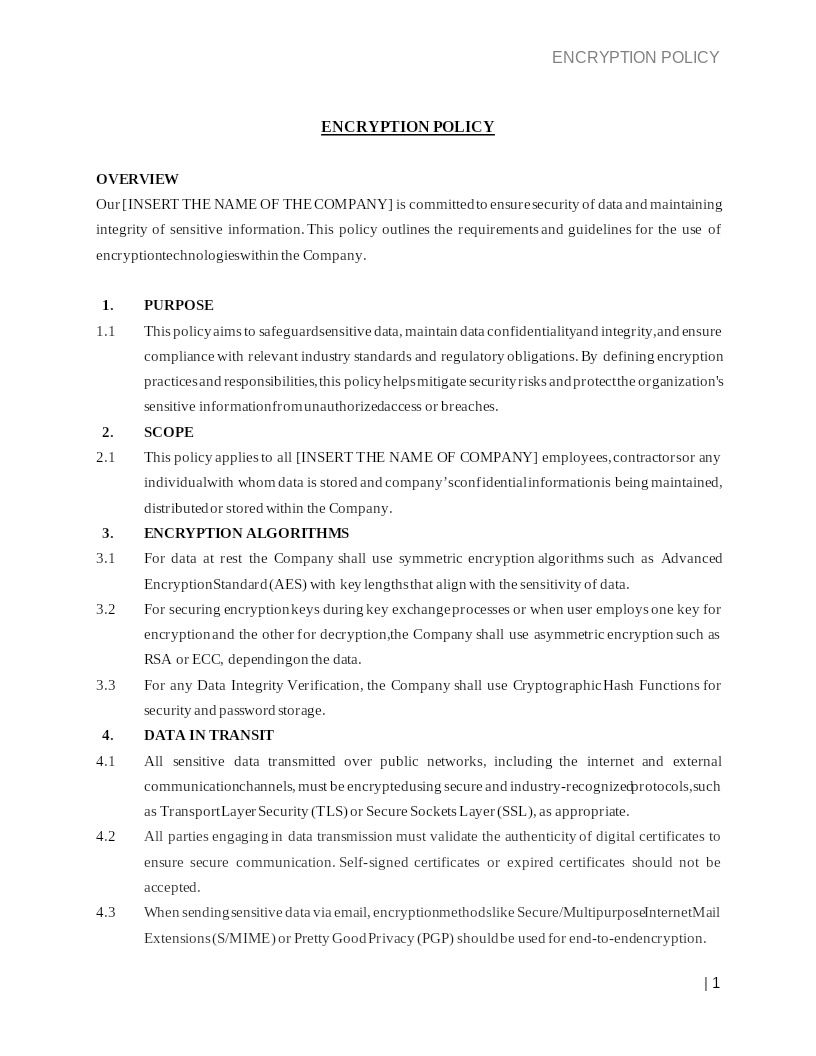
ENCRYPTION POLICY
How does it work?
1. Choose this template
Start by clicking on "Fill out the template"
2. Complete the document
Answer a few questions and your document is created automatically.
3. Save - Print
Your document is ready! You will receive it in Word and PDF formats. You will be able to modify it.
Understanding the Purpose and Use of an Encryption Policy
As organizations handle increasing amounts of sensitive information, whether financial data, personal records, confidential business files, or system credentials, it becomes essential to ensure that such data remains protected at all times. An Encryption Policy provides that structure. It outlines the tools, technologies, and standards that must be used to encrypt data both at rest and in transit, ensuring confidentiality, integrity, and security across all systems and communication channels.
By implementing an Encryption Policy, organizations reduce exposure to cyber risks, strengthen compliance with U.S. data protection laws, and build trust with customers, employees, and stakeholders. This policy forms a foundational component of broader cybersecurity, information governance, and risk-management frameworks.
Where Encryption Policies Are Commonly Used
Encryption requirements are standard across U.S. industries, including:
- Technology companies managing cloud systems, APIs, and user data
- Healthcare and financial institutions operating under HIPAA, PCI DSS, and SOX
- Government agencies securing classified or sensitive information
- E-commerce platforms protecting payment data and customer identities
- Professional services firms handling confidential client records
- Large corporations with distributed teams, remote access, and digital communication systems
- Any business storing or transmitting data vulnerable to interception or unauthorized access
Different Types of Encryption Practices You May Encounter
- Data-at-Rest Encryption: Protects databases, servers, storage devices, and endpoints against unauthorized access.
- Data-in-Transit Encryption: Secures emails, web traffic, file transfers, and internal communications moving across networks.
- End-to-End Encryption: Ensures only the communicating users can read messages, often used in messaging systems.
- File-Level and Application-Level Encryption: Encrypts individual files or specific applications, improving granular data protection.
- Key Management Procedures: Defines how encryption keys are created, stored, rotated, and retired securely.
When Legal Guidance Becomes Helpful
Most encryption decisions are technical in nature, but legal and in-house counsel become important when:
- Data is subject to regulatory requirements (GDPR, HIPAA, PCI DSS, FERPA, state privacy laws).
- The organization processes consumer data covered by U.S. privacy regulations such as CCPA/CPRA.
- Vendor contracts include strict encryption or cybersecurity obligations.
- Cross-border operations require compliance with international data protection rules.
- Intellectual property, trade secrets, or proprietary source code must be protected.
- Incident response or breach-notification laws depend on whether data was encrypted.
Legal review ensures that encryption practices meet legal standards and reduce liability.
How to Work with This Template
- Identify the systems, data categories, and communication channels requiring encryption.
- Define encryption methods, key-management protocols, and access controls.
- Assign roles for implementing and monitoring encryption measures.
- Select the governing state law and incorporate regulatory requirements where relevant.
- Review the policy internally or with legal counsel (optional).
- Communicate requirements to employees, IT teams, and third-party vendors.
This policy follows encryption and cybersecurity practices widely recognized across the United States.
Frequently Asked Questions
Q1. Why is an Encryption Policy important for U.S. businesses?
An Encryption Policy ensures that sensitive information is consistently protected, no matter where it is stored or transmitted. It provides clear rules that reduce the risk of unauthorized access and data breaches. With cyber threats on the rise, encryption is an essential defense mechanism for modern organizations. The policy also supports compliance with U.S. privacy and security regulations that mandate encryption of certain data types.
Q2. How does encryption help prevent data breaches?
Encryption ensures that even if attackers intercept or access data, it remains unreadable without decryption keys. This significantly limits the damage from cyberattacks, insider threats, or accidental data leaks. It also reduces the chances of sensitive information being misused or exposed. Strong encryption can turn a potentially catastrophic breach into a contained incident with minimal impact.
Q3. Does an Encryption Policy support regulatory compliance?
Yes. Many laws, including HIPAA, PCI DSS, SOX, GLBA, and state privacy statutes—require or strongly recommend encryption for sensitive data. A formal policy ensures organizations apply encryption consistently across systems, reducing the risk of non-compliance. It also simplifies audits and regulatory reporting by documenting how data is protected. Compliance with encryption standards helps avoid fines, penalties, and legal disputes.
Q4. How does encryption improve customer and stakeholder trust?
By demonstrating a commitment to protecting confidential information, organizations strengthen stakeholder confidence. Customers are more likely to trust companies that follow strong security standards, especially when sharing financial or personal data. Encryption reduces the likelihood of security incidents that could harm the organization's reputation. Over time, consistent data protection practices build long-term credibility and reliability.
Q5. Can encryption protect against data tampering?
Yes. Encryption not only keeps data confidential but also helps ensure integrity. Encrypted data is more resistant to unauthorized modification or corruption. When combined with digital signatures or hashing, encryption ensures that data received is exactly what was sent. This prevents tampering during storage or transmission and supports forensic verification in the event of security incidents.
Q6. How does encryption support business continuity?
Encrypted data remains secure even during unexpected disruptions such as system failures, cyberattacks, or natural disasters. This ensures that sensitive information can be recovered safely without exposing it to risk. Encryption helps organizations maintain operational stability and ensures that critical data remains protected throughout backup, recovery, and restoration processes. This strengthens resilience during crises.
Q7. Does this policy apply to both employees and third-party vendors?
Yes. Encryption requirements typically extend to any internal or external party handling organizational data. This includes employees, contractors, consultants, and service providers. Ensuring consistent encryption standards across the entire ecosystem reduces weak points that attackers can exploit. Vendor compliance also helps protect data during integrations, file transfers, or outsourced operations.
Q8. Is encryption necessary for small or mid-sized businesses?
Absolutely. Smaller businesses are increasingly targeted by cybercriminals because they often lack robust defenses. Encryption offers an affordable, scalable way to protect sensitive information without requiring large infrastructure investments. A defined policy ensures consistent data protection across systems and teams. This helps small businesses stay compliant, secure, and competitive in the digital marketplace.