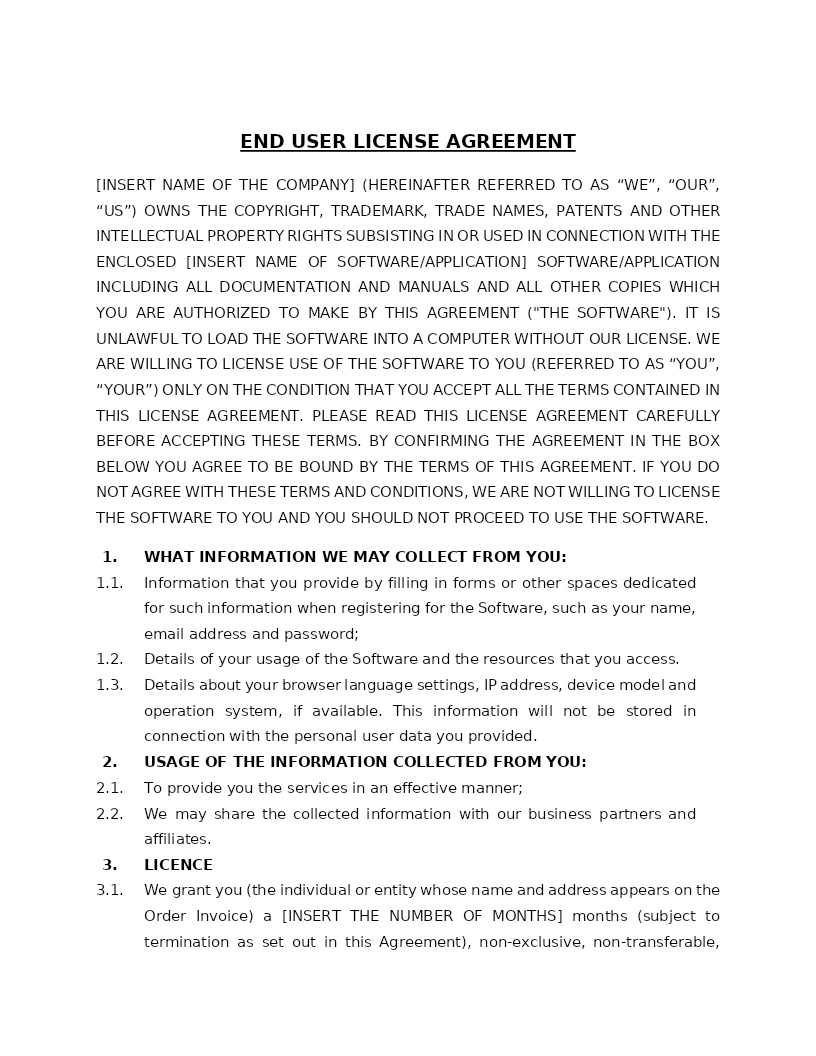
END USER LICENSE AGREEMENT
How does it work?
1. Choose this template
Start by clicking on "Fill out the template"
2. Complete the document
Answer a few questions and your document is created automatically.
3. Save - Print
Your document is ready! You will receive it in Word and PDF formats. You will be able to modify it.
Understanding End User License Agreements (EULA)
An End User License Agreement (EULA) is a legally binding contract between a software provider (the “Licensor”) and the individual or business using the software (the “End User”). It outlines the rights, restrictions, permitted uses, intellectual property protections, and legal obligations related to using the software, application, digital product, or platform.
In the United States, EULAs are governed by federal copyright laws, state contract laws, consumer protection regulations, data privacy laws, and industry-specific compliance standards. A properly drafted EULA protects the software creator’s intellectual property while informing users of what they can and cannot do with the software. It also helps to limit liability, reduce misuse, and maintain legal compliance in digital environments.
Where End User License Agreements Are Commonly Used
EULAs are widely used in various industries, especially where software or digital products are distributed, including:
- Mobile apps, SaaS platforms, and desktop software
- Gaming applications, VR/AR platforms, and digital entertainment
- Online tools, AI products, and subscription-based services
- Enterprise software systems and licensed technology solutions
- Web-based solutions, cloud computing, and data processing tools
- Productivity tools, creative software, and business applications
- Consumer devices, IoT products, and smart-technology integrations
Any time software is licensed (not sold) to a user, a EULA ensures clear rights and legal protection.
Different Types of EULA Licenses You May Encounter
- Single-User License: Allows one individual to install or use the software.
- Multi-User or Enterprise License: Permits multiple users or an entire organization to use the software.
- Subscription-Based License: Access is granted for a recurring fee and may include updates or support.
- Perpetual License: User pays once for long-term usage rights (subject to restrictions).
- Limited or Restricted License: Allows only specific uses e.g., personal use, non-commercial use, or device-specific restrictions.
- Trial or Beta License: Grants' temporary or pre-release access for testing under limited conditions.
When Legal Guidance Becomes Helpful
Legal review is recommended when:
- The software collects personal or sensitive data
- The EULA includes complex terms, restrictions, or usage limitations
- The licensing involves businesses, resellers, or enterprise-level clients
- The agreement must comply with COPPA, FERPA, HIPAA, GDPR, CCPA, or other regulations
- The software deals with financial, health, or regulated industry data
- The provider requires strong protections for proprietary technology
- The EULA interacts with Terms of Service, Privacy Policies, or API agreements
Legal guidance ensures the agreement is enforceable, compliant, and protective for both the licensor and end user.
How to Work with This Template
- Identify the Licensor and the end user
- Describe the software or application being licensed
- Define permitted and prohibited uses
- Include intellectual property ownership and licensing restrictions
- Address installation limits, device restrictions, and version control
- Include warranties, disclaimers, and limitation of liability clauses
- Add data privacy, user conduct, and security obligations
- Choose governing U.S. state law
- Outline termination rights, updates, and revocation conditions
- Sign electronically or provide acceptance through click-wrap or browse-wrap methods
This template aligns with standard U.S. software licensing practices and works with major digital signature and software-distribution platforms.
Frequently Asked Questions
Q1. What is an End User License Agreement and why is it important?
A EULA defines the legal terms under which users may access and use a software product. It is important because it protects intellectual property, limits misuse, and ensures the user understands their rights and restrictions before installing or operating the software.
Q2. Is a EULA legally enforceable in the United States?
Yes. A properly drafted EULA is enforceable under U.S. contract and copyright law when the user accepts it through a valid method such as click-wrap, sign-in-wrap, or electronic agreement. Courts often enforce EULAs as long as the terms are clear and reasonably presented.
Q3. What rights does a user receive under a EULA?
A user receives a license to use the software, not ownership of it. The EULA specifies whether the license is personal, non-exclusive, limited, revocable, commercial, or non-commercial. It also defines what actions are prohibited, such as copying or reverse-engineering.
Q4. Does a EULA protect the software developer?
Yes. A strong EULA protects developers by including intellectual property protections, liability limitations, disclaimers, warranty limitations, and usage restrictions, preventing unauthorized distribution or modification of the software.
Q5. Can a user share or resell software covered by a EULA?
Usually not. Most EULAs prohibit redistribution, sublicensing, or transferring the software to others unless explicitly permitted. This ensures the developer retains control over licensing and prevents unauthorized use.
Q6. Are updates and bug fixes covered under the EULA?
Many EULAs include provisions for updates, patches, or upgrades. The agreement may allow automatic updates or require the user to accept new terms. It should clearly outline whether updates are included in the license or require additional payment.
Q7. Can a EULA include data privacy requirements?
Absolutely. Many software products collect user data, so EULAs often reference or incorporate the developer’s Privacy Policy, outlining how data is collected, stored, and used while maintaining compliance with privacy laws.
Q8. Can a EULA be terminated?
Yes. A EULA may be terminated if the user violates the terms, engages in illegal use, or attempts to manipulate or reverse-engineer the software. Upon termination, the user must stop using the software and remove all copies.
Q9. Are electronic signatures acceptable for EULAs?
Yes. Under the U.S. ESIGN Act, EULAs can be accepted electronically using checkboxes, click-wrap consent, or digital signatures. These methods are legally binding and commonly used in software distribution.
Q10. Is a EULA suitable for both small apps and enterprise software?
Definitely. Whether you’re licensing a small mobile app or a large business platform, a EULA ensures legal protection, clarifies usage rights, and helps prevent misuse or disputes.