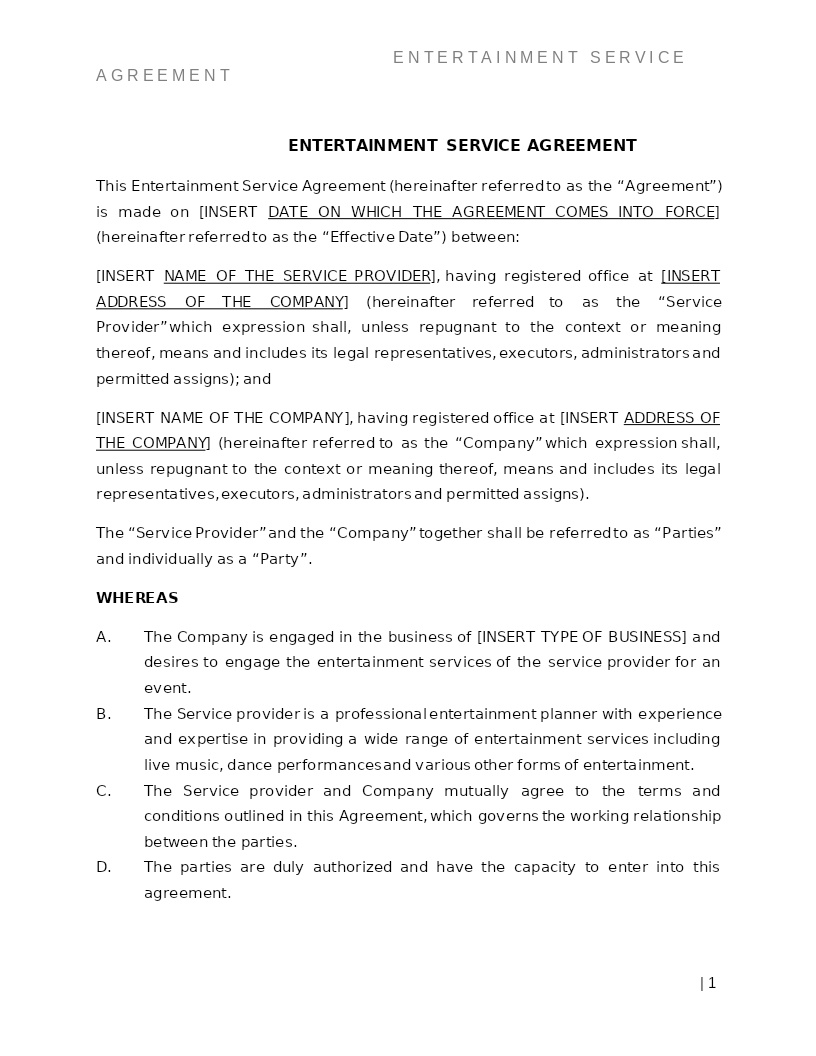
ENTERTAINMENT SERVICE AGREEMENT
How does it work?
1. Choose this template
Start by clicking on "Fill out the template"
2. Complete the document
Answer a few questions and your document is created automatically.
3. Save - Print
Your document is ready! You will receive it in Word and PDF formats. You will be able to modify it.
Understanding the Purpose of an Entertainment Service Agreement
When a performer, entertainer, or entertainment company provides services for an event, it’s essential to have a clear framework that governs how the performance will be delivered. An Entertainment Service Agreement provides that structure. It defines the scope of entertainment services, performance expectations, payment obligations, scheduling details, and the rights and restrictions that apply to both parties.
Having this agreement in place creates clarity and trust. It allows entertainers and clients to communicate openly, finalize arrangements, and prepare for the event without worrying about misunderstandings, cancellations, or disputes.
Where Entertainment Service Agreements Are Commonly Used
Entertainment contracts are standard in a wide range of professional settings, including:
- Live music performances, concerts, DJ events, and festivals
- Corporate functions, brand activations, and promotional events
- Weddings, private parties, and family celebrations
- Comedy shows, theatre performances, and stage acts
- Talent bookings, influencer events, or managed artist appearances
- Film shoots, production support, and media-related engagements
Any time entertainment services are booked, the agreement sets clear boundaries around what will be performed, what is included, and what each party is responsible for.
Different Types of Entertainment Service Agreements You May Encounter
- Performance Agreements: Used when a performer or group is hired for a specific show, event, or time slot, including details such as set length and technical requirements.
- Talent Booking Agreements: Applied when a booking agent or entertainment company arranges appearances, performances, or tours on behalf of a performer.
- Event-Specific Entertainment Contracts: Designed for weddings, corporate events, or themed functions with detailed scheduling, location, and customization requirements.
- Production or Creative Services Agreements: Used when entertainers provide additional creative input such as choreography, scriptwriting, or production planning.
- Digital or Recorded Entertainment Agreements: Focused on virtual performances, online content creation, or pre-recorded media, including usage and distribution rights.
When Legal Guidance Becomes Helpful
Most routine bookings don’t require extensive legal involvement, but professional guidance becomes valuable when:
- The performance involves intellectual property, copyrighted music, or recorded media
- Multiple venues, organizers, or jurisdictions are involved
- The entertainer is part of a managed or unionized group with special requirements
- There are complex cancellation, rescheduling, or force-majeure concerns
- The agreement includes licensing rights, usage approvals, or distribution permissions
- The entertainer participates in a highly regulated environment such as televised broadcasts
- High-value appearances require detailed liability and insurance protections
Legal review isn’t always mandatory, but it provides added security when performances involve financial, commercial, or reputational risks.
How to Work with This Template
- Identify the performer(s) or entertainment company providing services
- Clearly state the purpose, event details, schedule, and venue requirements
- Outline payment terms, deposits, and cancellation policies
- Specify equipment needs, performance expectations, and support obligations
- Clarify rights to recordings, photos, or promotional materials
- Select governing state law and address dispute-resolution preferences
- Review terms together; signatures may be added electronically or in hard copy
The template aligns with commonly used U.S. entertainment-industry standards and is compatible with major e-signature platforms.
Frequently Asked Questions
Q1. What is an Entertainment Service Agreement and why is it important?
An Entertainment Service Agreement outlines the terms under which an entertainer provides services for an event or project. It specifies performance details, payment arrangements, schedules, and expectations for both parties. This protects the entertainer’s rights while giving clients clarity on what is included. A written agreement minimizes misunderstandings and ensures a smooth, professional experience.
Q2. Does this agreement help prevent last-minute cancellations or misunderstandings?
Yes. The agreement defines cancellation rules, refund conditions, and rescheduling terms, reducing uncertainty for both sides. It also clarifies responsibilities such as arrival time, equipment setup, and event logistics. Clear expectations prevent miscommunication and allow events to run on schedule. This stability is especially important for weddings, corporate events, and high-value bookings.
Q3. Are performance rights and intellectual property covered in this agreement?
Entertainment often involves music, recordings, or creative content that carries intellectual-property protection. The agreement defines who owns the performance, whether recordings may be used, and whether promotional use is allowed. This protects entertainers from unauthorized distribution and ensures clients understand the limits of usage. Clear IP terms prevent disputes later.
Q4. Can this agreement apply to virtual or digital entertainment services?
Absolutely. Modern entertainment frequently includes livestreams, virtual concerts, recorded videos, or online appearances. The agreement can be customized to cover digital access, platform requirements, licensing rights, and editing permissions. This ensures entertainers are protected even in non-traditional or remote formats. It also clarifies how digital content may be stored or shared.
Q5. How does the agreement support financial protection for entertainers and clients?
It sets out the exact payment structure, including deposits, advance payments, and due dates—to prevent conflicts. Cancellation penalties and refund conditions are clearly defined. Clients gain transparency on costs, and entertainers receive assurance that their time and preparation are compensated. These financial terms create fairness and reduce disputes.
Q6. Does this contract address liability and safety concerns during performances?
Yes. Entertainment often involves equipment, staging, lighting, and interaction with attendees. The agreement can outline which party is responsible for safety, venue compliance, and equipment security. It may also include insurance requirements or limit liability for unforeseen incidents. This helps protect both sides from legal and financial exposure.
Q7. Is this agreement helpful for entertainers working with agencies or management teams?
Yes, when talent is represented by an agency or manager, clear documentation becomes essential for setting expectations between all parties. The agreement can identify the booking party, commission structure, and communication channels. This ensures everyone understands their role and avoids confusion during negotiations. It also improves coordination for large-scale or multi-event bookings.
Q8. Can this agreement be customized for large events, weddings, or corporate shows?
Yes. The template is flexible and can be tailored for any event type, from intimate private parties to multi-stage productions. Customizations may include rehearsal times, special requests, dress codes, additional performers, or extended sets. Tailored terms help meet unique event needs while still protecting contractual rights. This ensures smooth execution and professional results.