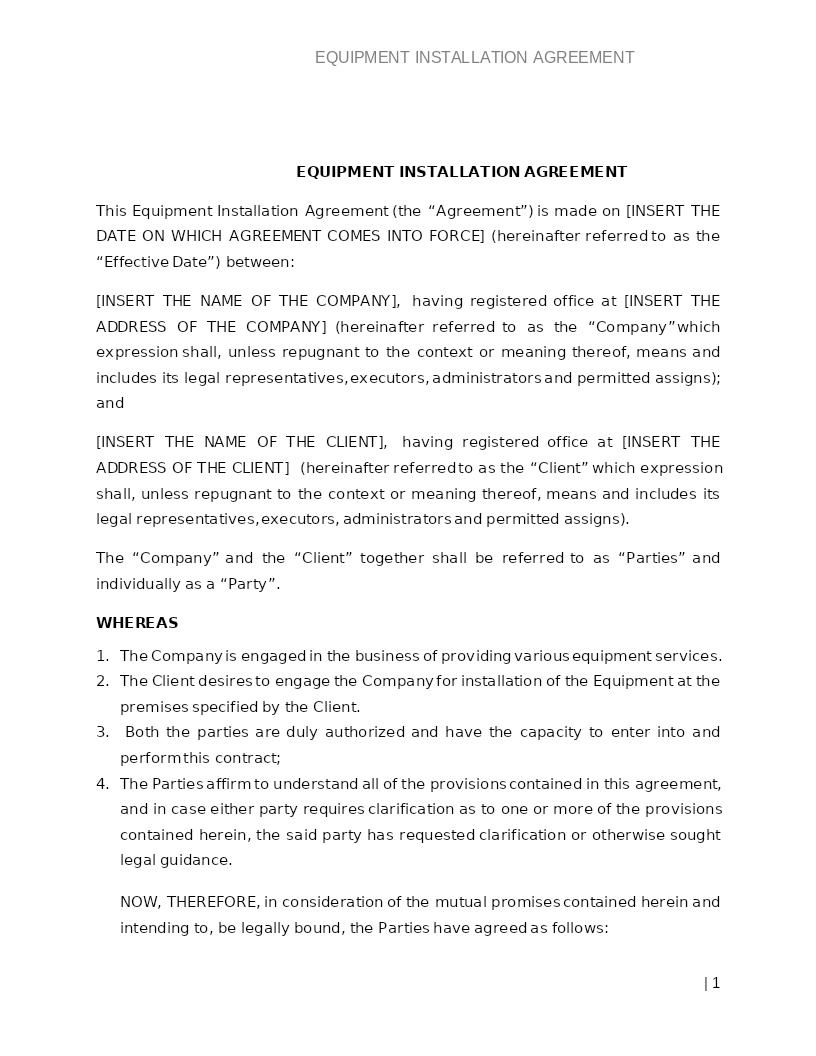
EQUIPMENT INSTALLATION AGREEMENT
How does it work?
1. Choose this template
Start by clicking on "Fill out the template"
2. Complete the document
Answer a few questions and your document is created automatically.
3. Save - Print
Your document is ready! You will receive it in Word and PDF formats. You will be able to modify it.
Understanding Equipment Installation Agreement In U.S.
An Equipment Installation Agreement is a legally binding contract between a service provider (installer) and a client that outlines the terms and conditions for installing equipment. It specifies the scope of installation work, responsibilities of each party, project timelines, payment terms, and technical requirements. The Agreement also addresses warranties, liability limitations, safety standards, and post-installation support. This ensures the installation is completed professionally, safely, and in compliance with U.S. industry and regulatory standards, while protecting both parties from disputes or unexpected risks.
Where Equipment Installation Agreements Are Commonly Used
Equipment Installation Agreements are widely used in:
- Residential and commercial appliance installation
- Industrial machinery and manufacturing equipment
- IT systems, networking, and software–hardware integrations
- Medical, laboratory, and technical devices
- HVAC, electrical systems, and renewable energy equipment
- Security systems, CCTV, and smart home installations
Any scenario involving professional installation services benefits from a formal and clear installation agreement.
Different Types of Equipment Installation Agreements You May Encounter
- Standard Installation Agreement: Used for routine installation projects involving basic equipment or appliances.
- Industrial Equipment Installation Agreement: Covers complex machinery, factory systems, and high-risk technical equipment.
- Technology & IT Installation Agreement: Used for servers, network systems, security devices, and software–hardware integrations.
- Maintenance + Installation Combined Agreement: Covers installation and ongoing service support.
- Turnkey Installation Agreement: Installer manages delivery, setup, testing, and project completion end-to-end.
When Legal Guidance Becomes Helpful
Legal support is valuable when:
- The equipment is high-value, custom-built, or technically complex
- The installation involves safety risks or regulatory compliance requirements
- Warranty terms, indemnification, or liability limits need customization
- The project involves multiple jurisdictions or federal/state technical standards
- Intellectual property or proprietary technology is part of the installation
- Insurance responsibilities and risk allocation require negotiation
Lawyers help ensure the Agreement complies with U.S. consumer protection laws, construction/installation safety rules, and industry-specific regulations.
How to Work With This Equipment Installation Agreement
- Clearly identify the equipment, installation tasks, and technical expectations
- Document all costs, payment schedules, and potential additional charges
- Clarify maintenance responsibilities and post-installation support
- Define safety standards, access requirements, and worksite conditions
- Include warranties, compliance standards, and liability protections
- Establish dispute resolution procedures and termination terms
- Ensure both parties sign before installation work begins
Frequently Asked Questions
Q1. Why is an Equipment Installation Agreement necessary?
An Equipment Installation Agreement protects both the client and installer by clearly outlining the installation process, costs, deadlines, and responsibilities. It helps prevent disputes and ensures compliance with U.S. safety and technical standards, offering legal protection in case of defects or delays.
Q2. What details are included in a standard Equipment Installation Agreement?
Typical agreements include the project scope, installation procedures, materials required, payment terms, safety guidelines, and warranty obligations. These details ensure both parties fully understand the expectations and responsibilities for a successful installation.
Q3. Does the Agreement include warranty terms?
Yes. Most Agreements specify warranties for both the installation work and the equipment itself. This may include labor warranties, manufacturer warranties, and repair obligations. Clearly defined warranties help protect clients from unexpected issues after installation.
Q4. Who is liable if equipment is damaged during installation?
Liability depends on the Agreement’s terms. Generally, the installer is responsible for damages caused by negligence, while the client must ensure safe access to the workspace. The Agreement clarifies risk allocation, insurance requirements, and compensation procedures.
Q5. Are installation timelines and deadlines required in the Agreement?
Yes. Timelines help maintain project efficiency and accountability. The Agreement sets expected start and completion dates and may include provisions for delays due to weather, supply issues, or unforeseen complications.
Q6. How are payment terms handled in an Equipment Installation Agreement?
Payment terms may include deposits, progress payments, or final payments upon completion. The Agreement outlines all fees, additional charges (like materials or overtime), and due dates to prevent financial misunderstandings.
Q7. Does the Agreement address safety and compliance requirements?
Absolutely. Equipment installation often involves electrical, mechanical, or technical risks. The Agreement includes safety standards, required permits, and compliance with OSHA, state laws, and industry regulations to ensure safe and lawful installation.
Q8. Can the Agreement include post-installation support or maintenance?
Yes. Many installations require follow-up maintenance, calibration, or inspection. The Agreement may include these services or offer them as optional add-ons. This ensures long-term functionality and reduces operational downtime for the client.