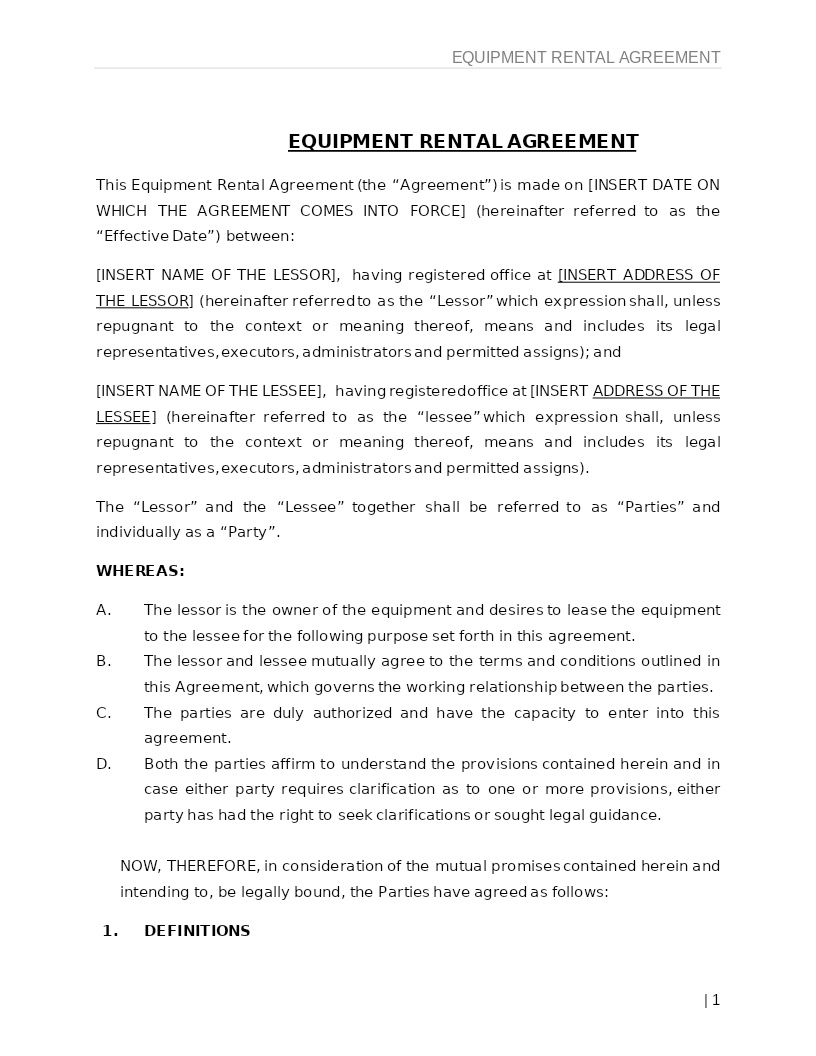
EQUIPMENT RENTAL AGREEMENT
How does it work?
1. Choose this template
Start by clicking on "Fill out the template"
2. Complete the document
Answer a few questions and your document is created automatically.
3. Save - Print
Your document is ready! You will receive it in Word and PDF formats. You will be able to modify it.
Providing Structure and Legal Protection for the Temporary Use of Equipment in the United States
Businesses, contractors, professionals, and individuals frequently require access to equipment without the burden of purchasing it outright. Whether for construction, events, film production, manufacturing, landscaping, medical use, or specialized technical projects, an Equipment Rental Agreement provides a legally enforceable framework governing the temporary lease of equipment.
This Agreement defines the terms and conditions under which equipment is rented—including rental duration, payment obligations, maintenance responsibilities, permitted use, liability for damage or loss, return conditions, and legal compliance requirements. It protects both the equipment owner (the “Lessor”) and the renting party (the “Lessee”) by establishing clear rules that ensure responsible usage, minimize risk, and outline remedies in cases of misuse or non-payment.
An Equipment Rental Agreement also ensures compliance with U.S. laws such as Uniform Commercial Code (UCC) provisions governing personal property leases, state-level equipment rental statutes, insurance standards, and general contract principles. It provides clarity and predictability for transactions involving valuable or hazardous equipment.
Where Equipment Rental Agreements Are Commonly Used
Equipment rental contracts are widely used across the United States, including
- Construction equipment (machinery, tools, scaffolding, power equipment)
- Filmmaking and photography equipment (cameras, lighting, audio gear)
- Event and staging equipment (sound systems, tents, tables, AV equipment)
- Medical equipment (diagnostic tools, mobility equipment)
- Industrial machinery and manufacturing tools
- Office or IT equipment (computers, servers, printers)
- Vehicles, trailers, and hauling equipment
- Landscaping and agricultural equipment
- Home improvement and DIY rental tools
Any time equipment is loaned, rented, or leased for temporary use, a written Equipment Rental Agreement protects both parties and ensures accountability.
Different Types of Equipment Rental Agreements You May Encounter
1. Short-Term Equipment Rental Agreement: For hourly, daily, or weekend rentals.
2. Long-Term Equipment Lease Agreement: Covers rentals lasting months or years with extended maintenance conditions.
3. Commercial Equipment Rental Agreement: Used by businesses for industrial, technical, or construction equipment.
4. Event Equipment Rental Agreement: Covers staging, audio-visual, and event furniture rentals.
5. Vehicle or Trailer Rental Agreement: For temporary use of cars, vans, trucks, or hauling trailers.
6. Medical Equipment Rental Agreement: For compliant and regulated medical device rentals.
When Legal Guidance Becomes Helpful
Legal review is advisable when:
· The equipment is expensive, hazardous, or requires special licensing
· Long-term leasing affects tax or UCC classification
· The lessee must carry insurance or meet OSHA requirements
· Damage, wear-and-tear, or loss responsibilities need clarity
· The rental involves vehicles subject to state registration laws
· Liability waivers are required for high-risk equipment
· The agreement includes cross-border rental arrangements
· Environmental, safety, or industry regulations apply
Legal guidance minimizes disputes and ensures enforceability.
How to Work With This Template
- Identify the equipment being rented, including serial numbers and condition
- Define rental duration, pick-up/delivery procedures, and return conditions
- State payment terms, deposits, late fees, and replacement costs
- Address liability, indemnification, and insurance requirements
- Include maintenance, repairs, and permitted use rules
- Specify governing law under U.S. state contract principles
- Add termination rights and dispute resolution mechanisms
- Execute physically or electronically (valid under ESIGN Act)
This structure aligns with U.S. rental, contract, and equipment liability standards.
Frequently Asked Questions
Q1. What is an Equipment Rental Agreement in the United States?
An Equipment Rental Agreement is a legally binding contract that outlines the terms under which one party (the Lessor) rents equipment to another party (the Lessee) for a defined period. It addresses rental fees, usage rules, damage liability, and return conditions.
In the U.S., these agreements are governed by state contract laws and relevant parts of the Uniform Commercial Code (UCC Article 2A), which regulates the lease of personal property.
Q2. Why is a written equipment rental contract important?
A written agreement protects both parties by setting clear usage rules, preventing disputes about responsibility for damage, protecting the owner from negligent misuse, clarifying fees and payment timelines, defining return obligations, and securing legal remedies in case of loss or non-payment. It also ensures compliance with safety standards, insurance policies, and liability protections.
Q3. Who is responsible for damage to rented equipment?
Typically, the lessee is responsible for any damage beyond normal wear and tear, loss, theft, or destruction of the equipment, improper use or failure to follow instructions, and failure to maintain equipment as required. Most agreements require the lessee to pay repair or replacement costs and may require a damage deposit or proof of insurance.
Q4. Can equipment rental agreements require insurance?
Yes. Many U.S. rental companies require lessees to carry general liability insurance, property damage insurance, commercial auto insurance (for vehicle rentals), and specialized coverage for expensive or hazardous equipment. Insurance requirements protect both parties and reduce financial risk.
Q5. Is the lessee allowed to sublease or loan the equipment to others?
Usually no. Most agreements strictly prohibit subleasing, lending, or permitting third-party use. Unauthorized subleasing may void insurance coverage, violate UCC provisions, and expose both parties to liability. The contract should clearly state who is allowed to use the equipment.
Q6. What happens if rented equipment breaks down during use?
Breakdown procedures depend on the agreement, but typically:
- The Lessee must immediately notify the Lessor
- The Lessor arranges repair or replacement if the failure is not caused by misuse
- Rental fees may be paused if the equipment becomes unusable through no fault of the lessee.
If misuse caused the breakdown, the lessee is liable for repair costs.
7. Can the agreement include delivery and pickup services?
Yes. Many agreements specify delivery fees, pickup schedules, responsibilities for loading/unloading, and risk of loss during transportation. Clear logistics terms help avoid accidents and disputes.
8. Are electronic signatures valid on Equipment Rental Agreements?
Yes. Under the ESIGN Act and Uniform Electronic Transactions Act (UETA), electronic signatures are fully enforceable in all U.S. states. This makes it easy for rental companies and customers to finalize contracts remotely.
9. Can the lessor inspect equipment during the rental period?
Yes. The Agreement may grant the Lessor the right to inspect the equipment, verify proper usage, and confirm maintenance and safety compliance. Inspection rights protect owners from misuse and help maintain asset value.
10. What happens if the lessee keeps the equipment past the return date?
The Agreement typically imposes late return fees, rental charges, and potential liability for conversion (wrongful possession) and loss-of-use damages for the Lessor. Clear return procedures help prevent extended possession issues.
11. Are equipment rental agreements enforceable in every U.S. state?
Yes. These agreements are governed by state contract law and UCC Article 2A. As long as the contract is clearly written, agreed to by both parties, signed physically or electronically, and contains lawful terms, it is legally enforceable across the United States.