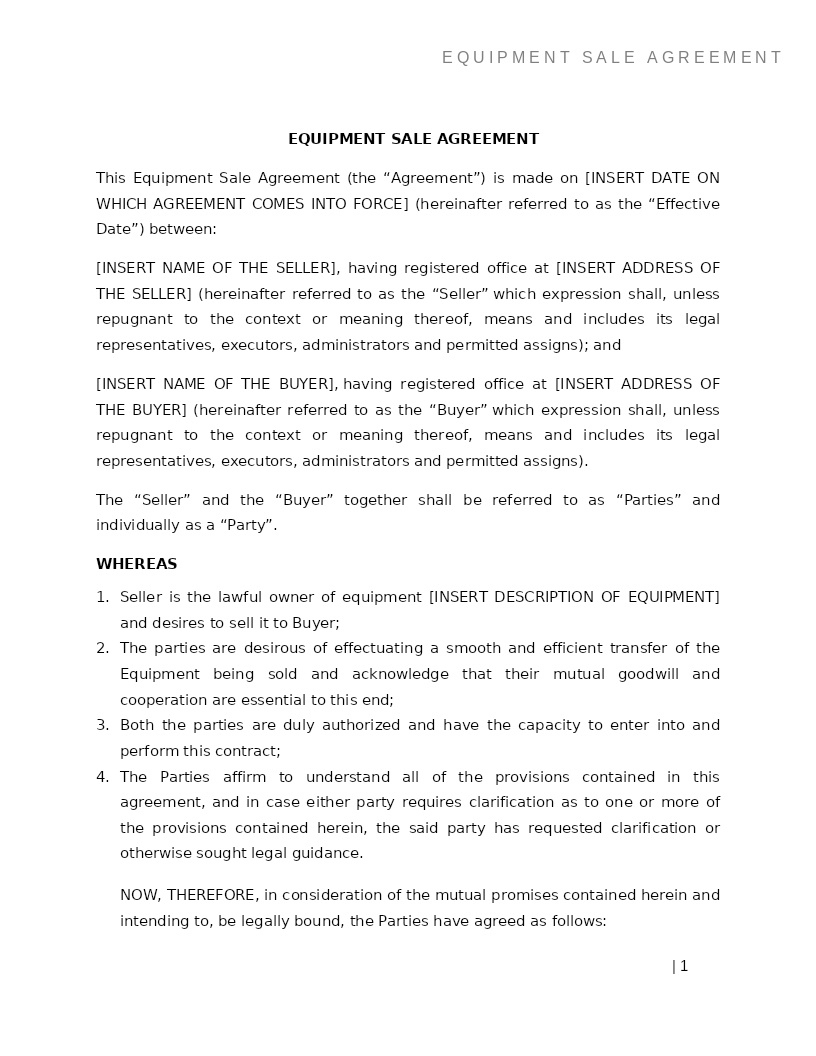
EQUIPMENT SALE AGREEMENT
How does it work?
1. Choose this template
Start by clicking on "Fill out the template"
2. Complete the document
Answer a few questions and your document is created automatically.
3. Save - Print
Your document is ready! You will receive it in Word and PDF formats. You will be able to modify it.
Understanding the Equipment Sale Agreement
When businesses sell, purchase, or transfer machinery, tools, or commercial equipment, they need a clear contract that defines the terms of the transaction. An Equipment Sale Agreement provides that structure. It outlines pricing, delivery, warranties, liability, and ownership transfer, ensuring both parties understand their rights and obligations throughout the sale.
Putting an Equipment Sale Agreement in place helps prevent disputes, protects against fraud, and documents the transaction for regulatory, tax, and business purposes.
Where Equipment Sale Agreements Are Commonly Used
Equipment Sale Agreements are widely used across industries that rely on machinery or technical assets, including:
- Manufacturing and industrial operations
- Construction and heavy equipment suppliers
- Medical and laboratory equipment sales
- IT hardware, servers, computers, and electronics
- Automotive, trucking, agricultural, and marine sectors
- Retail or wholesale businesses selling commercial tools or fixtures
Any time equipment; new or used, is sold or transferred, this agreement ensures clarity, legal protection, and a documented record of the sale.
Different Types of Equipment Sale Agreements You May Encounter
- Standard Equipment Sale Agreement: Defines price, delivery, warranties, and transfer of ownership for general commercial equipment.
- Used or As-Is Equipment Sale Agreement: Common for second-hand machinery; limits the seller’s warranties while clarifying equipment condition.
- Installment or Financed Equipment Sale Agreement: Used when the buyer pays over time, requiring clear payment schedules, interest, and remedies for default.
- Equipment Sale and Installation Agreement: Includes installation, setup, or training requirements along with the sale terms.
- Equipment Sale with Maintenance or Service Plan: Adds long-term service, support, or spare-parts obligations tied to the equipment purchase.
When Legal Guidance Becomes Helpful
Legal review becomes essential when:
- High-value, specialized, or dangerous equipment is involved
- Warranties, repairs, or maintenance obligations are complex
- The equipment sale involves financing, deposits, or installment payments
- The sale crosses state lines or involves international shipping
- The equipment contains software, firmware, or licensed IP
- Liability and insurance obligations need customization
- The parties require detailed inspection, testing, or acceptance procedures
Legal oversight ensures enforceability, regulatory compliance, and protection against risks.
How to Work with This Template
- Identify the seller and buyer clearly
- Describe the equipment, condition, serial numbers, and included accessories
- Specify pricing, deposits, and payment terms
- Outline delivery details, risk of loss, and transfer of ownership
- Define warranties, liability limits, and inspection rights
- Choose governing U.S. state law
- Review the terms together—legal review optional but recommended
- Sign electronically or physically—e-signatures are enforceable across the United States
This template follows widely accepted standards for commercial equipment sales in the U.S.
Frequently Asked Questions
Q1. What is an Equipment Sale Agreement and why is it important?
An Equipment Sale Agreement is a legally binding contract that outlines the terms for buying or selling machinery or tools. It helps prevent disputes by clearly defining payment, delivery, warranties, and ownership transfer. In the U.S., it protects both parties by providing a written record of the transaction. This ensures transparency, accountability, and long-term legal protection.
Q2. Does the agreement cover warranties and equipment condition?
Yes. The agreement can specify manufacturer warranties, seller warranties, or “as-is” sales with no guarantees. It may also include equipment condition reports, inspection rights, and maintenance obligations. This clarity ensures the buyer knows exactly what condition the equipment is in before finalizing the purchase. Proper documentation reduces the risk of fraud or hidden defects.
Q3. Can an Equipment Sale Agreement include installation or training services?
Absolutely. Many U.S. businesses require installation, setup, calibration, or staff training alongside the purchase. The agreement can incorporate detailed service obligations, timelines, and fees. Including these terms ensures the buyer receives full operational support while protecting the seller against unrealistic performance expectations.
Q4. Is an Equipment Sale Agreement enforceable for used or second-hand equipment?
Yes. Used equipment sales are enforceable as long as the agreement clearly states the condition, warranty limitations, and inspection procedures. “As-is” clauses are common but must be explicit to protect the seller. Having these details in writing helps avoid disputes about defects or performance after the sale is completed.
Q5. Does the agreement apply to cross-state or online equipment sales?
Yes. Equipment can be sold across states, and the contract remains enforceable as long as it includes a governing law clause. Online or remote equipment sales benefit greatly from detailed delivery, inspection, and risk-of-loss terms. This ensures both parties understand when ownership transfers and who is responsible for shipping damages.
Q6. Can the buyer request an inspection before purchasing the equipment?
Yes. Most Equipment Sale Agreements allow buyers to conduct inspections before the sale is finalized. This may include visual checks, performance tests, or third-party evaluations. Adding inspection rights ensures transparency and protects both parties from disagreements over quality. It also strengthens the enforceability of “as-is” or warranty-based sales.
Q7. What happens if the equipment is damaged during delivery or shipping?
The agreement usually specifies when the risk of loss transfers from seller to buyer. If the seller is responsible for delivery, they must ensure proper packaging and safe shipment. If the buyer arranges transportation, they may bear the shipping risk. Clear delivery and risk-transfer clauses help prevent disputes and ensure smooth logistics in cross-state or commercial shipments.
Q8. Can this agreement be used for bulk or multiple-equipment sales?
Yes. An Equipment Sale Agreement can be expanded to cover bulk purchases, multiple machines, or full inventory transfers. It can include batch pricing, staggered delivery schedules, and equipment-specific condition lists. Businesses often use this structure for manufacturing, construction, or IT procurements where several assets are purchased at once.