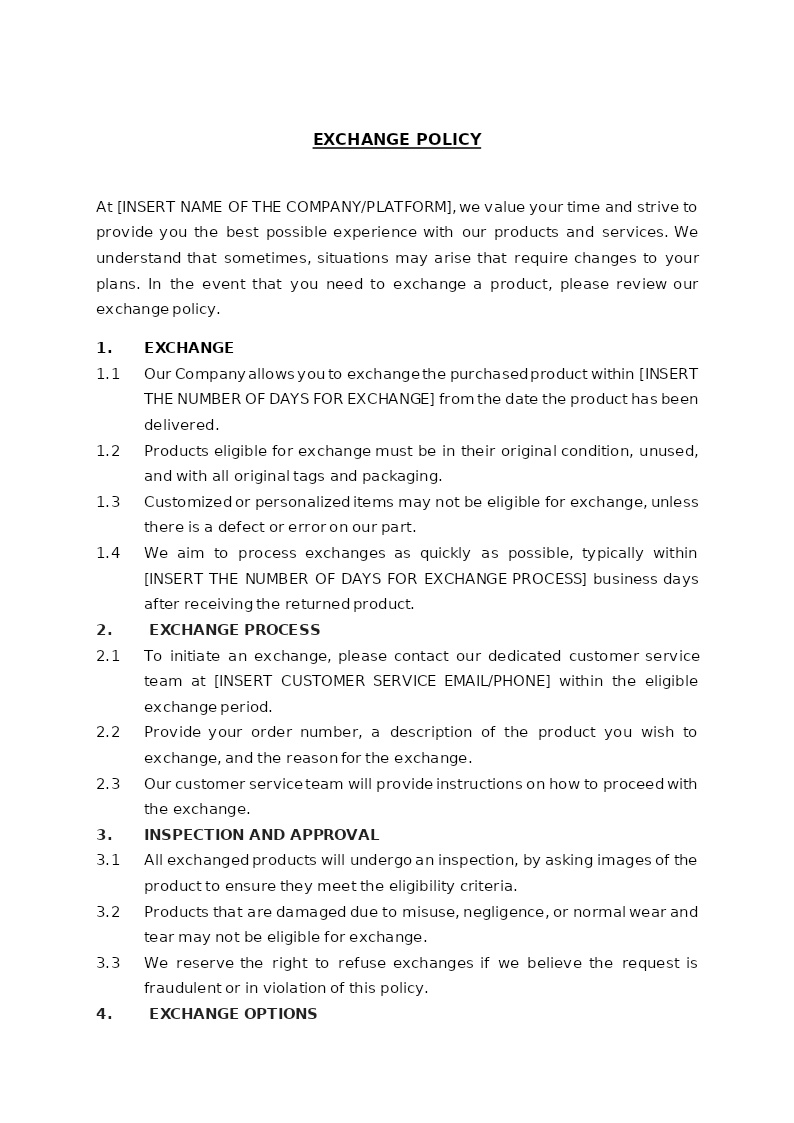
EXCHANGE POLICY
How does it work?
1. Choose this template
Start by clicking on "Fill out the template"
2. Complete the document
Answer a few questions and your document is created automatically.
3. Save - Print
Your document is ready! You will receive it in Word and PDF formats. You will be able to modify it.
Providing Clarity and Fairness in Customer Exchanges
When customers purchase an item, whether online or in-store, they expect flexibility if the product does not meet their needs. An Exchange Policy provides the framework for how purchased goods may be exchanged. It outlines eligibility rules, timelines, conditions of the product, and procedures customers must follow to initiate an exchange.
Having a well-defined Exchange Policy builds trust, enhances the shopping experience, and ensures fairness for both the customer and the business. It allows retailers to handle exchanges consistently while maintaining operational efficiency and protecting inventory integrity.
Where Exchange Policies Are Commonly Used
Exchange policies are widely implemented across retail and service industries, including:
- Apparel, footwear, and accessories retailers
- Electronics, appliances, and gadget stores
- Online marketplaces and e-commerce businesses
- Home goods, furniture, and lifestyle brands
- Beauty, wellness, and personal care products (with hygiene-related restrictions)
- Gift shops, specialty stores, and subscription-based services
Any business offering tangible products or physical deliveries benefits from having a clear exchange structure.
Different Types of Exchange Processes You May Encounter
- Standard Exchanges: Allow customers to replace a product with a different size, color, or model within a specified period.
- Defective Product Exchanges: Permit customers to exchange items that arrive damaged, malfunctioning, or flawed, often with more flexible timelines.
- Store Credit Exchanges: Provide store credit instead of a product-for-product swap, enabling customers to choose an alternative item later.
- Conditional Exchanges: Apply to items with specific requirements, such as tags attached, original packaging, unused condition, or proof of purchase.
- Online-to-Store or Store-to-Online Exchanges: Offer convenience by allowing customers to exchange products across different purchase channels.
When Legal or Professional Guidance Becomes Helpful
Most retailers can implement general exchange rules without extensive legal support. However, professional advice becomes useful when:
- The business operates in multiple states with varied consumer protection laws
- Exchanges involve high-value or customized goods
- Industry-specific regulations apply (e.g., health products, electronics warranties)
- The business wants to combine exchanges with refund or warranty terms
- Complex terms apply to perishable, intimate, or final-sale items
- The company wants to limit liability while maintaining compliance
Legal review ensures the policy aligns with U.S. consumer laws and avoids unfair or unenforceable provisions.
How to Work with This Template
- Define eligible and non-eligible products for exchange
- Specify the time window for initiating an exchange
- Outline the proof of purchase required
- Decide whether exchanges allow same-product or other-product swaps
- Establish conditions (e.g., tags intact, unused condition, original packaging)
- Set the procedure for in-store, online, or third-party fulfillment exchanges
- Review federal and state consumer compliance requirements
- Communicate the policy clearly on receipts, websites, and product packaging
This structure follows practices commonly recognized across U.S. retail and e-commerce sectors.
Frequently Asked Questions
Q1. Why do businesses need an Exchange Policy?
An Exchange Policy helps retailers manage product replacements in a fair, consistent manner. It clarifies what customers can expect and protects the business from misuse or ambiguity. A clear policy strengthens brand credibility, enhances customer satisfaction, and supports smooth retail operations. It also ensures compliance with U.S. consumer rights standards.
Q2. How long do customers usually have to exchange an item in the U.S.?
Most U.S. retailers offer an exchange window ranging from 7 to 30 days, depending on the product type. Some categories, like electronics or seasonal goods, may have shorter timelines. The policy typically specifies different durations for defective, damaged, or incorrect items. Clearly defining timelines helps prevent misunderstandings.
Q3. Do customers need a receipt or proof of purchase?
Yes. Proof of purchase, such as a receipt, order number, or digital invoice—is usually required to process an exchange. It verifies purchase legitimacy and helps the merchant identify product details. This ensures proper inventory tracking, fraud prevention, and smooth transaction handling. Some retailers also accept bank statements for verification.
Q4. Can exchanged items be used or opened?
Most businesses require items to be unused, unwashed, and in their original packaging to qualify for an exchange. This protects product integrity and ensures the item can be restocked. However, defective or damaged products typically qualify for exchange even if opened. The policy outlines specific conditions to maintain consistency and fairness.
Q5. Are exchanges different from returns in the U.S.?
Yes. Exchanges allow customers to replace an item, while returns typically involve refunding money. Businesses often prefer exchanges because they retain the sale and reduce financial loss. Customers benefit from a quick resolution without waiting for refund processing. Clear distinctions in the policy help avoid confusion.
Q6. Can customers exchange online purchases in physical stores?
Many U.S. retailers support cross-channel exchanges, allowing customers to exchange online purchases in-store. This offers convenience, reduces shipping waits, and allows immediate product replacement. The policy usually outlines exceptions for oversized, dropshipped, or customized items. This flexibility strengthens customer trust and brand loyalty.
Q7. What happens if an item is defective or damaged upon delivery?
Retailers generally allow immediate exchanges for products that arrive defective or damaged. Customers may need to provide photos or documentation for verification. Businesses then offer a replacement, store credit, or alternative solution. These protections increase customer confidence and uphold service quality.
Q8. Are there items that cannot be exchanged?
Yes. Final-sale items, intimate products, perishable goods, customized items, and certain electronics may be non-exchangeable. These restrictions are usually stated clearly in the policy to avoid confusion. Businesses set these limits to maintain health standards, inventory integrity, and regulatory compliance. Transparency helps customers make informed purchases.