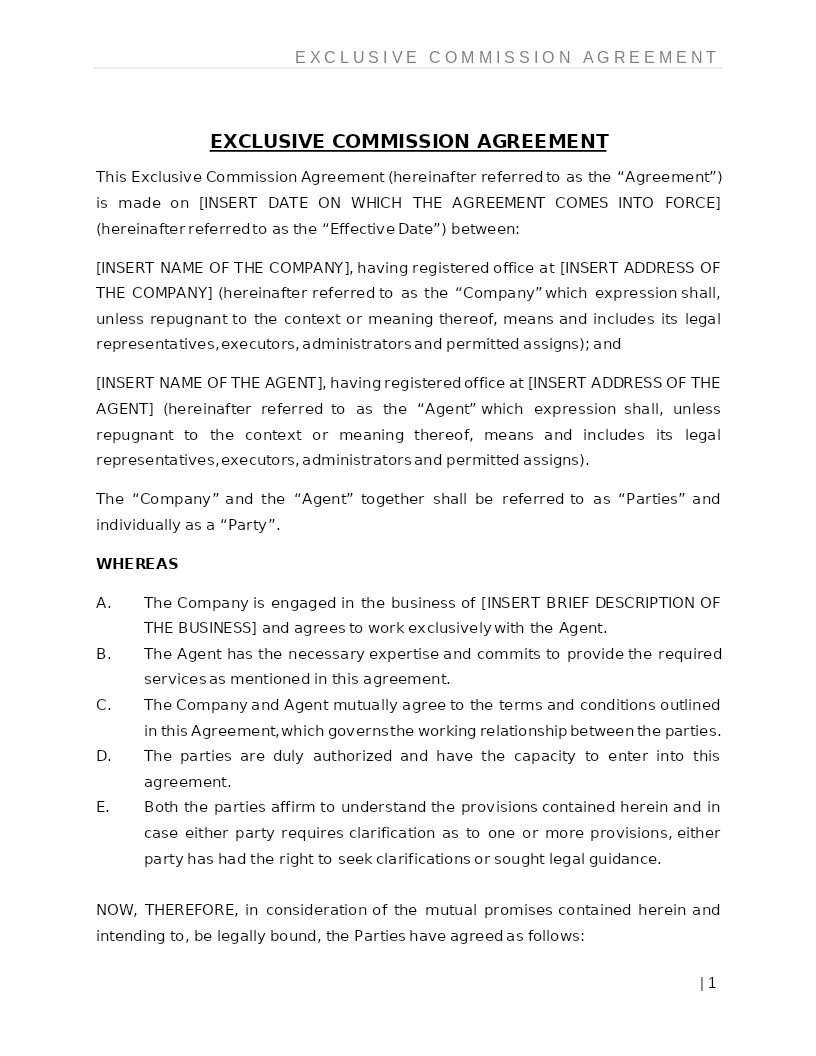
EXCLUSIVE COMMISSION AGREEMENT
How does it work?
1. Choose this template
Start by clicking on "Fill out the template"
2. Complete the document
Answer a few questions and your document is created automatically.
3. Save - Print
Your document is ready! You will receive it in Word and PDF formats. You will be able to modify it.
Establishing Exclusive Commission Rights in Commercial Engagements
When parties enter into a relationship in which one party is granted the exclusive right to solicit, procure, or secure business, sales, clients, or transactions on behalf of another, it is essential to establish a clear contractual framework governing the parties’ rights and responsibilities. An Exclusive Commission Agreement fulfills this function. It outlines the terms under which the Commission Agent (the “Representative”) is granted the exclusive authority to perform defined services and earn commission-based compensation, while the Principal agrees not to engage competing representatives within the designated territory, market segment, or industry sector.
An Exclusive Commission Agreement allows both parties to engage in commercial activities with confidence. It clarifies compensation structure, exclusivity boundaries, performance obligations, confidentiality requirements, and termination rights, ensuring compliance with U.S. contract laws, federal regulations, and applicable state commercial statutes.
Where Exclusive Commission Agreements Are Commonly Used
Exclusive commission arrangements are widely used across various industries and business environments, including:
• Sales representation and exclusive agent appointments
• Business development, lead procurement, and client acquisition services
• Real estate brokerage and property marketing activities
• Talent, creative, media, and entertainment representation
• Distribution, wholesale, and reseller arrangements
• Professional service sourcing and referral-based business activities
• Recruitment, staffing, and executive placement engagements
Any time a business relies on an exclusive outside representative to generate or secure revenue, an Exclusive Commission Agreement establishes the legal obligations and commercial expectations of the parties.
Different Types of Exclusive Commission Agreements You May Encounter
- Exclusive Sales Representation Agreements: Grant a representative exclusive authority to solicit and secure customer orders within a defined territory or market.
- Exclusive Referral or Lead-Generation Agreements: Apply when a representative earns commission solely for introducing clients or opportunities.
- Exclusive Creative or Talent Commission Agreements: Used in entertainment, modeling, music, or creative industries where agents manage exclusive representation rights.
- Exclusive Brokerage Agreements: Common in real estate, investment services, and high-value asset transactions where exclusivity protects the representative’s efforts.
- Exclusive Distribution or Reseller Commission Agreements: Apply when a distributor is the sole authorized seller in a geographic or market-specific area.
When Legal Guidance Becomes Helpful
While many exclusive commission arrangements are straightforward, legal guidance may be beneficial when:
- The agreement involves complex commission structures or multi-tiered compensation
- Significant revenue, long-term exclusivity, or high-value transactions are at stake
- The representative operates across multiple states or regulated sectors
- Intellectual property or confidential information is being shared
- Termination rights, non-solicitation restrictions, or renewal provisions must be carefully drafted
- The arrangement must comply with Federal Trade Commission (FTC) rules, antitrust laws, or state commercial code requirements
- The parties anticipate disputes regarding performance obligations or commission entitlement
Legal review helps ensure that the agreement is enforceable, compliant, and aligned with industry standards.
How to Work With This Template
- Identify the Principal and the Exclusive Representative
- Specify the scope of exclusive rights (territory, market, or services)
- Define the commission structure, payment method, and calculation terms
- Establish performance expectations and reporting requirements
- Specify confidentiality, intellectual property, and non-circumvention obligations
- Select the governing law and jurisdiction
- Review the agreement to ensure accuracy and completeness
- Execute the agreement electronically or in written form
This template follows widely recognized commercial standards and is compatible with major e-signature platforms used throughout the United States.
Frequently Asked Questions
1. What is an Exclusive Commission Agreement, and why is it used?
An Exclusive Commission Agreement is a legally binding contract granting a representative exclusive rights to perform sales, referral, brokerage, or service-related activities in exchange for commission-based compensation. It is used to protect the representative’s efforts, prevent competing agents from operating in the same territory, and clearly define commission obligations.
2. Does exclusivity prevent the Principal from hiring other representatives?
Yes. Under an exclusive arrangement, the Principal agrees not to appoint or authorize any other representative to perform the same services within the defined scope. This ensures that the exclusive representative receives the full benefit of their efforts and investment.
3. Is an Exclusive Commission Agreement enforceable under U.S. law?
Yes. These agreements are enforceable under U.S. contract law, provided the terms are clear, consideration is exchanged, and the exclusivity does not violate antitrust or unfair competition laws. Proper drafting ensures enforceability in court or arbitration.
4. How is commission calculated under an exclusive agreement?
Commission may be based on gross revenue, net profit, closed deals, sourced leads, or other measurable outcomes. The agreement must specify the calculation method, payment schedule, and any deductions or adjustments to avoid disputes.
5. Can an exclusive agreement include performance requirements?
Yes. Many agreements require the representative to meet sales targets, maintain communication, or provide periodic reports. Failure to meet such obligations may allow the Principal to terminate exclusivity.
6. What happens if the Principal completes a sale independently?
In many exclusive arrangements, the exclusive representative is still entitled to a commission for transactions occurring within the defined scope or territory, even if the Principal closes the deal directly. This depends on the contract language.
7. Are electronic signatures valid for exclusive commission agreements?
Yes. Electronic signatures are enforceable under the U.S. ESIGN Act and are widely accepted for commercial contracts, provided both parties consent.
8. Can the exclusivity cover specific industries or market sectors?
Absolutely. Exclusivity may apply to industries, customer types, territories, or product categories. Clearly defining the scope prevents ambiguity and improves enforceability.
9. Can a representative assign their exclusive rights to someone else?
Generally no, unless the agreement expressly permits assignment. Most exclusive agreements prohibit assignment to ensure the Principal retains control over representation quality.
10. What if either party wants to terminate the agreement?
Termination may occur upon breach, failure to meet performance requirements, expiration of the contract term, or written notice. The agreement should outline termination rights and commission obligations for pre-termination activities.