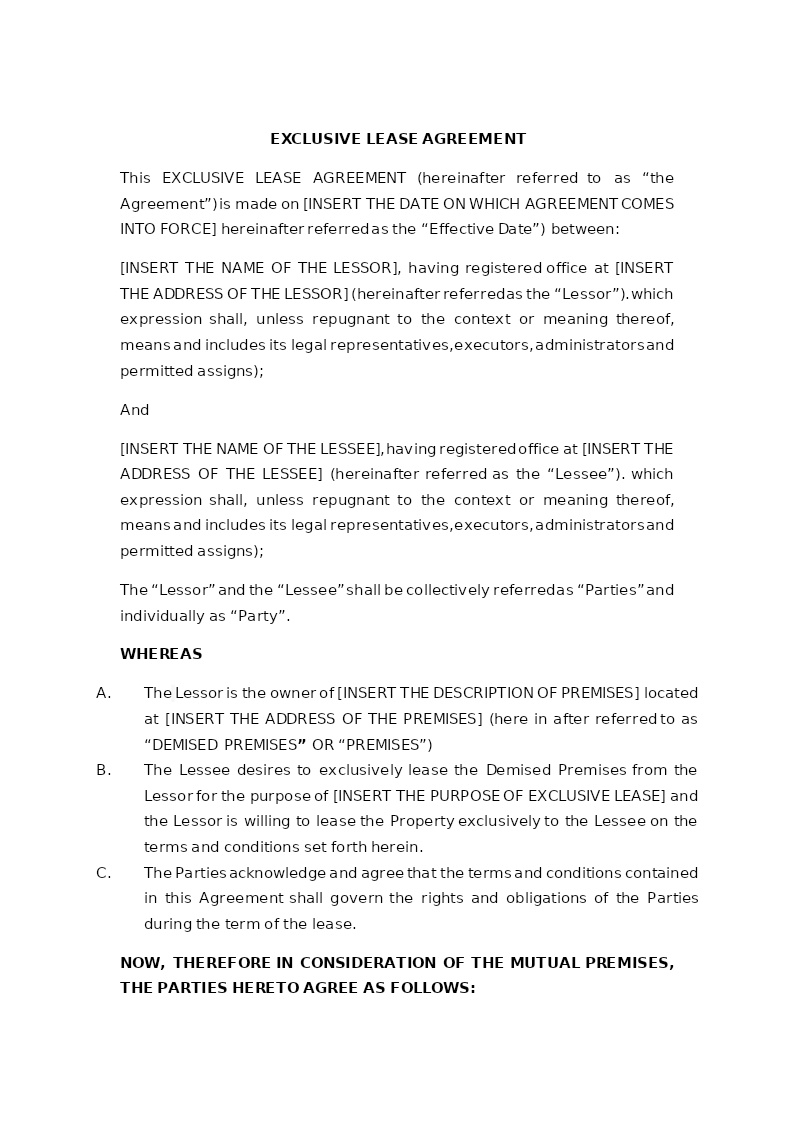
EXCLUSIVE LEASE AGREEMENT
How does it work?
1. Choose this template
Start by clicking on "Fill out the template"
2. Complete the document
Answer a few questions and your document is created automatically.
3. Save - Print
Your document is ready! You will receive it in Word and PDF formats. You will be able to modify it.
Defining Exclusive Possession Rights Through an Exclusive Lease Agreement
Landlords and tenants often require a formal document that grants the tenant exclusive rights to occupy and use a specific property or defined portion of leased premises. An Exclusive Lease Agreement serves this purpose by outlining the terms under which a landlord leases real property exclusively to a tenant, preventing competing tenants or unauthorized third parties from occupying, accessing, or interfering with the use of the leased space. This agreement is executed in accordance with U.S. real estate law, landlord-tenant regulations, zoning and occupancy requirements, commercial leasing standards, and applicable state statutes.
A well-drafted Exclusive Lease Agreement clearly defines the boundaries of exclusive possession, rights of access, permitted uses, maintenance responsibilities, insurance obligations, rent schedules, compliance duties, and restrictions on subleasing or shared occupancy. By formalizing these terms, the agreement ensures that the tenant receives sole, uninterrupted use of the property while the landlord retains enforceable rights and protections related to ownership, regulatory compliance, and lease enforcement.
Where Exclusive Lease Agreements Are Commonly Used
Exclusive Lease Agreements are widely used in commercial, retail, industrial, and residential settings, including:
- Retail stores requiring exclusive control over storefront space
- Commercial office tenants needing secured access and private occupancy
- Restaurants or franchises seeking exclusive rights within a shopping center
- Industrial or warehouse tenants requiring uninterrupted use of storage or production areas
- Residential tenants renting a stand-alone unit or exclusive living quarters
- Businesses needing exclusive laboratory, studio, or specialized work environments
- Landlords seeking to avoid co-tenancy conflicts or competitive use issues
- Properties subject to zoning or regulatory rules requiring single-tenant occupancy
Any scenario requiring private, secure, and uninterrupted occupancy benefits from an Exclusive Lease Agreement.
Different Types of Exclusive Lease Agreements You May Encounter
1. Commercial Exclusive Lease Agreements: Used for retail, office, industrial, and business-use properties requiring sole control of defined premises.
2. Residential Exclusive Lease Agreements: Apply to exclusive arrangements for apartments, homes, studios, or rooms.
3. Exclusive Use Lease Agreements: Grant the tenant exclusive rights to engage in a specific type of business within a multi-tenant property (e.g., the only bakery or coffee shop in a center).
4. Short-Term Exclusive Lease Agreements: Cover temporary events, pop-ups, tenant improvements, or seasonal occupancy.
5. Long-Term Exclusive Lease Agreements: Provide extended occupancy rights, often tied to high-value commercial activity or capital investments.
When Legal Guidance Becomes Helpful
Legal counsel may be needed when:
- The leased property is subject to complex zoning, permitting, or regulatory restrictions
- The lease involves commercial activities governed by additional compliance rules
- Exclusive-use clauses may conflict with existing tenant agreements
- The lease term involves significant financial investment or improvement obligations
- The property includes hazardous materials, environmental requirements, or safety standards
- Negotiations include renewal rights, expansion rights, or exclusivity radius clauses
- The landlord requires indemnification for activities conducted on the property
- State laws impose specific notice, eviction, or habitability requirements
Legal review ensures the agreement complies with U.S. property law, avoids conflicting obligations, and protects both parties against foreseeable risks.
How to Work with This Template
- Identify the landlord, tenant, property address, and exclusive-use boundaries
- Describe the lease term, renewal options, and possession commencement date
- Outline rent amounts, payment schedules, deposits, and late-fee policies
- Define permitted uses, prohibited activities, and compliance obligations
- Address maintenance responsibilities, repairs, utility obligations, and access rights
- Include insurance requirements, indemnification clauses, and liability protections
- Specify restrictions on subleasing, assignment, or sharing occupancy
- State governing law, dispute-resolution procedures, and enforcement mechanisms
- Execute electronically or in writing in accordance with U.S. e-signature laws
This template is compatible with U.S. leasing practices and may be used for commercial landlords, residential property owners, management companies, and business tenants.
Frequently Asked Questions
Q1. What is an Exclusive Lease Agreement, and why is it important?
An Exclusive Lease Agreement is a legally enforceable contract granting a tenant exclusive rights to occupy and use a property. It is important because it prevents unauthorized parties from accessing or sharing the space, ensuring privacy, security, and uninterrupted business operations.
Q2. Are exclusive-use rights enforceable under U.S. law?
Yes. Exclusive-use rights are generally enforceable as long as they comply with state landlord-tenant laws and do not violate zoning or anti-competitive regulations.
Q3. Can a landlord lease the same space to another tenant?
No. Under an exclusive lease, the landlord is prohibited from granting rights to other parties that interfere with the tenant’s exclusive possession.
Q4. What is an exclusive-use clause in a commercial lease?
An exclusive-use clause restricts the landlord from renting space to competing businesses. For example, a tenant may secure exclusive rights to operate the only coffee shop in a shopping center.
Q5. Are electronic signatures valid for lease agreements?
Yes. Under the ESIGN Act and UETA, electronic signatures are legally enforceable for lease agreements and related addenda.
Q6. Can the tenant sublease the property under an exclusive lease?
Only if the agreement permits it. Many exclusive leases restrict subleasing to maintain control over occupancy.
Q7. What happens if the tenant violates the lease terms?
The landlord may pursue remedies such as eviction, damages, or lease termination, depending on the severity of the breach and state law.
Q8. Who is responsible for repairs and maintenance?
Responsibility depends on the agreement. Commercial leases often require the tenant to handle interior maintenance, while landlords typically manage structural repairs.
Q9. Can exclusive leases be used for residential properties?
Yes. Many residential leases provide exclusive possession of the unit, ensuring that the tenant’s privacy and occupancy rights are protected.
Q10. What if the landlord needs to access the property?
Access is generally allowed for repairs, inspections, or emergencies but must comply with notice requirements under state law and the terms of the lease.