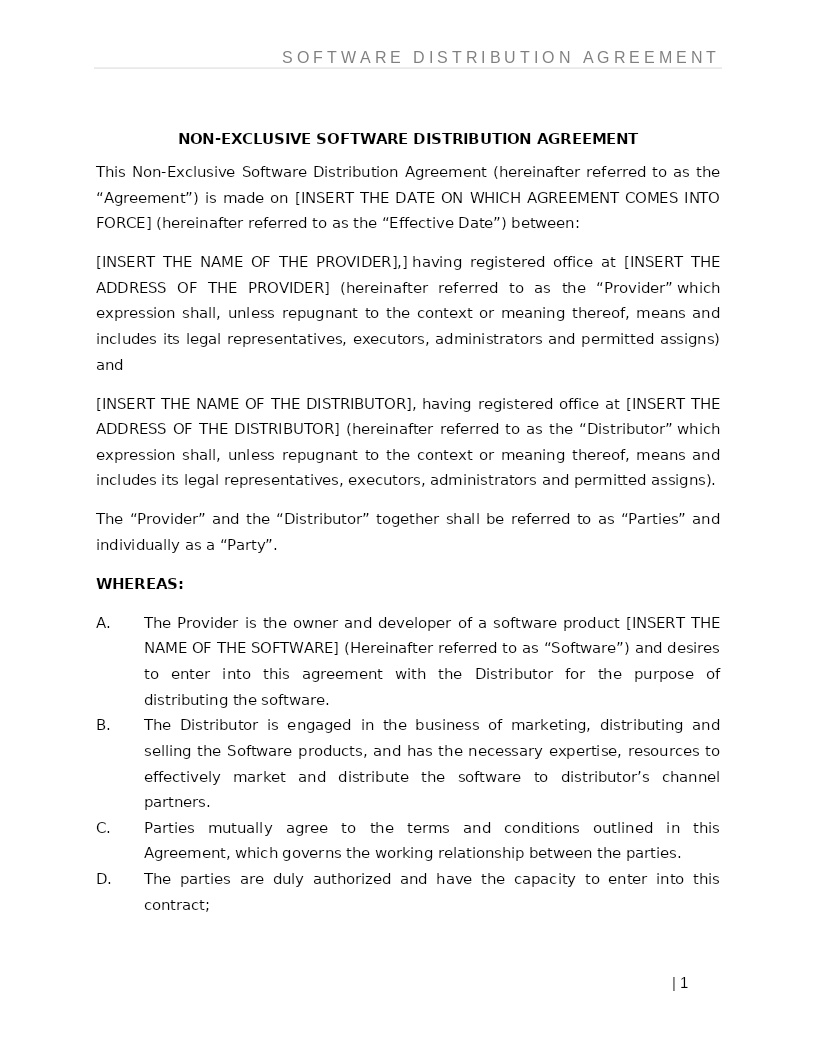
EXCLUSIVE SOFTWARE DISTRIBUTION AGREEMENT
How does it work?
1. Choose this template
Start by clicking on "Fill out the template"
2. Complete the document
Answer a few questions and your document is created automatically.
3. Save - Print
Your document is ready! You will receive it in Word and PDF formats. You will be able to modify it.
Understanding Non-Exclusive Software Distribution Agreements
A Non-Exclusive Software Distribution Agreement is a legally binding contract that allows a distributor to market, sell, or promote software products while the software owner retains the right to appoint additional distributors. This type of agreement does not grant territorial or market exclusivity, giving the software provider flexibility to expand distribution channels without restriction.
In the United States, these agreements operate under federal copyright laws, software licensing rules, digital commerce standards, contract law, and applicable industry regulations. A well-structured agreement clearly defines licensing rights, distribution scope, payment terms, marketing responsibilities, and restrictions to ensure both parties understand their obligations.
Putting a distribution agreement in place helps software creators scale their reach while giving distributors clear guidelines regarding resale, promotion, and use of the software.
Where Non-Exclusive Software Distribution Agreements Are Commonly Used
These agreements are widely used across the tech, SaaS, and digital product markets, including:
• Reseller programs for SaaS, cloud tools, and enterprise software
• Retail distribution of downloadable or packaged software
• Channel partnerships with IT consultants and technology providers
• Software deployment for educational or government clients
• App marketplace distribution or white-label offerings
• International distribution networks with multiple resellers
• Startups expanding reach without exclusive commitments
Any time software is distributed through third parties, a non-exclusive agreement clarifies rights, protects ownership, and reduces legal uncertainty.
Different Types of Software Distribution Models You May Encounter
- Reseller Distribution: Distributors purchase licenses at a discount and resell them to end users.
- Referral or Affiliate Distribution: Distributors refer customers for a commission without handling the sale directly.
- OEM or Bundled Software Distribution: Software is packaged with hardware or other software products.
- Value-Added Reseller (VAR): Distributors add services or custom features before reselling the software.
- Marketplace or Platform Distribution: Software is listed on digital platforms such as app stores or third-party marketplaces.
When Legal Guidance Becomes Helpful
Most standard distribution relationships are straightforward, but legal advice becomes valuable when:
• The software contains proprietary code, data, or trade secrets
• Distribution covers multiple states or countries
• The agreement includes revenue-sharing or complex commission structures
• Additional licensing rights are needed (white-labeling, sublicensing, branding)
• End-user data is involved, requiring compliance with privacy laws
• The distributor handles technical support or product customization
• Intellectual property protection is a core concern
Legal review helps ensure the arrangement complies with U.S. regulatory requirements and safeguards both parties’ commercial interests.
How to Work with This Template
• Identify the software provider and distributor
• Clearly state the licensed software and permitted distribution rights
• Specify territory, distribution channels, and marketing responsibilities
• Set pricing, commission levels, and reporting requirements
• Choose the governing state law
• Outline IP protection, confidentiality, and restricted activities
• Address compliance with copyright laws and end-user license terms
• Review responsibilities together (legal review is optional)
• Sign electronically or in hard copy
The template aligns with U.S. contract standards and is compatible with major e-signature platforms.
Frequently Asked Questions
Q1. What is a Non-Exclusive Software Distribution Agreement?
It is a contract where the software owner allows a distributor to market or resell software without granting exclusivity. This means the provider may appoint multiple distributors simultaneously.
Q2. Is this agreement legally enforceable in the U.S.?
Yes. It is enforceable under state contract laws and federal copyright regulations. Clear written terms help prevent disputes about rights, commissions, and distribution boundaries.
Q3. Does this agreement transfer software ownership?
No. The software provider retains full ownership of the intellectual property. The distributor only receives limited rights to market and distribute the software.
Q4. Can the distributor modify or rebrand the software?
Only if the agreement allows it. Many agreements prohibit modification, reverse engineering, or white-label use unless expressly permitted in writing.
Q5. What are the typical payment structures?
Common models include:
• Commission-based sales
• Fixed reseller discounts
• Revenue sharing
• Tiered pricing based on sales volume
The agreement will specify which model applies.
Q6. Are electronic signatures valid?
Yes. Under the U.S. ESIGN Act, electronic signatures are legally binding once both parties consent to electronic execution.
Q7. Can multiple distributors be appointed at the same time?
Yes. That is the defining feature of a non-exclusive agreement. The software owner may engage other distributors without violating the contract.
Q8. Does this agreement require protection of intellectual property?
Absolutely. IP protection clauses prevent unauthorized copying, sublicensing, or distribution outside of approved channels.
Q9. Is this suitable for SaaS or subscription-based software?
Yes. Many SaaS companies use non-exclusive distribution agreements to scale growth through channel partners without granting exclusivity.
Q10. Can the agreement be terminated early?
Yes. Most agreements include termination rights for non-performance, breach, or business changes. Notice periods and post-termination obligations will apply.