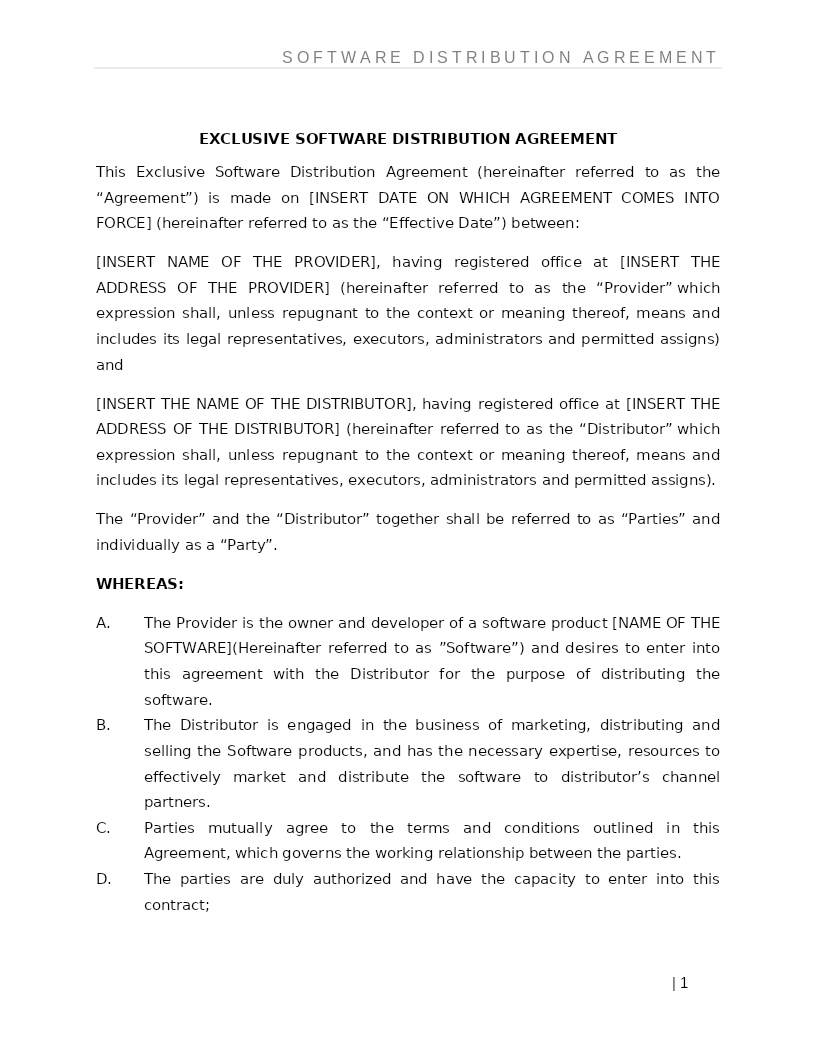
EXCLUSIVE SOFTWARE DISTRIBUTION AGREEMENT
How does it work?
1. Choose this template
Start by clicking on "Fill out the template"
2. Complete the document
Answer a few questions and your document is created automatically.
3. Save - Print
Your document is ready! You will receive it in Word and PDF formats. You will be able to modify it.
Understanding Exclusive Software Distribution Agreements
When a software company wants to expand into new regions, markets, or customer segments, appointing a distributor can be an effective strategy. An Exclusive Software Distribution Agreement defines the terms under which one distributor gains sole rights to market, sell, and distribute a software product within a specific territory or market segment.
This type of agreement outlines the distributor’s responsibilities, the scope of exclusivity, pricing terms, marketing obligations, sales targets, intellectual property protections, and what the distributor is prohibited from doing. An exclusive arrangement also requires clear performance expectations and remedies if obligations aren’t met.
Putting this agreement in place ensures both parties understand the commercial relationship and helps maintain consistency in how the software is promoted, supported, and delivered.
Where Exclusive Software Distribution Agreements Are Commonly Used
Exclusive distribution is widely used in the software industry, especially when market specialization or local presence is essential. Common examples include:
- SaaS products entering new regional markets
- Enterprise software requiring localized support
- Cybersecurity and IT solutions offered through certified partners
- Industry-specific tools, such as legal tech, medical software, or engineering systems
- Reseller and VAR (Value-Added Reseller) networks
- International distribution channels
- Startup products scaling through strategic local partners
Any time a software company wants one distributor to take primary responsibility for a designated market, an exclusive distribution agreement gives structure and protection.
Different Types of Exclusive Software Distribution Agreements You May Encounter
- Territorial Exclusivity: The distributor has sole rights to sell the software within a geographic region (e.g., U.S. West Coast, EU markets).
- Market-Sector Exclusivity: Exclusive rights apply to a specific industry or client category, such as government, education, or healthcare.
- Product-Line Exclusivity: The distributor is given exclusive rights to one specific product or suite of products, not the entire catalog.
- Performance-Based Exclusivity: Exclusivity continues only if the distributor meets sales goals or compliance requirements.
When Legal Guidance Becomes Helpful
Legal support is particularly useful when:
- The agreement covers multiple states or international jurisdictions
- The software involves intellectual property, licensing, or proprietary code
- Exclusivity may conflict with existing reseller arrangements
- The distributor handles customer data or support services
- Sales targets, terminations, or renewal rights involve financial risk
- The arrangement may trigger antitrust concerns in certain industries
- Trademark or branding guidelines need to be enforced consistently
Legal review helps clarify rights, prevent IP misuse, and reduce the risk of future disputes.
How to Work with This Template
- Identify the software owner and the exclusive distributor
- Define the scope of exclusivity, territory, industry, product line
- Outline responsibilities such as marketing, reporting, and support
- Specify pricing, commissions, and payment terms
- Set performance metrics or sales targets
- Include intellectual property protections and restrictions
- Choose the governing state law
- Add provisions for renewal, termination, and confidentiality
- Sign electronically or physically under U.S. contract standards
This template aligns with software-industry practices and is compatible with major e-signature platforms.
Frequently Asked Questions
Q1. What is an Exclusive Software Distribution Agreement and why is it important?
It is a contract granting one distributor sole rights to market and sell a software product in a defined territory or sector. It is important because it prevents competing distributors in the same region and ensures consistent brand representation and controlled sales strategy.
Q2. Does exclusivity mean the distributor owns the software?
No. Exclusivity only applies to distribution rights. The software creator or company retains full ownership of all intellectual property, source code, and branding assets.
Q3. What should be included in an Exclusive Software Distribution Agreement?
Clear definitions of territory, pricing, support obligations, IP protections, marketing responsibilities, and performance expectations. These details help both parties avoid misunderstandings and maintain a productive partnership.
Q4. Can exclusivity be revoked if the distributor underperforms?
Yes. Many agreements include performance-based triggers that allow the software owner to cancel or modify exclusivity if the distributor fails to meet sales targets or compliance standards.
Q5. Are electronic signatures enforceable in the U.S.?
Yes. Under the ESIGN Act, e-signatures are legally binding once both parties consent to signing electronically.
Q6. Can the distributor sublicense the software to others?
Only if the agreement explicitly allows it. Most exclusive agreements restrict sublicensing to maintain control over brand quality and customer experience.
Q7. Does this agreement include marketing obligations?
Often, yes. Exclusive distributors may be required to promote the software, attend trainings, or follow brand guidelines to maintain consistency in the marketplace.
Q8. Is an exclusive arrangement suitable for startups?
Yes, exclusive distribution can help startups scale quickly in new markets. However, it’s important to set realistic targets and protective clauses to avoid dependency on a single distributor.
Q9. What happens if customers in another region try to buy from the exclusive distributor?
The agreement defines whether cross-territory sales are permitted. Many software companies restrict out-of-territory transactions to maintain orderly markets.
Q10. Does this agreement prevent the software owner from selling directly to customers?
It depends on the contract. Some agreements allow direct sales, while others give the distributor complete exclusivity. Clear terms prevent conflicts.