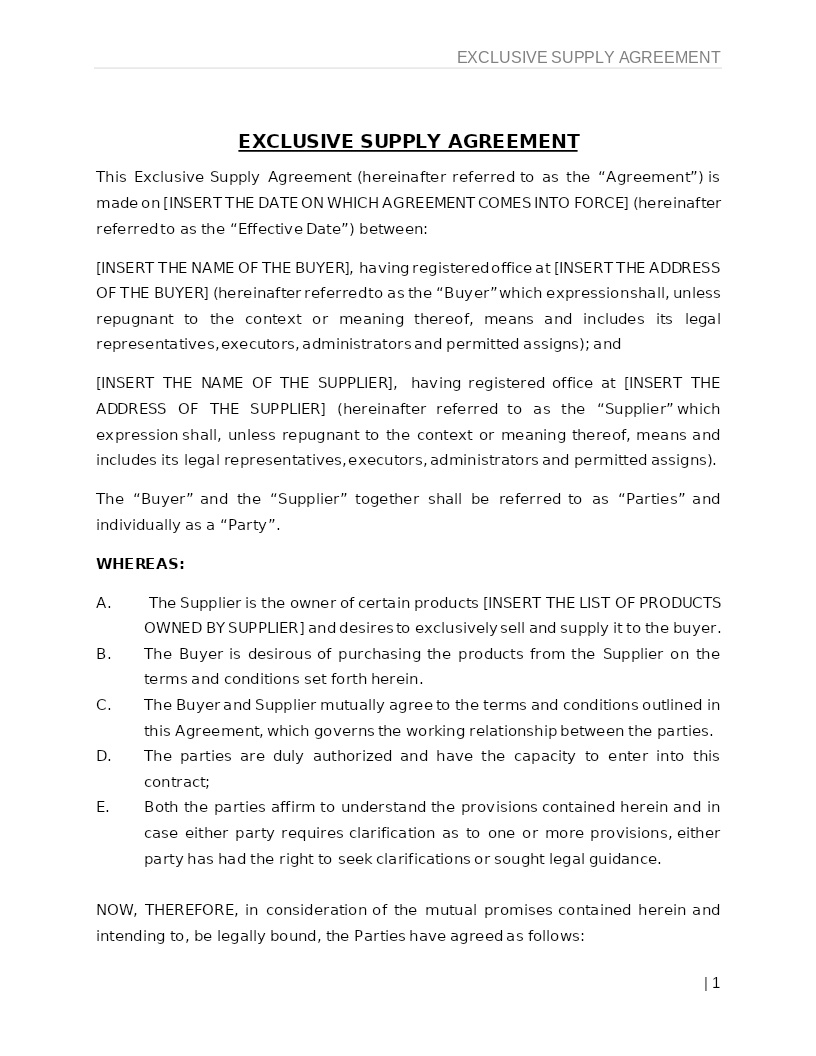
EXCLUSIVE SUPPLY AGREEMENT
How does it work?
1. Choose this template
Start by clicking on "Fill out the template"
2. Complete the document
Answer a few questions and your document is created automatically.
3. Save - Print
Your document is ready! You will receive it in Word and PDF formats. You will be able to modify it.
Establishing Exclusive Supply Relationships in U.S. Commercial Contracts
An Exclusive Supply Agreement is a legally binding contract in which a supplier agrees to provide specific goods or services exclusively to one buyer, often within a defined territory, industry, or timeframe. This exclusivity prevents the supplier from selling the same products to the buyer’s competitors, creating a controlled supply chain arrangement that strengthens market stability and competitive advantage.
In U.S. business environments, Exclusive Supply Agreements are widely used in manufacturing, retail, franchising, distribution, food & beverage, pharmaceuticals, and technology sectors. These agreements ensure consistent product availability, predictable pricing, and a strategic partnership built on long-term commitment.
Where Exclusive Supply Agreements Are Commonly Used
Exclusive supply arrangements are used across multiple commercial scenarios, including:
- Manufacturers supplying products exclusively to a distributor or retail chain
- Suppliers providing specialty components for high-tech or automotive companies
- Food & beverage suppliers servicing restaurants, hotels, or franchises
- Pharmaceutical or medical suppliers supporting healthcare networks
- Private-label or co-branded product collaborations
- Logistics and procurement partnerships that require steady inventory
- Long-term supply chains for construction, energy, or industrial materials
These agreements help create predictable supply conditions and foster dependable working relationships.
Different Types of Exclusive Supply Agreements You May Encounter
- Exclusive Product Supply: Supplier provides specific goods exclusively to one buyer within a defined market.
- Exclusive Territory Supply: The buyer receives exclusivity within a specific region or geographic boundary.
- Exclusive Channel Supply: Supplier agrees not to sell through competing distribution channels (e.g., online vs. retail).
- Requirements Supply Agreement: Supplier provides all of the buyer’s needs for certain products, ensuring full supply commitment.
- Co-Brand or Private Label Supply: Products are customized or branded exclusively for a specific buyer.
When Legal Guidance Becomes Helpful
Exclusive supply arrangements often involve competitive restrictions and long-term commercial commitments. Legal consultation becomes valuable when:
- The agreement impacts pricing, distribution rights, or competition in the market
- Either party wants to include performance obligations or minimum purchase targets
- The supplier sells multiple product lines or operates in heavily regulated industries
- The buyer needs guaranteed supply for critical operations or production lines
- The agreement involves multi-state or cross-border operations
- There are concerns about antitrust compliance or restrictive trade practices
- Intellectual property, trademarks, or proprietary formulas are involved
Legal review ensures compliance with U.S. commercial laws, antitrust regulations, and industry standards.
How to Work with This Template
- Specify the supplier and buyer with full business details
- Describe the products or services covered by exclusivity
- Define pricing, payment terms, delivery schedules, and order procedures
- Clarify exclusivity boundaries (territory, product category, industry, or sales channel)
- Outline quality requirements, inspection rights, and performance expectations
- Include provisions for shortages, delays, supply failures, or force majeure
- Address intellectual property rights if products involve proprietary materials
- Select governing state law and dispute resolution procedures
- Sign electronically or in hard copy
This template aligns with U.S. commercial contracting standards and supports both small and large supply-chain arrangements.
Frequently Asked Questions
Q1. How does an Exclusive Supply Agreement benefit a business in the U.S. market?
An Exclusive Supply Agreement gives the buyer predictable access to products or services without worrying about supply shortages or competitors purchasing from the same source. In industries where consistency and timing matter, such as manufacturing, retail, food service, pharmaceuticals, and technology, exclusive access stabilizes inventory planning and strengthens the buyer’s competitive advantage. For the supplier, exclusivity helps secure long-term demand and strengthens revenue predictability.
Q2. Does exclusivity mean the supplier can only sell to one customer?
Not always. Exclusivity applies only to what is defined in the contract. A supplier may agree to sell specific products exclusively to one buyer, or restrict sales only within certain regions, industries, or distribution channels. Outside those boundaries, the supplier may continue operating freely. The agreement’s wording determines how narrow or broad the exclusivity actually is.
Q3. How is pricing typically structured in an Exclusive Supply Agreement?
Pricing can be fixed, tiered, volume-based, or subject to periodic review, depending on market conditions. Because the buyer commits to exclusivity, they often secure favourable pricing, priority allocation, or locked-in rates for a defined duration. Clear pricing terms, such as discounts, price-adjustment formulas, and payment cycles, help avoid future disagreements and ensure transparency for both parties.
Q4. What happens if the supplier fails to meet the required supply levels?
Supply-failure provisions are essential in an Exclusive Supply Agreement. Some contracts require the supplier to give early notice of delays, provide temporary alternative products, or compensate the buyer for missed deadlines. In extreme cases, the buyer may gain the right to temporarily source from third parties until the supplier resolves the issue. These clauses protect the buyer’s operations and maintain reliability in the supply chain.
Q5. Are quality standards and inspection rights usually included?
Yes. Exclusive supply arrangements almost always outline strict quality standards, testing procedures, inspection rights, and performance metrics. This ensures the buyer receives consistent quality and the supplier adheres to agreed specifications. In industries like food processing, pharmaceuticals, or electronics, quality-control clauses help avoid costly recalls, regulatory violations, or operational disruption.
Q6. Do Exclusive Supply Agreements raise competition or antitrust concerns?
They can but only if drafted incorrectly. U.S. antitrust laws prohibit agreements that unfairly restrict competition or harm market fairness. When exclusivity is reasonable in scope, time, and product coverage, it is generally enforceable. Legal review ensures the agreement complies with antitrust principles and avoids excessive restrictions that could be challenged in court.
Q7. How long does an Exclusive Supply Agreement typically last?
The duration varies widely. Some agreements last one to three years, while others extend for five years or more, particularly in industries with long product life cycles or significant supplier investments. The term should reflect the nature of the goods, expected demand, and the level of commitment the supplier must make. Renewal options, extension mechanisms, and termination rights are also important to outline clearly.
Q8. Can the buyer exit the agreement early? What happens then?
Early termination depends on the specific contract terms. Some agreements allow termination for cause, such as supply failures, quality issues, or breach of obligations. Others may require notice periods, payment of outstanding invoices, reimbursement of supplier investments, or fulfilment of minimum-purchase commitments before exiting. Early exit clauses protect both parties from unexpected financial losses.
Q9. Can Exclusive Supply Agreements be signed electronically in the U.S.?
Yes. Under the ESIGN Act and UETA, electronic signatures are fully enforceable across all U.S. states. Businesses frequently finalize supply agreements through DocuSign, Adobe Sign, or other e-signature tools, which speeds up procurement processes, reduces administrative delays, and creates secure digital records for long-term compliance.