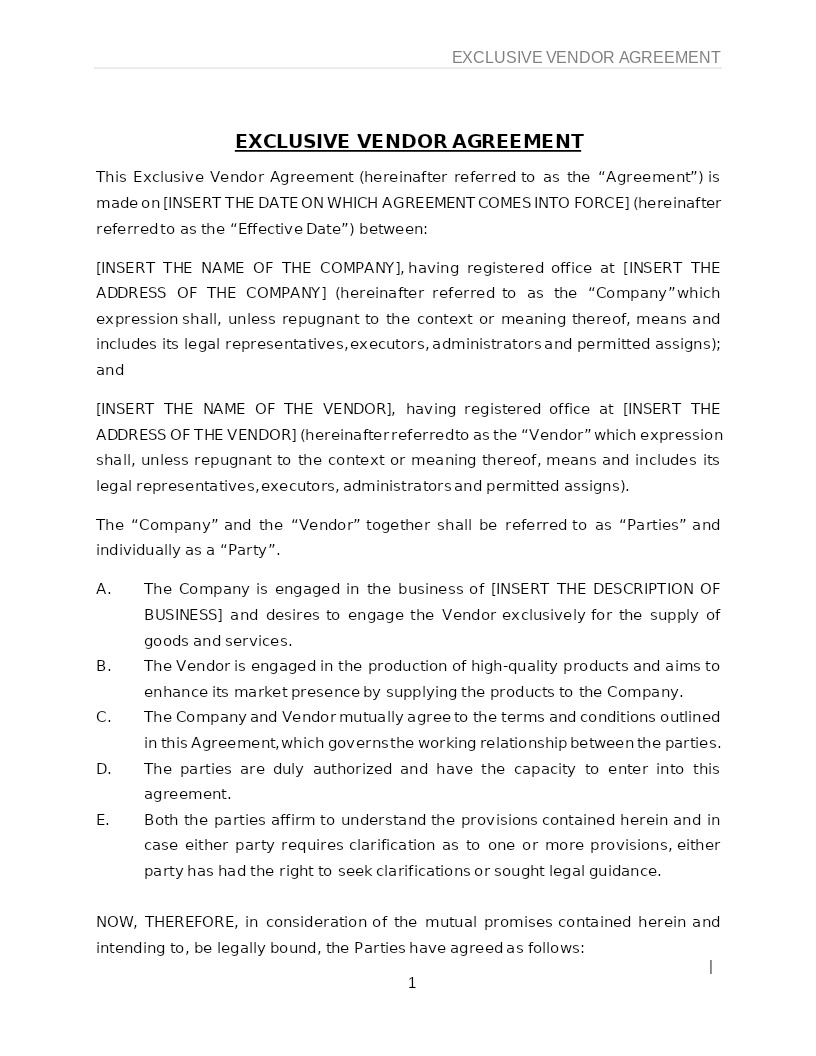
EXCLUSIVE VENDOR AGREEMENT
How does it work?
1. Choose this template
Start by clicking on "Fill out the template"
2. Complete the document
Answer a few questions and your document is created automatically.
3. Save - Print
Your document is ready! You will receive it in Word and PDF formats. You will be able to modify it.
Understanding Exclusive Vendor Agreements
An Exclusive Vendor Agreement is a legally binding contract in which a business grants a vendor the exclusive right to supply specific goods or services for a defined period, territory, or product category. This agreement outlines exclusive supply rights, pricing, quality standards, delivery obligations, confidentiality, performance requirements, and termination conditions.
In the United States, Exclusive Vendor Agreements operate under state contract laws, Uniform Commercial Code (UCC) rules for goods, federal competition and antitrust regulations, and industry-specific compliance requirements. These agreements help businesses maintain consistent product quality, streamline supply chains, and build reliable long-term vendor relationships while ensuring exclusive access to certain products or services.
Where Exclusive Vendor Agreements Are Commonly Used
Exclusive Vendor Agreements are frequently used in business relationships where dedicated supply and quality consistency are essential. Common applications include:
- Franchise businesses requiring standardized products or ingredients
- Retail chains working with exclusive suppliers for branded merchandise
- Restaurants and food-service companies sourcing unique ingredients
- Manufacturers partnering with vendors for specialized components
- Technology companies procuring proprietary software or hardware
- Event organizers contracting exclusive service providers
- E-commerce brands forming long-term supply partnerships
Any time a business wants guaranteed access to a single vendor’s goods or services, an Exclusive Vendor Agreement provides clear expectations and legal protections.
Different Types of Exclusive Vendor Arrangements You May Encounter
- Product-Specific Exclusivity: Vendor supplies only certain defined products exclusively.
- Territorial Exclusivity: Vendor is the exclusive provider for a specific geographic region or market segment.
- Category-Based Exclusivity: Vendor is the sole provider for a category, such as packaging, equipment, or ingredients.
- Time-Limited Exclusivity: Exclusivity applies only for a set duration, tied to performance metrics or contract renewal.
When Legal Guidance Becomes Helpful
Legal review is especially beneficial when:
- Exclusivity clauses may raise antitrust or competition concerns
- The vendor relationship involves large financial commitments
- The company relies heavily on the vendor for critical supplies
- The agreement includes intellectual property licensing or branding rights
- Performance requirements or minimum purchase obligations are included
- The vendor accesses confidential or proprietary business information
- The contract spans multiple U.S. states or international jurisdictions
Legal guidance ensures the agreement stays compliant with U.S. commercial laws and protects both parties from supply-chain, performance, and liability risks.
How to Work with This Template
- Identify the client and exclusive vendor
- Define the scope of products or services covered by exclusivity
- Specify pricing, payment terms, order procedures, and delivery timelines
- Outline quality standards, performance obligations, and inspection rights
- Include confidentiality, IP protections, and compliance requirements
- Set the duration of exclusivity and renewal terms
- Choose the governing U.S. state law
- Include termination rights for non-performance or breach
- Sign electronically or in hard copy following U.S. contract rules
This template is compatible with all major U.S. e-signature platforms and aligns with widely accepted commercial contracting practices.
Frequently Asked Questions
1. What is an Exclusive Vendor Agreement and why is it important?
An Exclusive Vendor Agreement designates a single vendor as the exclusive provider of certain goods or services. It is important because it ensures consistency, prevents suppliers from serving competitors, and creates a stable, long-term business partnership.
2. Are Exclusive Vendor Agreements legally enforceable in the U.S.?
Yes. These agreements are enforceable under state contract law and UCC standards. However, exclusivity must comply with U.S. antitrust and competition laws to avoid unfair market restrictions. Clear terms and performance standards help ensure enforceability.
3. What should be included in an Exclusive Vendor Agreement?
A strong agreement includes exclusive supply terms, pricing, quality requirements, order processes, confidentiality, liability protections, and termination rights. These provisions prevent misunderstandings and protect both parties legally.
4. Can exclusivity apply to only certain products or services?
Absolutely. Exclusivity can be limited to specific products, categories, services, or regions. This flexibility allows businesses to tailor the agreement to their operational needs while maintaining competitive control.
5. How do businesses ensure vendors meet performance standards?
Most agreements include inspection rights, service-level expectations, quality standards, reporting duties, and performance metrics. Businesses may also include minimum purchase requirements or penalties for non-compliance.
6. Does exclusivity mean the business cannot buy from any other vendor?
Yes, within the scope defined in the agreement. If exclusivity applies to certain products, services, or regions, the client must purchase those items solely from the agreed-upon vendor during the contract term.
7. Can an Exclusive Vendor Agreement include intellectual property rights?
Yes. Agreements often include brand usage rights, private-label manufacturing terms, packaging standards, or IP licensing to maintain consistency and protect proprietary information.
8. Can the agreement be terminated early?
Yes. Early termination is usually allowed for non-performance, breach of contract, quality failures, or failure to meet minimum purchase obligations. The agreement will outline notice periods and termination procedures.
9. Are electronic signatures valid for Exclusive Vendor Agreements?
Yes. Under the U.S. ESIGN Act, electronic signatures are fully enforceable. Most businesses use platforms like Docu Sign or Adobe Sign for fast, secure contract execution.
10. Is an Exclusive Vendor Agreement suitable for small businesses?
Definitely. Small businesses can benefit from consistent pricing, reliable supply, and priority service. Exclusive partnerships help build long-term vendor relationships and ensure access to essential products or services without interruption.