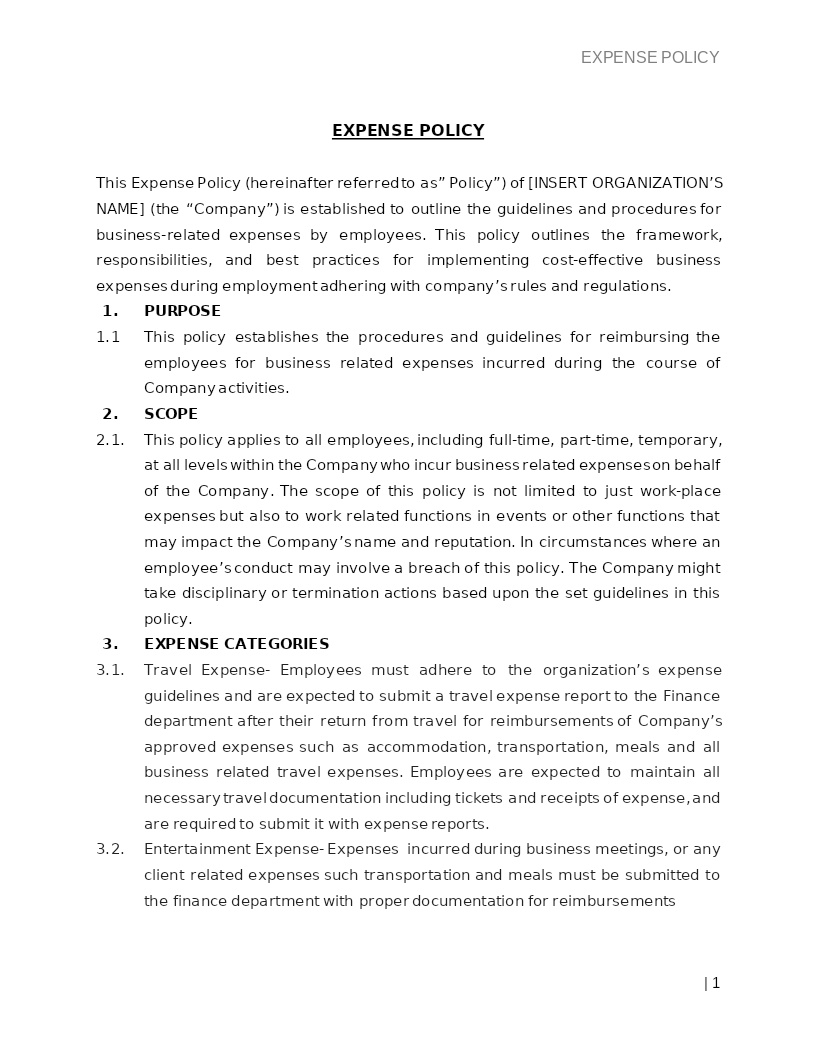
EXPENSE POLICY
How does it work?
1. Choose this template
Start by clicking on "Fill out the template"
2. Complete the document
Answer a few questions and your document is created automatically.
3. Save - Print
Your document is ready! You will receive it in Word and PDF formats. You will be able to modify it.
Promoting Financial Accountability and Compliance Through an Expense Policy
An Expense Policy is a formal internal governance document that establishes the rules, procedures, and standards governing the reimbursement, approval, and documentation of business-related expenses incurred by employees, contractors, and authorized representatives. Drafted in accordance with U.S. federal tax laws, including IRS substantiation requirements, state employment regulations, Department of Labor (DOL) standards, and organizational accounting principles, this policy ensures that expenditures made in the course of employment are necessary, reasonable, compliant, and properly documented. It provides the framework through which organizations maintain financial integrity, prevent misuse of corporate funds, and create clear expectations regarding permissible expenses.
A well-structured Expense Policy outlines categories of reimbursable and non-reimbursable expenses, defines approval workflows, establishes submission deadlines, and sets forth requirements for receipts, reports, digital-record retention, and audit procedures. It also explains the standards for travel expenses, lodging, meals, mileage, entertainment, supplies, professional training, and client-facing expenditures. By implementing this policy, an organization ensures transparency, improves budgetary controls, reinforces fiscal responsibility, and reduces legal and financial risks associated with improper reimbursements, tax-reporting errors, or regulatory noncompliance.
Where Expense Policies Are Commonly Used
Expense Policies are widely adopted across all sectors and organizational structures, including:
- Corporations with large traveling workforces or multi-state operations
- Government contractors required to follow strict audit and documentation standards
- Nonprofits and educational institutions with grant-funded or donor-restricted budgets
- Professional services firms managing client-billable or project-based expenditures
- Healthcare providers and medical institutions with compliance-sensitive operations
- Startups and technology companies seeking uniform reimbursement practices
- Retail and field-service operations with frequent travel or procurement needs
- Financial institutions subject to internal-control and regulatory-audit requirements
Any organization that reimburses employees for work-related expenses benefits from a formal Expense Policy.
Different Types of Expense Policies You May Encounter
1. General Corporate Expense Policies: Cover routine reimbursements, travel, per diem rules, and internal expense controls.
2. Travel and Entertainment (T&E) Policies: Provide detailed guidance for airfare, lodging, ground transportation, business meals, and client-entertainment expenses.
3. Procurement and Purchasing Expense Policies: Address purchase approvals, vendor selection, and acquisition of goods or services.
4. Grant-Funded or Compliance-Specific Expense Policies: Apply to nonprofits, research institutions, or government-funded projects.
5. Remote-Work Expense Policies: Cover home-office equipment, communication tools, and technology-related expenses.
When Legal Guidance Becomes Helpful
Legal review may be needed when:
- The organization reimburses employees across multiple states with varying labor rules
- The policy intersects with IRS accountable-plan regulations
- Reimbursements include taxable and non-taxable components
- The company must comply with federal contractor or grant-management rules
- The policy governs travel across international borders
- Disputes arise over reimbursement eligibility or payroll deductions
- Expense documentation must meet strict audit or regulatory-filing requirements
- Employees work remotely and require clarification on legally required reimbursements
Professional legal guidance ensures compliance with U.S. tax, employment, and financial-reporting laws, reducing exposure to audits, disputes, and penalties.
How to Work with This Template
- Define the scope of reimbursable and non-reimbursable expenses clearly
- Establish approval processes, including supervisory and financial-department review
- Provide detailed rules for travel—airfare, lodging, meal allowances, mileage, and incidentals
- Include receipt, invoice, and documentation requirements for all reimbursements
- Integrate IRS guidelines regarding substantiation and tax treatment of reimbursements
- Clarify deadlines for submitting reimbursement requests and consequences for late filings
- Set forth per diem rates, spending limits, and exceptions for unusual circumstances
- Address remote-work expenses, equipment allowances, and technology reimbursements
- Outline the auditing, compliance, and disciplinary procedures for misuse of funds
- Require acknowledgement from employees through written or electronic signature
This template reflects widely accepted corporate and regulatory compliance practices for U.S. employers.
Frequently Asked Questions
Q1. What is an Expense Policy, and why is it important?
An Expense Policy outlines the rules for reimbursing employees for business-related expenses. It is important because it ensures financial accountability, promotes tax compliance, and prevents misuse of company funds.
Q2. Are organizations legally required to have an Expense Policy?
While not always mandatory, many industries—especially government-funded, nonprofit, or regulated sectors—must maintain written reimbursement standards for compliance and audit purposes.
Q3. What expenses are typically reimbursable?
Common reimbursable expenses include travel, lodging, meals, mileage, supplies, professional-development costs, and client-business expenses. Each organization may set unique parameters.
Q4. Do reimbursements need to comply with IRS guidelines?
Yes. The IRS requires proper documentation, business purpose, and timely submissions to qualify as non-taxable reimbursements under an accountable plan.
Q5. Are meal and entertainment costs reimbursable?
Often yes, but limits usually apply, and IRS deductibility rules may restrict certain expenses.
Q6. Can remote-work expenses be reimbursed?
Many employers reimburse reasonable remote-work expenses, such as internet, phone use, or office equipment, depending on company policy and applicable state laws.
Q7. What happens if an employee submits fraudulent or unauthorized expenses?
Such actions may result in disciplinary measures, reimbursement denial, payroll adjustments, or termination, and may expose employees to legal liability.
Q8. How soon must employees submit reimbursement requests?
Most policies require submission within a specified timeframe—often 30 days—along with receipts and proper documentation.
Q9. Should employees keep original receipts?
Yes. Original or digital receipts are required for audit purposes and must be retained according to organizational recordkeeping standards.
Q10. Should legal counsel review the Expense Policy?
Yes. Because reimbursement rules interact with tax, labor, and financial-reporting laws, legal counsel can ensure the policy is compliant, defensible, and tailored to organizational needs.