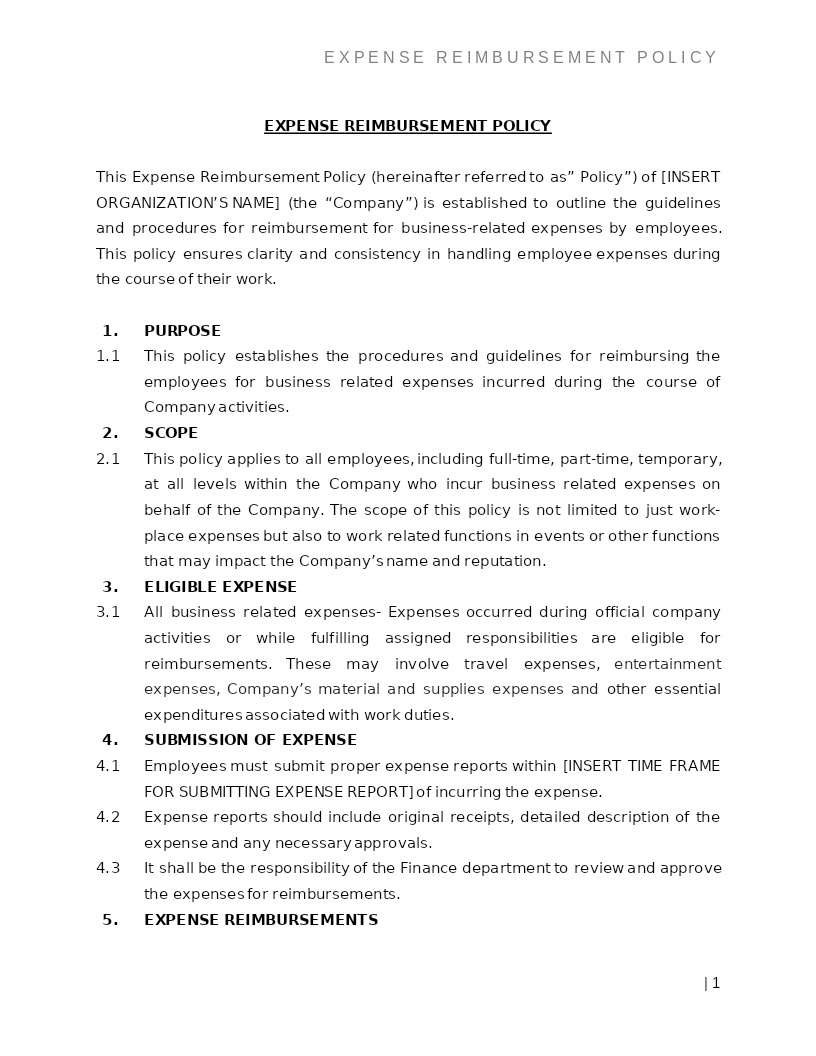
EXPENSE REIMBURSEMENT POLICY
How does it work?
1. Choose this template
Start by clicking on "Fill out the template"
2. Complete the document
Answer a few questions and your document is created automatically.
3. Save - Print
Your document is ready! You will receive it in Word and PDF formats. You will be able to modify it.
Understanding Expense Reimbursement Policy in U.S.
An Expense Reimbursement Policy is a formal workplace policy that outlines the rules, procedures, and documentation requirements for employees seeking repayment of business-related expenses. This policy provides clear guidelines on eligible expenses, submission timelines, approval processes, and reimbursement limits. In the United States, an Expense Reimbursement Policy also helps employers comply with federal and state wage and hour laws, IRS regulations, and accountable plan requirements. A well-defined policy ensures fair, accurate, and timely reimbursements while maintaining financial transparency and promoting responsible company spending.
Where an Expense Reimbursement Policy Is Commonly Used
- Corporate offices and professional service firms
- Tech companies and remote-work environments
- Sales, marketing, and business development teams
- Travel-intensive roles (consultants, field agents, executives)
- Nonprofits, educational institutions, and government programs
- Healthcare, construction, logistics, and service-based industries
- Any business requiring employees to incur expenses for work
Different Types of Expense Reimbursement Policies
- Standard Expense Reimbursement Policy: Covers general business expenses such as meals, travel, and office purchases.
- Travel & Entertainment (T&E) Policy: Defines rules for airfare, hotels, transportation, and client-related entertainment.
- Remote Work Expense Policy: Reimburses home-office expenses such as internet, equipment, and utilities.
- Vehicle & Mileage Reimbursement Policy: Follows IRS mileage rates for business-related travel.
- Project-Specific or Client-Billable Expense Policy: Used when costs must be approved, tracked, and billed to clients.
- Executive & Leadership Reimbursement Policy: Covers higher-level allowances for senior management and executive travel.
When Legal Guidance becomes Helpful
Customizing this policy with real-time lawyers or in-house counsel ensures:
- Compliance with IRS rules for "Accountable Plans"
- Alignment with federal and state employment laws
- Protection against wage and hour violations under the FLSA
- Clear definitions of reimbursable vs. non-reimbursable expenses
- Proper risk management and fraud prevention measures
- Accurate and enforceable employee obligations
- Customized approval flows and reimbursement limits
- Strong documentation requirements to support audits and tax filings
Legal review ensures your policy is enforceable, compliant, and tailored to your business operations, minimizing risks and financial disputes.
How to Use This Policy
- Provide to all employees during onboarding
- Include in employee handbooks and HR systems
- Review during travel planning and expense submissions
- Require employees to sign acknowledgment of policy acceptance
- Update annually based on IRS rate changes or legal updates
Frequently Asked Questions
Q1. What types of expenses are typically reimbursable under an Expense Reimbursement Policy?
Reimbursable expenses usually include travel costs, meals, lodging, mileage, office supplies, client entertainment, and job-related fees. Each company may define additional eligible categories. The policy helps employees understand which purchases are covered and avoids confusion during reimbursement.
Q2. How does the reimbursement process work for employees?
Employees must submit receipts and required documentation within the timeline stated in the policy, often through an expense management system. Supervisors review and approve claims, and accounting processes the reimbursement. A clear process ensures accuracy, accountability, and timely payments.
Q3. Are there legal requirements for expense reimbursement in the U.S.?
Yes. Under certain state laws (e.g., California, Illinois), employers must reimburse necessary business expenses. Additionally, IRS guidelines require companies to maintain an Accountable Plan to avoid treating reimbursements as taxable income. A compliant policy helps businesses meet these legal obligations.
Q4. How does the policy prevent fraudulent or excessive expense claims?
The policy requires original receipts, pre-approvals, spending limits, and detailed documentation. These controls help prevent misuse, detect irregularities, and ensure claims are legitimate. Clear auditing procedures further reduce the risk of fraudulent reimbursements.
Q5. What happens if an employee submits a claim without proper documentation?
Without required documentation, the reimbursement may be delayed or denied based on company policy. Employees may be asked to provide missing receipts, written explanations, or alternative proof. These rules maintain financial accuracy and protect the company during audits.
Q6. Are reimbursements taxable for employees?
Under an IRS Accountable Plan, reimbursements for valid business expenses are generally not taxable. If the policy does not follow IRS standards, such as requiring receipts or timely submission, reimbursements may be considered taxable wages. A compliant policy ensures employees are not taxed unnecessarily.
Q7. How long does reimbursement typically take?
Most companies reimburse employees within 7–30 days after submission, depending on internal approval workflows. Clear timelines help maintain employee satisfaction and ensure financial predictability. Delays are minimized with complete documentation and streamlined processes.
Q8. Can employees be reimbursed for personal expenses incurred during business trips?
Personal expenses, such as leisure activities, personal items, or non-business meals, are typically not reimbursable. If an expense includes both personal and business portions (e.g., shared hotel room), only the business portion is reimbursed. The policy clearly distinguishes these categories to avoid confusion.