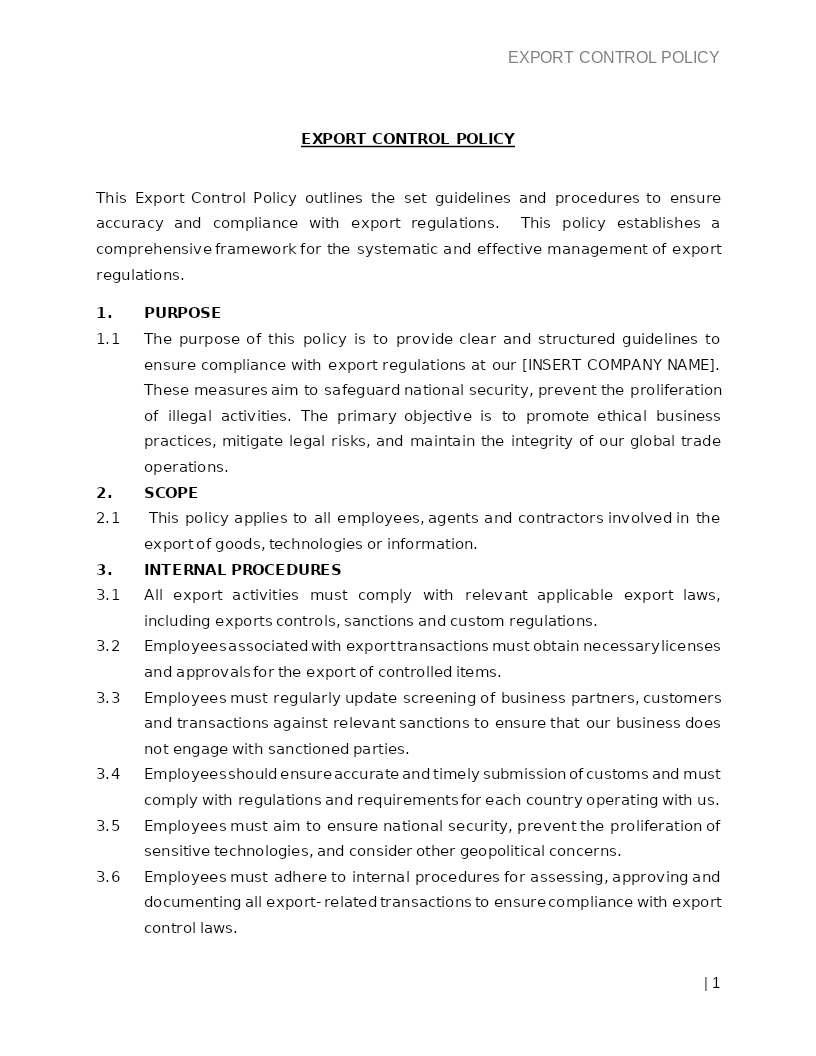
EXPORT CONTROL POLICY
How does it work?
1. Choose this template
Start by clicking on "Fill out the template"
2. Complete the document
Answer a few questions and your document is created automatically.
3. Save - Print
Your document is ready! You will receive it in Word and PDF formats. You will be able to modify it.
Strengthening Regulatory Compliance Through an Export Control Policy
An Export Control Policy is a formal organizational directive that governs the lawful handling, transfer, and export of goods, software, technology, data, and services that are subject to U.S. export-control regulations. Developed in accordance with the Export Administration Regulations (EAR), International Traffic in Arms Regulations (ITAR), Office of Foreign Assets Control (OFAC) sanctions, and related federal statutes, this policy establishes the procedures required to ensure that no restricted items, controlled technologies, or sensitive information are exported physically, digitally, or verbally without proper authorization from the governing authorities.
A comprehensive Export Control Policy sets forth the obligations of employees, contractors, researchers, and corporate divisions in identifying controlled items, classifying technologies, screening transactions, and securing the licenses necessary to comply with U.S. law. It provides guidelines for recordkeeping, due diligence, red-flag screening, restricted-party checks, secure handling of technical data, and reporting of potential violations. By adopting this policy, an organization demonstrates its commitment to global compliance, national security, customer transparency, and responsible international business conduct. The policy also minimizes legal exposure by preventing unauthorized exports, mitigating enforcement actions, and ensuring robust governance over sensitive operations.
Where Export Control Policies Are Commonly Used
Export Control Policies are heavily relied upon across industries engaged in international trade, sensitive technologies, or cross-border collaboration, including:
- Aerospace and defense manufacturers handling ITAR-controlled technical data
- Technology companies exporting encryption software, semiconductors, or dual-use items
- Universities and research institutions conducting international collaborations or hosting foreign researchers
- Manufacturers producing hardware, equipment, or industrial systems for global distribution
- Financial institutions screening international transactions for sanctioned entities
- Logistics and shipping companies transporting controlled goods or restricted items
- Energy and chemical companies managing regulated substances and specialized technologies
- Corporate enterprises distributing software, cloud services, or digital platforms to international markets
Any organization that interacts with foreign persons, foreign entities, or exportable technologies benefits from a legally robust Export Control Policy.
Different Types of Export Control Policies You May Encounter
1. General Corporate Export Control Policies: Apply organization-wide, governing the export of goods, software, and technology.
2. ITAR-Specific Compliance Policies: Developed for entities dealing with military or defense-related articles and technical data.
3. EAR Technology-Classification Policies: Address the categorization of commercial and dual-use items under the Commerce Control List (CCL).
4. Sanctions and Restricted-Party Screening Policies: Focus on OFAC compliance and global sanctions enforcement.
5. Research and Academic Export Policies: Designed for universities or labs handling foreign collaborations or sensitive research.
When Legal Guidance Becomes Helpful
Legal counsel may be required when:
- The organization develops, uses, or exports-controlled technologies or encryption products
- Business operations involve foreign subsidiaries, suppliers, investors, or collaborators
- Exports require classification under EAR or ITAR technical categories
- The company conducts restricted-party screening for sanctioned individuals or entities
- Internal investigations or audits reveal suspected compliance violations
- A government agency issues inquiries, notices, or enforcement actions
- The business must develop internal licensing, training, or corrective-action programs
- Cross-border data flows or cloud-based services involve foreign access to controlled information
Legal review ensures compliance with U.S. trade laws, reduces enforcement risk, and strengthens internal governance.
How to Work with This Template
- Identify which products, software, and technologies may be subject to export controls
- Classify items according to EAR categories, ITAR USML listings, or OFAC restrictions
- Establish screening procedures to identify restricted countries, entities, and individuals
- Define responsibilities for licensing, approvals, and reporting obligations
- Implement secure handling and access-control measures for technical data and sensitive technology
- Require training for employees interacting with controlled items or international partners
- Outline incident-reporting and violation-escalation procedures
- Maintain export documentation and retention records as required under U.S. regulations
- Integrate compliance measures with procurement, logistics, R&D, and IT security processes
- Review and update the policy regularly based on law changes or organizational growth
This template aligns with industry-standard practices for U.S. export compliance and is suitable for companies of all sizes, as well as academic and research institutions.
Frequently Asked Questions
Q1. What is an Export Control Policy, and why is it important?
An Export Control Policy is a formal compliance document governing the lawful export of goods, technologies, software, and services. It is important because it helps organizations avoid violations of U.S. export laws, reduces legal risk, and ensures proper handling of controlled technologies.
Q2. Which U.S. laws govern export controls?
Key laws include the Export Administration Regulations (EAR), International Traffic in Arms Regulations (ITAR), and OFAC sanctions programs, all of which impose strict requirements on the export of sensitive items.
Q3. Does this policy apply to digital exports?
Yes. Export controls apply to encrypted software, cloud-based data transfers, emails containing technical information, and foreign access to controlled systems.
Q4. Who must follow the Export Control Policy?
Employees, contractors, consultants, researchers, vendors, and any individual handling export-controlled items must comply.
Q5. Can exporting controlled technology without a license result in penalties?
Yes. Violations can result in civil penalties, criminal fines, loss of export privileges, reputational damage, and, in some cases, imprisonment.
Q6. Does the policy apply to foreign employees working in the U.S.?
Yes. Sharing controlled information with a foreign person even within U.S. borders may constitute a “deemed export.”
Q7. How does the company determine which items are controlled?
Through classification under the EAR’s Commerce Control List (CCL), ITAR’s U.S. Munitions List (USML), and OFAC’s restricted entity lists.
Q8. Are universities and research institutions subject to export controls?
Yes. Research activities involving foreign nationals, sensitive technologies, or international collaborations may trigger export requirements.
Q9. Can the Export Control Policy be combined with cybersecurity policies?
Many organizations integrate export control with cybersecurity, data-protection, and access-control protocols to prevent unauthorized digital exports.
Q10. Should legal counsel review the Export Control Policy?
Absolutely. Given the severity of penalties and the technical nature of export controls, legal review is essential for compliance and risk mitigation.