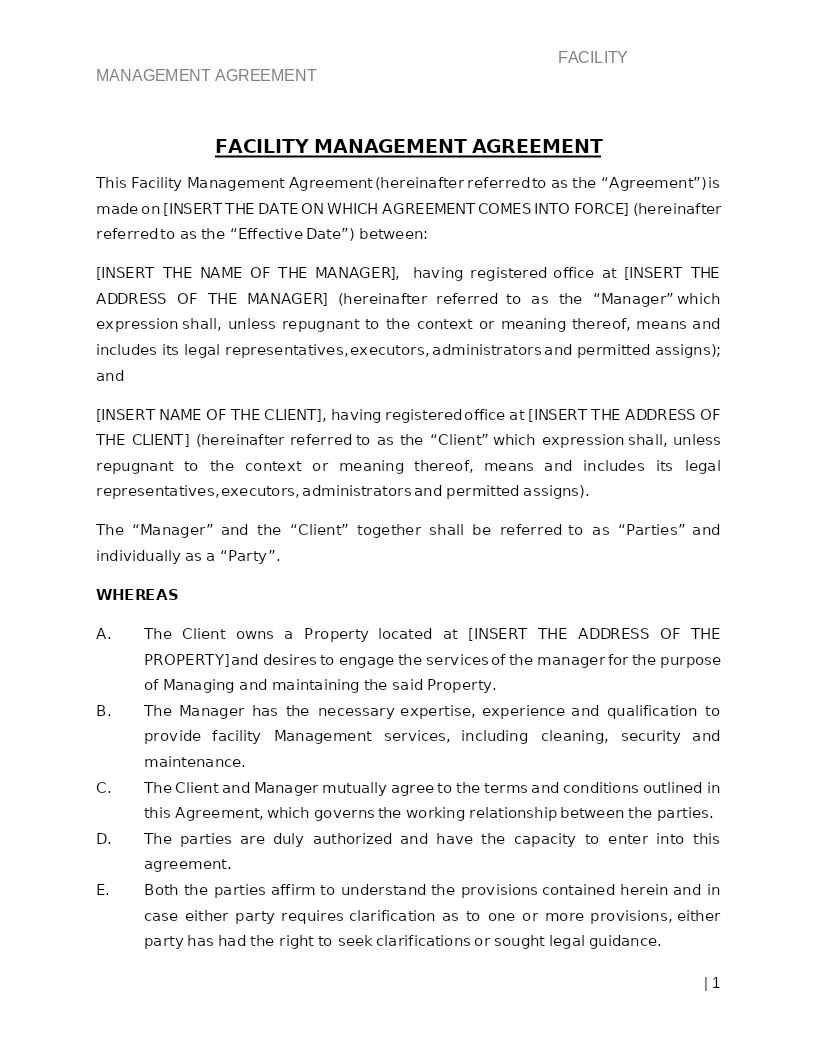
FACILITY MANAGEMENT AGREEMENT
How does it work?
1. Choose this template
Start by clicking on "Fill out the template"
2. Complete the document
Answer a few questions and your document is created automatically.
3. Save - Print
Your document is ready! You will receive it in Word and PDF formats. You will be able to modify it.
Managing Facility Operations with Clarity & Accountability
When an organization hires a service provider to manage, operate, or maintain a facility whether an office building, industrial plant, commercial complex, or multi-use property there must be a clear framework that defines responsibilities, performance standards, and service expectations. A Facility Management Agreement provides that structure. It outlines the services the provider will deliver, how the facility will be maintained, and what standards must be met for safety, efficiency, and compliance.
Putting a Facility Management Agreement in place allows both parties to work confidently, exchange operational information, and maintain the property effectively without uncertainty about duties, liabilities, or quality expectations.
Where Facility Management Agreements Are Commonly Used
Facility management contracts are widely used across the U.S. in situations such as:
- Commercial office buildings, coworking spaces, and business parks
- Warehouses, distribution centers, and manufacturing plants
- Retail malls, hotels, and hospitality properties
- Hospitals, healthcare centers, and regulated facilities
- Residential complexes and homeowner associations
- Educational campuses and institutional buildings
- Government and public-sector buildings
- Corporate headquarters and multi-location enterprises
Any time a facility owner relies on a third-party provider for maintenance, security, cleaning, compliance, or energy management, a written agreement ensures transparency and protects both parties.
Different Types of Facility Management Agreements You May Encounter
- Full-Service Facility Management Agreement: The service provider manages all aspects of facility operations, including maintenance, security, cleaning, utilities, and vendor coordination.
- Maintenance-Only Agreement: Covers preventive and corrective maintenance for equipment, infrastructure, HVAC systems, and building assets.
- Soft Services Agreement: Focuses on cleaning, landscaping, waste management, pest control, and other non-technical services.
- Hard Services Agreement: Covers technical and engineering services, including electrical, mechanical, plumbing, and energy management.
- Project-Specific Facility Services: Used for renovation support, one-time equipment upgrades, audits, or compliance projects.
- Integrated Facility Management (IFM) Agreement: A comprehensive contract where a single provider manages multiple services across multiple sites for consistency and efficiency.
When Legal Guidance Becomes Helpful
Most routine facility management engagements benefit from legal review, but professional guidance becomes essential when:
- The scope includes high-value assets or complex building operations
- The facility is subject to strict safety, environmental, or regulatory standards
- The contract includes performance-based payments or service-level agreements (SLAs)
- Multiple jurisdictions or multi-site properties are involved
- The tasks include handling sensitive information, security systems, or proprietary equipment
- Liability exposure is high, such as in healthcare, education, or manufacturing facilities
- The agreement includes energy management, green compliance, or certification requirements
- The contract affects existing vendor, lease, or service arrangements
Legal review ensures that responsibilities are clearly defined, liabilities are managed, and the contract complies with U.S. facility, safety, and operational regulations.
How to Work with This Template
- Identify the parties (facility owner and service provider)
- Clearly define the purpose of the agreement and the service scope
- Specify operational duties, deliverables, and service-level expectations
- Set out payment terms, invoicing structure, and performance metrics
- Detail responsibilities for maintenance, repairs, security, and compliance
- Identify insurance, indemnity, and liability requirements
- Choose governing state law
- Review the terms together (legal review recommended)
- Sign electronically or in hard copy
The template follows standard U.S. contracting practices and works with all major e-signature platforms.
Frequently Asked Questions
Q1. What is a Facility Management Agreement and why is it important in the U.S.?
A Facility Management Agreement is a contract that defines how a service provider will manage and maintain a property. In the U.S., where buildings must meet strict safety, environmental, and operational standards, this agreement protects both parties by clearly outlining duties, service quality expectations, and liability boundaries. It ensures that facilities operate efficiently and remain compliant with federal, state, and local regulations.
Q2. What services are typically covered in a Facility Management Agreement?
Facility management contracts may include cleaning, maintenance, security, energy management, landscaping, administrative support, and technical services such as HVAC, plumbing, and electrical maintenance. The agreement specifies which services the provider must deliver and the performance standards each service must meet.
Q3. Who benefits the most from a Facility Management Agreement—the owner or the service provider?
Both benefits. The facility owner gains operational efficiency, cost savings, and professional expertise, while the service provider receives a clear outline of expectations, risk allocation, and payment terms. A well-structured agreement ensures that both parties understand their obligations and minimizes disputes.
Q4. Does a Facility Management Agreement help reduce operational costs?
Yes. By outlining preventive maintenance, optimized scheduling, and resource management, the agreement helps minimize breakdowns, avoid unexpected repairs, and reduce energy waste. Many U.S. organizations use these agreements to stabilize budgets and improve asset life cycles.
Q5. How does a Facility Management Agreement address safety and regulatory compliance?
The agreement typically includes clauses requiring compliance with U.S. building codes, OSHA standards, environmental laws, fire-safety regulations, and any industry-specific requirements. Compliance provisions protect the facility owner from penalties and ensure that the service provider follows legally mandated practices.
Q6. Can the scope of services be customized for different types of facilities?
Absolutely. Whether managing a hospital, school, industrial plant, or commercial building, the scope can be tailored to match the facility’s operational needs, risk profile, and service-level expectations. Customizing the agreement ensures the services align with the facility’s size, usage, and regulatory environment.
Q7. Are electronic signatures legally valid for Facility Management Agreements in the United States?
Yes. Under the ESIGN Act, electronic signatures are recognized as legally binding. Most U.S. businesses prefer e-signatures because they simplify contract execution and allow multiple parties to sign remotely.
Q8. What happens if either party fails to meet their obligations?
If one party breaches the agreement such as failing to provide agreed services or failing to make payments the non-breaching party may seek remedies like termination, financial compensation, or dispute resolution such as arbitration. Most agreements include cure periods, allowing the breaching party to correct issues before further action is taken.
Q9. Can a Facility Management Agreement cover multiple locations or jurisdictions?
Yes. Many U.S. organizations use integrated facility management agreements that cover several buildings or states. The contract designates one governing state law, while service terms are adapted to local requirements and performance standards.
Q10. Should companies consult lawyers before signing a Facility Management Agreement?
Yes. Because these agreements involve operational risk, regulatory requirements, and large-scale responsibilities, legal review ensures that the terms are enforceable, fair, and protective of business interests. A U.S. lawyer can help negotiate liability terms, ensure compliance, and customize the scope based on industry-specific obligations.