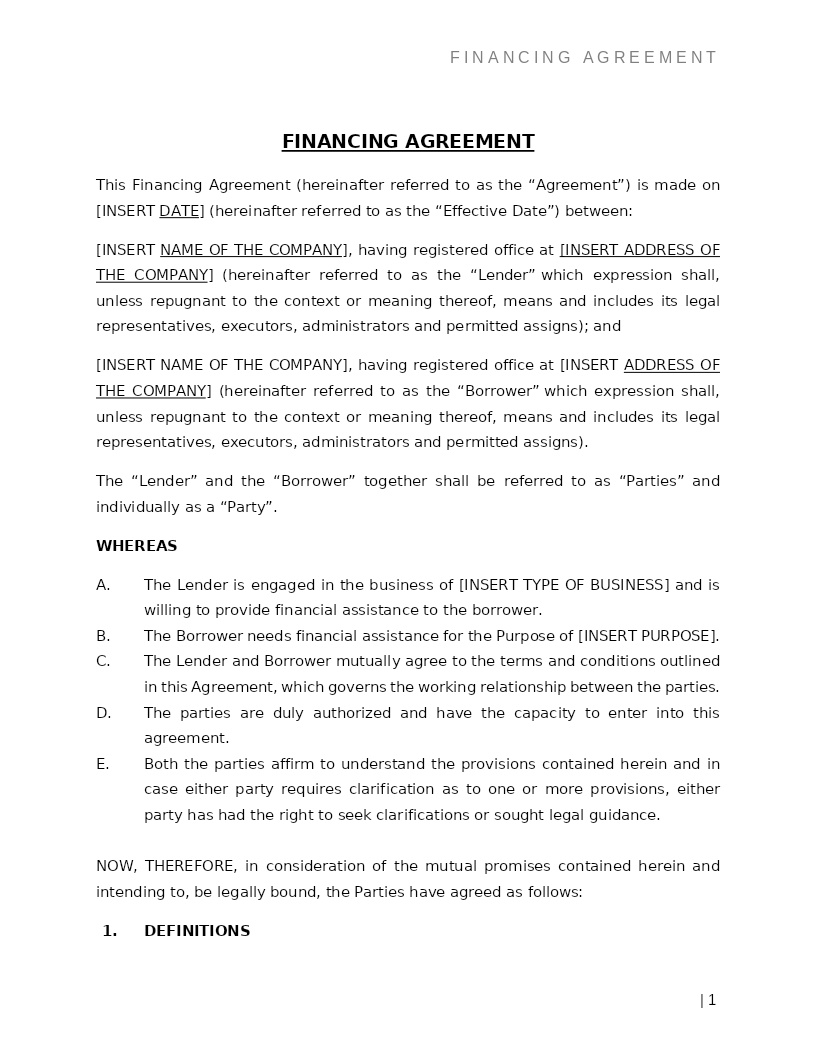
FINANCING AGREEMENT
How does it work?
1. Choose this template
Start by clicking on "Fill out the template"
2. Complete the document
Answer a few questions and your document is created automatically.
3. Save - Print
Your document is ready! You will receive it in Word and PDF formats. You will be able to modify it.
Establishing Financial Obligations in Lending and Credit Transactions
When parties enter into a financial arrangement in which one party provides funds, credit, or other monetary consideration to another, it is essential to establish a comprehensive contractual framework governing such obligations. A financing agreement serves this purpose. It outlines the terms under which the lender extends financing to the borrower, including repayment obligations, interest, collateral, covenants, representations, and remedies, all in accordance with U.S. federal lending regulations and applicable state commercial and consumer protection laws.
By executing a financing agreement, the parties create a legally enforceable record of their financial relationship. This allows both lender and borrower to proceed with certainty regarding repayment terms, security interests, permitted uses of funds, and the consequences of default. A properly drafted financing agreement minimizes risk, prevents misunderstandings, and ensures compliance with relevant lending regulations such as the Truth in Lending Act (TILA), Uniform Commercial Code (UCC) provisions, and any applicable state usury laws.
Where Financing Agreements Are Commonly Used
Financing agreements are utilized in a wide range of commercial and personal financial transactions, including:
- Business loans and commercial lending arrangements
- Equipment financing and lease-to-own structures
- Secured and unsecured credit facilities
- Startup financing, bridge loans, and convertible debt
- Real estate acquisition and development financing
- Personal loans, promissory notes, and credit extensions
- Vendor financing, purchase-money security interests, and trade credit
- Franchise financing, working capital loans, and expansion funding
Any time funds are extended in exchange for repayment obligations, a financing agreement formalizes and governs the transaction.
Different Types of Financing Agreements You May Encounter
1. Secured Financing Agreements: Require the borrower to provide collateral, granting the lender a security interest under Article 9 of the UCC.
2. Unsecured Financing Agreements: Extend funds without collateral but typically involve stricter covenants.
3. Term Loans: Structured with fixed repayment periods and interest schedules.
4. Revolving Credit Facilities: Permit repeated borrowing up to a set credit limit.
5. Convertible Financing Agreements: Allow the lender to convert debt into equity under defined conditions.
6. Equipment or Asset-Based Financing: Use specific assets as collateral or as the basis for loan approval.
When Legal Guidance Becomes Helpful
Legal review may be advisable when:
- The financing involves significant principal or complex security interests
- The Borrower is a business entity with multiple owners or subsidiaries
- Collateral must be perfected under the UCC filing system
- Personal guarantees, subordination agreements, or intercreditor arrangements are required
- Consumer lending laws, licensing requirements, or usury limits apply
- The financing includes variable interest, balloon payments, or equity conversion features
- Enforcement remedies, foreclosure rights, or dispute resolution clauses need clarity
Legal counsel ensures the agreement complies with federal and state lending regulations and protects the rights of both parties.
How to Work With This Template
- Identify the Lender and Borrower
- Specify the financing amount, term, and interest rate
- Outline repayment schedules, fees, and charges
- Clarify whether the financing is secured and describe any collateral
- Include representations, warranties, and financial reporting obligations
- Set forth default events and remedies
- Select governing law and dispute-resolution terms
- Review the draft for compliance with applicable U.S. lending laws
- Execute the agreement electronically or in writing
This template aligns with generally accepted U.S. commercial lending practices and is compatible with major e-signature platforms.
Frequently Asked Questions
1. What is a Financing Agreement, and why is it necessary?
A financing agreement is a legally binding contract setting forth the terms under which a lender provides funds to a borrower. It is necessary because it clarifies repayment obligations, interest rates, security interests, and remedies, reducing the risk of disputes and ensuring compliance with U.S. lending laws.
2. Is collateral required in a Financing Agreement?
Not always. Some financing arrangements are unsecured. However, many commercial or high-value loans require collateral, which must be perfected under UCC Article 9 to ensure the lender’s priority rights.
3. Are interest rates regulated under U.S. law?
Yes. Federal and state laws impose restrictions on interest rates (usury laws), disclosures (TILA), and lending practices. A financing agreement must comply with these regulations to remain enforceable.
4. How are repayment terms established?
Repayment terms including payment schedule, late fees, and methods of payment—are clearly outlined in the agreement. Fixed, variable, and amortizing structures may all be used depending on the nature of the loan.
5. Can a Financing Agreement include personal guarantees?
Yes. Lenders often require business owners or affiliates to personally guarantee repayment, providing additional security for the loan.
6. What happens if the borrower defaults?
Default may trigger remedies such as acceleration of the outstanding balance, foreclosure on collateral, legal action, or termination of financing. The agreement specifies the events of default and available remedies.
7. Are electronic signatures valid for Financing Agreements?
Yes. Electronic signatures are enforceable under the ESIGN Act and widely used in commercial and consumer lending transactions.
8. Can the borrower prepay the loan without penalty?
Prepayment rights depend on the agreement. Some loans allow penalty-free prepayment, while others impose fees to compensate the lender for lost interest.
9. Does a Financing Agreement apply to personal loans?
Yes. Financing Agreements may govern business loans, personal loans, and hybrid arrangements. Consumer protections apply more strictly in personal lending.
10. Can a Financing Agreement be modified after execution?
Yes, but modifications must be documented in a written amendment signed by both parties. Oral changes are generally unenforceable.
11. How does the lender enforce its security interest?
If the loan is secured, the lender may enforce its rights through repossession, foreclosure, or sale of collateral, subject to UCC procedures and state foreclosure laws.
12. Does the agreement cover additional advances or credit increases?
It can. Some Financing Agreements include provisions for future advances, increased credit limits, or refinancing, subject to mutual consent.