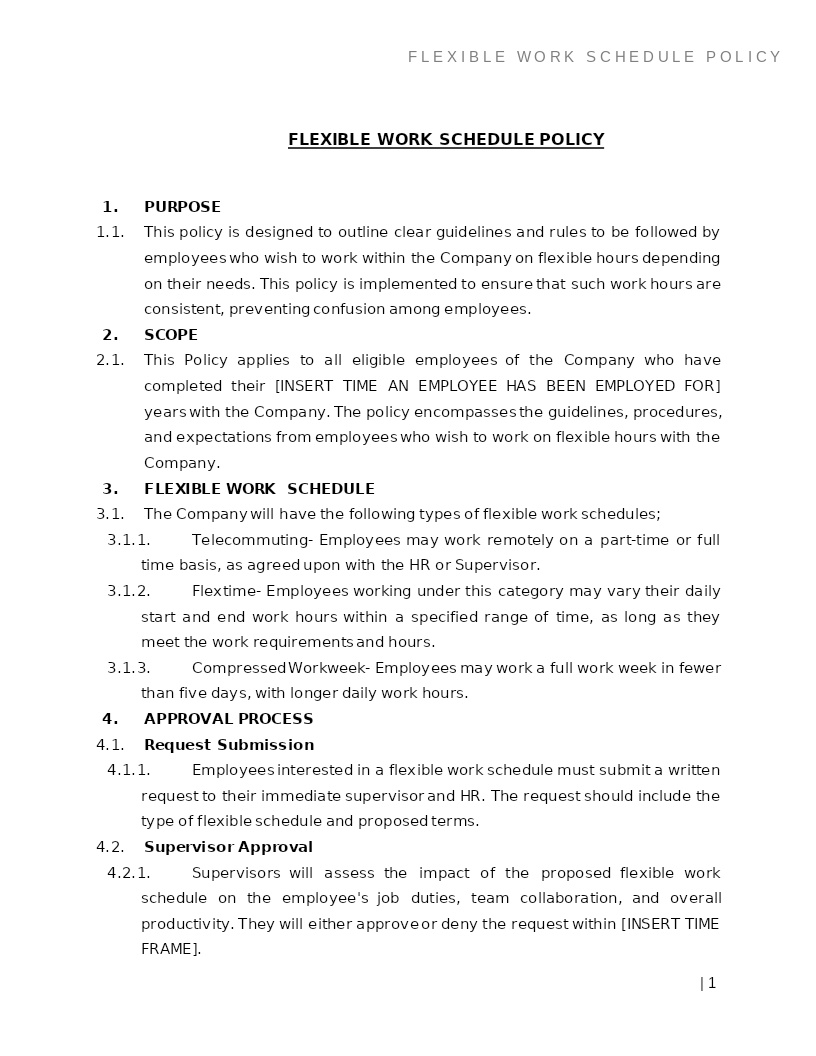
FLEXIBLE WORK SCHEDULE POLICY
How does it work?
1. Choose this template
Start by clicking on "Fill out the template"
2. Complete the document
Answer a few questions and your document is created automatically.
3. Save - Print
Your document is ready! You will receive it in Word and PDF formats. You will be able to modify it.
Understanding Flexible Work Schedule Policy In U.S.
A Flexible Work Schedule Policy outlines the guidelines under which employees may adjust their work hours or location to better meet personal needs while fulfilling job responsibilities. It covers options such as remote work, staggered shifts, flexible start and end times, hybrid work arrangements, and compressed workweeks. This policy helps create a supportive work environment that aligns with U.S. labor laws and organizational goals.
By establishing a structured, legally compliant framework, the policy enhances employee well-being, boosts efficiency, and helps organizations attract and retain talent. It clarifies expectations regarding communication, availability, performance standards, and accountability to ensure smooth business operations.
Where Flexible Work Schedule Policies Are Commonly Used
Flexible Work Schedule Policies are widely used across industries that support remote or hybrid work environments or require adaptable scheduling. These policies are popular in:
• Corporate offices, startups, and tech companies
• Healthcare, education, and administrative sectors
• Customer service, marketing, HR, and operations teams
• Government, non-profit, and hybrid-model organizations
• Remote freelance teams, distributed workforces, and national employers
• Industries where employees balance caregiving, commutes, or varying workloads
Any business seeking to promote productivity and employee engagement can benefit from structured flexible work guidelines.
Different Types of Flexible Work Arrangements You May Encounter
- Remote or Hybrid Work Arrangements: Allow employees to work fully or partially from home, ensuring secure access to company systems and compliance with data protection laws.
- Flexible Hours (Flextime): Employees choose their start and end times within approved ranges, improving work-life balance without affecting core business operations.
- Compressed Workweeks: Employees work longer hours over fewer days (e.g., 4×10 schedule), maintaining full-time hours with increased personal time.
- Staggered or Shift-Based Schedules: Useful for reducing workplace crowding, accommodating time zones, and improving operational coverage.
- Part-Time Flexibility or Job Sharing: Two employees share one full-time role, or employees work reduced hours with defined responsibilities.
When Legal Guidance Becomes Helpful
Legal consultation is critical when customizing a Flexible Work Schedule Policy because:
• U.S. labor regulations, including the Fair Labor Standards Act (FLSA), govern hours worked, overtime, and pay practices.
• State wage-and-hour laws differ, especially concerning breaks, overtime, remote work reimbursements, and recordkeeping.
• Employers must navigate privacy rules for employee monitoring, time tracking, and remote access to company systems.
• Lawyers ensure compliance with ADA accommodation requirements, which may overlap with flexible scheduling.
• Multi-state employers must ensure consistency while adhering to state-specific legal obligations.
In-house counsel helps align flexibility initiatives with the company’s risk management, data security, performance expectations, and legal duties.
How to Work With This Policy Template
• Determine which roles are eligible for flexible or remote work arrangements.
• Define communication protocols, availability requirements, and performance expectations.
• Establish guidelines for secure remote access, data protection, and equipment use.
• Clarify scheduling approval processes, manager responsibilities, and documentation rules.
• Ensure compliance with federal and state wage-and-hour laws, including overtime calculations.
• Implement procedures for periodic review and evaluation of flexible arrangements.
• Train managers to apply flexibility rules consistently and fairly across all teams.
Frequently Asked Questions
Q1. Why is a Flexible Work Schedule Policy important for modern workplaces?
A Flexible Work Schedule Policy helps employees manage personal responsibilities while maintaining job performance. It reduces burnout, supports mental health, and increases engagement. By offering structure around flexibility, organizations promote productivity and create a positive, employee-friendly culture.
Q2. Does this policy comply with U.S. labor and employment laws?
Yes. Flexible Work Schedule Policies are drafted to align with the Fair Labor Standards Act (FLSA), state wage-and-hour laws, ADA requirements, and other relevant regulations. Legal compliance ensures that scheduling flexibility does not conflict with employee rights or employer obligations.
Q3. What types of flexible work options can be included?
Organizations may incorporate remote work, hybrid schedules, flextime, compressed workweeks, part-time roles, or job-sharing. Each option is designed to improve work-life balance and operational efficiency. The policy clearly outlines eligibility and expectations for each arrangement.
Q4. How does flexibility improve productivity?
Employees often perform better when they have control over their schedules. Flexibility reduces stress, supports focus, and enhances time management. Many employers report higher productivity, fewer absences, and improved commitment when flexible options are available.
Q5. How is performance measured when employees work flexible hours or remotely?
Performance is evaluated based on results, quality of work, responsiveness, and adherence to deadlines. The policy outlines communication expectations, reporting procedures, and manager oversight. This ensures productivity remains consistent regardless of schedule or location.
Q6. What equipment or tools are required for flexible work?
Organizations may provide laptops, secure access tools, communication platforms, or VPN connections depending on job roles. The policy defines responsibilities for equipment use, data protection, and system security to maintain compliance and protect company assets.
Q7. Can flexible arrangements be denied or revoked?
Yes. Managers may deny or revoke flexible arrangements if they negatively affect performance, collaboration, client service, or operational needs. The policy ensures decisions are made fairly and includes procedures for revisiting or adjusting schedules based on business requirements.
Q8. Is a Flexible Work Schedule Policy suitable for all types of businesses?
Absolutely. Whether a company operates in tech, healthcare, retail, services, or administration, flexible work options can be customized to fit operational needs. The policy ensures consistency, fairness, and legal compliance while supporting a more modern and competitive workplace.