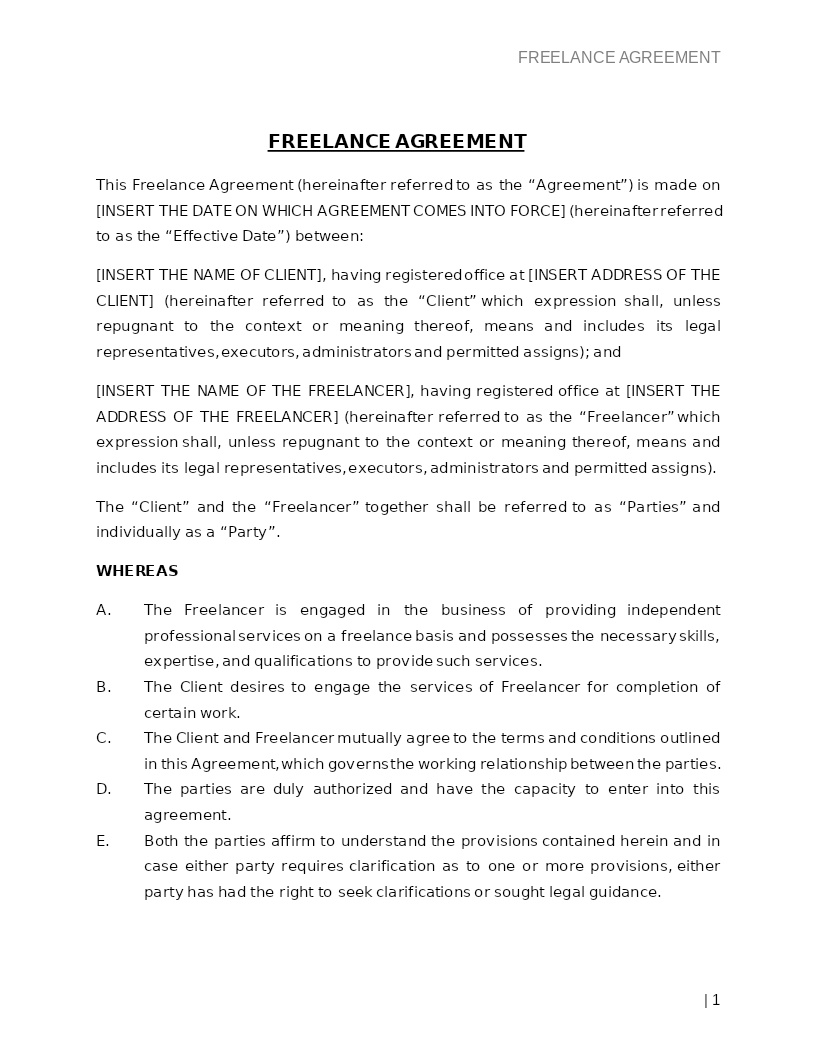
FREELANCE AGREEMENT
How does it work?
1. Choose this template
Start by clicking on "Fill out the template"
2. Complete the document
Answer a few questions and your document is created automatically.
3. Save - Print
Your document is ready! You will receive it in Word and PDF formats. You will be able to modify it.
Defining Clear Expectations in Project-Based and Independent Contractor Work
When hiring a freelancer or independent contractor, it is essential to establish a clear framework that governs the services being performed, how deliverables will be provided, and how intellectual property and payment terms will be handled. A Freelance Agreement provides that structure. It defines the project scope, performance timelines, compensation, confidentiality obligations, and ownership rights associated with the work.
Putting a Freelance Agreement in place allows both parties to collaborate confidently, exchange work materials, and proceed with the project knowing their responsibilities and rights are clearly documented. It ensures transparency, reduces misunderstandings, and provides legal protection throughout the engagement.
Where Freelance Agreements Are Commonly Used
Freelance Agreements are standard across creative, technical, consulting, marketing, software development, and professional service industries in the United States. They are used when businesses engage contractors for specialized expertise, project-based assignments, short-term work, or remote engagements. Anytime a client hires an independent professional rather than a full-time employee, a Freelance Agreement ensures the work, payment, and rights are defined from the start.
Different Types of Freelance Agreements You May Encounter
- Project-Based Freelance Agreement: Covers specific deliverables with defined timelines.
- Hourly or Retainer-Based Agreement: Used when payments are tied to hours worked or ongoing monthly support.
- Creative Services Agreement: Applies to design, writing, branding, or multimedia projects with copyright implications.
- Consulting or Professional Services Agreement: Covers advisory, strategy, or expert assignments requiring specialized skills.
- Software Development or Technical Services Agreement: Used when coding, development, testing, or IT solutions are involved, often with strong IP protections.
When Legal Guidance Becomes Helpful
Legal review becomes valuable when the freelancer handles confidential data, creates intellectual property, or works across multiple states. Attorneys also help address IRS contractor-classification rules, copyright assignments, data security requirements, liability limitations, and complex payment structures. For high-value or long-term engagements, customized clauses can help reduce disputes and ensure compliance with employment and tax laws.
How to Work with This Template
- Identify the parties and define the service scope
- Specify timelines, deliverables, and communication expectations
- Outline payments, invoicing, and approval procedures
- Include IP, confidentiality, and contractor-status clauses
- Choose governing state law
- Review the terms together
- Sign electronically or in hard copy
The template aligns with U.S. contracting standards and is compatible with major e-signature platforms.
Frequently Asked Questions
Q1. Is a Freelance Agreement legally binding in the United States?
Yes. Once signed by both parties, a Freelance Agreement becomes a legally enforceable contract under U.S. contract law. It clearly defines what work must be delivered, how the freelancer will be paid, and what rights the client receives. Because freelance engagements often involve intellectual property and sensitive information, having a written agreement helps prevent disputes and provides strong legal protection. It ensures both sides understand the terms before work begins.
Q2. Can a Freelance Agreement be signed electronically?
Absolutely. Under the federal E-SIGN Act and UETA, electronic signatures are fully valid and enforceable in every U.S. state. This allows clients and freelancers to execute agreements quickly through platforms like DocuSign or Adobe Sign, regardless of location. Electronic signing is especially helpful for remote or digital-first freelance engagements. Once signed electronically, the agreement carries the same legal weight as a hand-signed contract.
Q3. Who owns the work produced under a Freelance Agreement?
In most U.S. freelance engagements, ownership of the final deliverables transfers to the client once full payment is made. However, the freelancer typically retains ownership of any pre-existing tools, templates, or intellectual property they use during the project. If the client wants exclusive ownership of everything created including drafts or proprietary methods, the agreement must explicitly state a full IP assignment. Clear IP clauses help avoid disputes over copyright or usage rights later.
Q4. Is a freelancer allowed to subcontract the work to someone else?
A freelancer may only subcontract work if the agreement expressly allows it or the client provides written permission. Many clients prefer the freelancer to complete the work personally to ensure quality and consistency. Unauthorized subcontracting can violate confidentiality obligations and may be treated as a breach of contract. Having a clear clause on subcontracting protects both the client’s expectations and the integrity of the deliverables.
Q5. What happens if one party breaches the Freelance Agreement?
If either party fails to meet their obligations such as non-payment, missed deadlines, or misuse of intellectual property, the non-breaching party may pursue remedies under the contract. These may include terminating the agreement, recovering damages, or demanding the return of intellectual property or confidential information. A well-drafted Freelance Agreement also includes dispute-resolution procedures to handle conflicts efficiently. Clear breach consequences help maintain accountability throughout the engagement.
Q6. How does a Freelance Agreement protect intellectual property rights?
IPs are one of the most important aspects of freelance work. A Freelance Agreement usually states that the final deliverables belong to the client once payment is made, while the freelancer keeps rights to their pre-existing materials. It may also include “work-for-hire” language, copyright assignments, or licensing terms. These provisions protect the client’s business interests while allowing the freelancer to preserve ownership of their professional tools and portfolio rights, depending on the negotiated terms.
Q7. Does a Freelance Agreement define the freelancer as an independent contractor?
Yes. A core function of the agreement is to clarify that the freelancer is an independent contractor, not an employee. This distinction affects taxes, liability, and benefits. The agreement typically states that the freelancer is responsible for their own tax filings, insurance, and compliance with federal and state laws. This helps prevent misclassification issues and protects the client from unintended employment liabilities.
Q8. How are revisions and approvals handled in a Freelance Agreement?
Freelance Agreements generally outline a clear revision and approval process, including how many rounds of edits are included, expected turnaround times, and acceptance criteria. This helps ensure that both parties share the same expectations about how deliverables will be reviewed and finalized. Defining these processes in advance reduces delays, streamlines communication, and prevents disputes about extra work or additional charges.
Q9. What payment structures are commonly used in Freelance Agreements?
Common payment structures include fixed-fee projects, milestone-based payments, hourly rates, or monthly retainers. The agreement usually includes billing timelines, invoicing expectations, and late-payment terms. By documenting payment details clearly, both client and freelancer can plan their workload and cash flow effectively. A transparent payment schedule also helps build trust and prevents misunderstandings about when and how compensation will be made.
Q10. Can a Freelance Agreement be used for remote or international freelancers?
Yes. Freelance Agreements are frequently used for interstate and international engagements. The agreement can specify the governing law, jurisdiction, communication expectations, data security standards, and delivery timelines. For cross-border work, additional clauses may address tax obligations, IP ownership across jurisdictions, and currency of payment. Tailoring the agreement ensures it remains enforceable and practical regardless of the freelancer’s location.
Related Templates You May Need
• Independent Contractor Agreement
• Non-Disclosure Agreement (NDA)
• Intellectual Property (IP) Assignment Agreement
• Service Level Agreement (SLA)