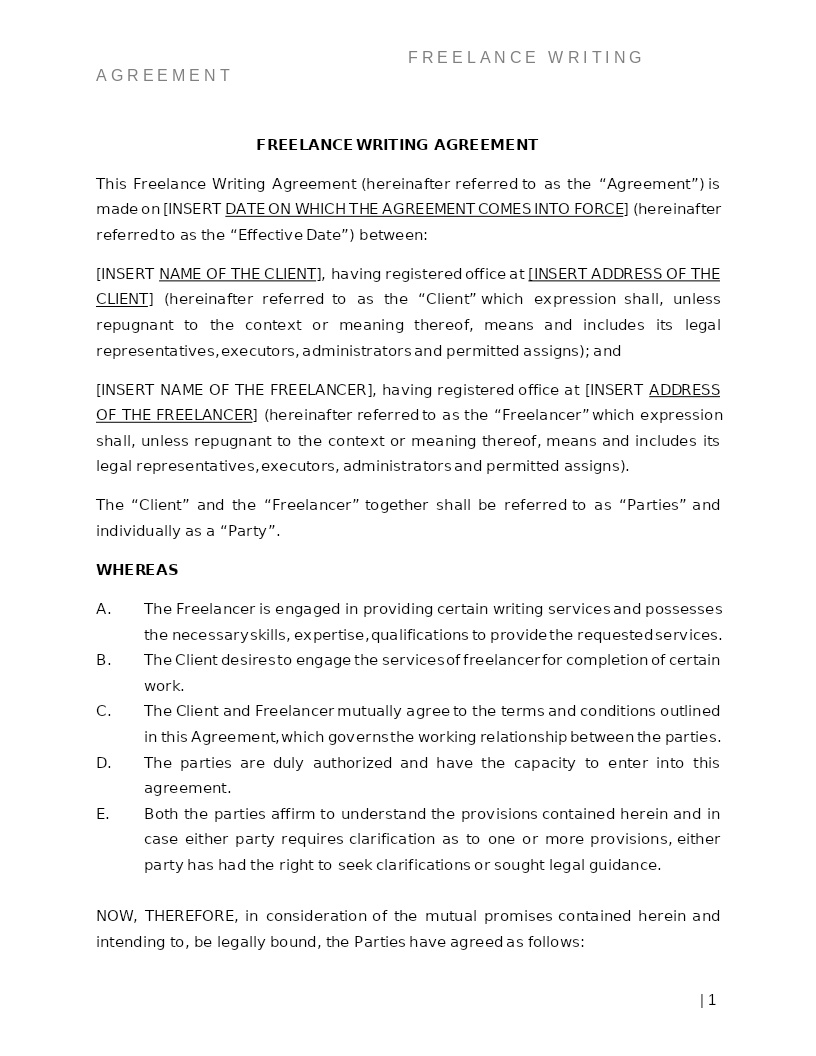
FREELANCE WRITING AGREEMENT
How does it work?
1. Choose this template
Start by clicking on "Fill out the template"
2. Complete the document
Answer a few questions and your document is created automatically.
3. Save - Print
Your document is ready! You will receive it in Word and PDF formats. You will be able to modify it.
Defining Content Creation Obligations Through Freelance Writing Engagements
Businesses, publishers, and digital platforms frequently rely on independent writers to develop written materials that support marketing, editorial, and operational needs. To ensure clear expectations and legal protection for both parties, the terms of such engagements must be formally documented. A Freelance Writing Agreement fulfills this function. It sets forth the rights, duties, compensation, timelines, intellectual property ownership, confidentiality requirements, and performance standards applicable to freelance writing services, all in accordance with U.S. contract law, copyright regulations under the U.S. Copyright Act, and independent-contractor compliance standards.
By utilizing a Freelance Writing Agreement, the parties establish a binding legal framework that governs how content is created, delivered, revised, and used. The agreement also clarifies the relationship between the writer and the client by confirming independent-contractor status, defining ownership of the completed work, and preventing potential disputes regarding compensation or usage rights.
Where Freelance Writing Agreements Are Commonly Used
Freelance Writing Agreements are broadly implemented across numerous professional and creative contexts, including:
- Blogs, news platforms, and digital media publications
- Marketing agencies and copywriting services
- E-commerce product descriptions and SEO content creation
- Technical writing, instructional guides, and documentation
- Ghostwriting for books, articles, and thought-leadership pieces
- Scriptwriting for video, podcasts, and advertising content
- Academic research assistance or editorial support
- Corporate communications, press releases, and reporting materials
Whenever written content is developed by someone other than an employee, a Freelance Writing Agreement establishes the governing legal terms.
Different Types of Freelance Writing Agreements
1. Article or Per-Piece Writing Agreements: Apply when writers are compensated per article, blog post, or deliverable.
2. Retainer-Based Writing Agreements: Cover ongoing monthly or periodic writing services for a fixed fee.
3. Ghostwriting Agreements: Address authorship rights, confidentiality, and assignment of intellectual property.
4. Technical Writing or Documentation Agreements: Apply to specialized content requiring accuracy, research, and technical expertise.
5. Marketing and Copywriting Agreements: Define branding tone, SEO expectations, promotional standards, and content usage rights.
When Legal Guidance Becomes Helpful
Legal counsel may be advisable when:
- The agreement concerns ownership of substantial intellectual property rights
- Ghostwriting, confidentiality, or attribution issues are involved
- The writer handles sensitive data, trade secrets, or proprietary information
- Multi-jurisdictional contractors or remote work arrangements are present
- The contract contains indemnity, non-disparagement, or usage-restriction clauses
- The compensation structure includes royalties or revenue sharing
- The parties need clarity regarding independent-contractor status under IRS rules
Legal review ensures that the agreement complies with U.S. copyright law, avoids misclassification issues, and clearly addresses ownership and usage concerns.
How to Work with This Template
- Identify the Client and the Freelance Writer
- Define the scope of services, writing style requirements, and deliverable expectations
- Specify deadlines, milestones, revision procedures, and approval processes
- Establish compensation terms, invoicing methods, and payment timelines
- Clarify intellectual property ownership (work-for-hire or licensed rights)
- Outline confidentiality duties and limitations on content reuse
- Set forth governing law, dispute-resolution procedures, and termination rights
- Review the agreement for compliance with federal and state laws
- Execute the agreement electronically or in written form
This template aligns with U.S. freelance services contracting practices and works well for individual creators, agencies, and corporate clients.
Frequently Asked Questions
Q1. What is a Freelance Writing Agreement, and why is it important?
A Freelance Writing Agreement is a legally binding contract that outlines the terms under which a writer creates content for a client. It is important because it clarifies payment terms, deadlines, intellectual property ownership, and expectations—reducing the risk of disputes while ensuring each party understands its rights and obligations.
Q2. Who owns the written content created under the agreement?
Ownership depends on the contract. Many clients require “work-for-hire” terms under the U.S. Copyright Act, which transfer ownership to the client upon payment. Other agreements allow the writer to retain rights while granting the client a license. The contract should clearly specify ownership.
Q3. Are freelance writers considered employees?
No. Freelancers are independent contractors, and the agreement should explicitly state this to avoid IRS misclassification issues. Independent contractors are responsible for their own taxes and are not eligible for employee benefits.
Q4. What compensation terms are typically included?
Compensation may be per piece, hourly, project-based, or retainer-based. The agreement should specify payment schedules, invoicing practices, late-payment penalties, and reimbursement rules if applicable.
Q5. Can the client request revisions?
Yes. Most agreements allow for a set number of revisions, provided they are consistent with the original assignment. Additional revisions may incur extra fees unless stated otherwise.
Q6. Are confidentiality and non-disclosure terms included?
Often, yes. Writers may receive access to proprietary or sensitive information, requiring confidentiality clauses to protect the client’s business.
Q7. Can the writer republish or reuse the content?
Only if permitted. Work-for-hire agreements typically prohibit reuse. In licensing-based agreements, writers may sometimes repurpose content with restrictions. All reuse terms should be clearly detailed.
Q8. Are electronic signatures valid for Freelance Writing Agreements?
Yes. Under the ESIGN Act, electronic signatures are legally enforceable, making digital execution fully valid.
Q9. What happens if the writer misses a deadline?
The agreement may impose penalties, allow for timeline adjustments, or permit termination. Clear deadline and remedy language helps avoid misunderstanding.
Q10. Can a Freelance Writing Agreement terminate early?
Yes. Most agreements include termination-for-cause and termination-for-convenience provisions, along with rules for final payment and delivery of partially completed work.