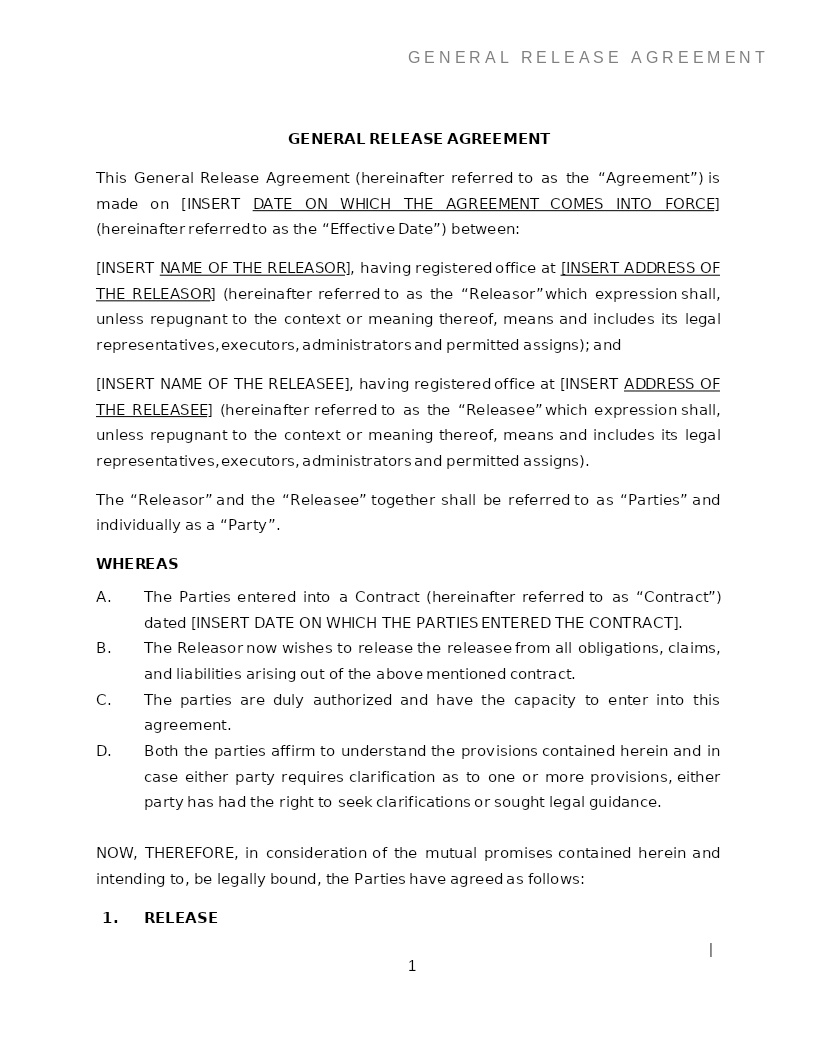
GENERAL RELEASE AGREEMENT
How does it work?
1. Choose this template
Start by clicking on "Fill out the template"
2. Complete the document
Answer a few questions and your document is created automatically.
3. Save - Print
Your document is ready! You will receive it in Word and PDF formats. You will be able to modify it.
Formally Releasing Legal Claims Through a General Release Agreement
When parties wish to conclusively resolve disputes, eliminate uncertainty, or prevent future claims, a written release is essential to establish closure. A General Release Agreement serves this function by documenting the releasing party’s agreement to waive, discharge, and relinquish all claims known or unknown arising from past events or interactions with the other party. This document is drafted in accordance with U.S. contract law, state-specific release statutes, waiver enforceability principles, and applicable federal regulations governing settlement-related agreements.
A General Release Agreement provides a clear legal record that one party voluntarily releases another from liability related to existing or potential claims, disputes, obligations, or grievances. By executing this agreement, the parties reduce future risks, avoid prolonged litigation, preserve business relationships, and ensure that the matter is concluded in a binding and enforceable manner under the laws of the United States.
Where General Release Agreements Are Commonly Used
General Release Agreements are widely utilized across personal, commercial, and workplace settings, including:
- Settlement of disputes arising from contracts, services, or business transactions
- Resolution of disagreements between employers and employees
- Termination of independent contractor or consulting relationships
- Release of liability following property damage, personal disputes, or financial matters
- Claims involving vendors, clients, partners, or third parties
- Closure of customer complaints or service-related conflicts
- Waivers connected to debt settlement, performance disputes, or project issues
- Release of obligations under certain insurance-related or indemnity scenarios
Whenever parties wish to bring finality to a claim or potential legal dispute, a General Release Agreement provides the necessary legal mechanism.
Different Types of General Release Agreements You May Encounter
1. Mutual Release Agreements: Both parties release one another from all claims or disputes.
2. Unilateral Release Agreements: Only one party releases the other, typically as part of a settlement or resolution.
3. Comprehensive Release Agreements: Cover all claims, known or unknown, regardless of type or origin.
4. Limited or Specific Release Agreements: Release only specific claims while leaving others unaffected.
5. Employment Release Agreements: Used upon termination or dispute resolution, subject to federal and state employment laws.
When Legal Guidance Becomes Helpful
Legal assistance is recommended when:
- The release involves employment-related claims governed by federal laws, such as the Age Discrimination in Employment Act (ADEA)
- The parties are settling substantial financial or contractual disputes
- One party seeks to include non-disparagement, confidentiality, or non-compete terms
- State laws impose special rules (e.g., California Civil Code §1542 regarding unknown claims)
- The releasing party may not fully understand the scope of the waiver
- The release involves potential future liability, indemnification, or third-party claims
- The agreement must address tax implications, insurance matters, or regulatory reporting
An attorney ensures that the release is legally valid, properly executed, compliant with state requirements, and tailored to the specific circumstances of the dispute.
How to Work with This Template
- Identify the parties and the background giving rise to the release
- Clearly state the claims being released, including known and unknown claims
- Specify whether the release is unilateral or mutual
- Include language addressing consideration or compensation supporting the release
- Address confidentiality, non-admission of liability, and dispute-resolution clauses
- Ensure compliance with state-specific release requirements
- Specify the effective date, governing law, and execution requirements
- Confirm that all parties sign electronically or in writing
- Retain the agreement with related records or settlement documentation
This template is consistent with widely accepted U.S. legal standards for drafting releases and may be used by businesses, individuals, employers, service providers, and legal teams.
Frequently Asked Questions
Q1. What is a General Release Agreement, and why is it important?
A General Release Agreement is a binding document that formally waives and extinguishes claims against another party. It is important because it prevents future disputes, provides legal certainty, and ensures final resolution of past conflicts.
Q2. Does a General Release Agreement cover unknown or future claims?
Many releases include language covering unknown claims, but enforceability may vary by state. Some states require specific statutory language, such as California’s Civil Code §1542 disclosure.
Q3. Is consideration required for a valid release?
Yes. Under U.S. contract law, a release must be supported by consideration such as payment, mutual release, or another benefit to be enforceable.
Q4. Are electronic signatures valid on General Release Agreements?
Yes. Under the ESIGN Act, electronic signatures are legally enforceable for release agreements, making digital execution widely accepted.
Q5. Can a General Release Agreement waive employment-related claims?
Yes, but federal and state laws impose strict requirements. For example, ADEA waivers require specific language, revocation periods, and employee rights advisories.
Q6. Can a release be revoked after signing?
Generally, no. Once signed and supported by consideration, a release is legally binding unless it was obtained through fraud, coercion, or significant misrepresentation.
Q7. What happens if a party violates confidentiality terms in the release?
The non-breaching party may seek damages, injunctive relief, or enforcement actions depending on the agreement’s terms and applicable laws.
Q8. Should tax implications be considered in settlement-related releases?
Yes. Settlement payments may impact tax obligations, and parties should consult tax professionals before finalizing terms.
Q9. Does signing a release prevent filing future lawsuits?
Yes, if the claims fall within the scope of the release. Properly drafted releases bar future legal action on released matters.
Q10. Is legal review recommended before signing a General Release Agreement?
Absolutely. Because releases waive significant rights, legal counsel can ensure the terms are fair, enforceable, and compliant with federal and state law.